
Breadcrumb Trail Links
Alberta premier aims to see total oil output double to eight million barrels per day by 2035. Our weekly Countdown to 2 Million special series continues.
Published Feb 25, 2026 • Last updated 1 hour ago • 11 minute read
You can save this article by registering for free here. Or sign-in if you have an account.
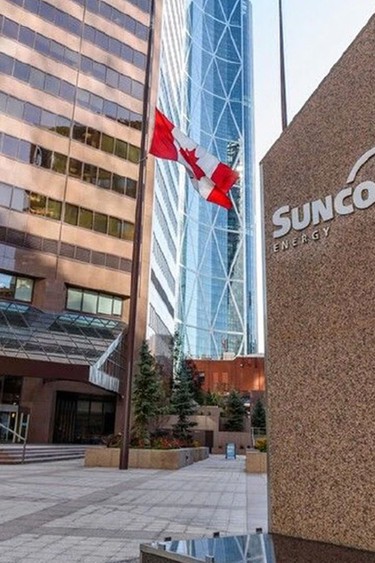 The Suncor Energy Centre building in downtown Calgary. Postmedia fileArticle content
It was known for years by Calgarians as Red Square, the headquarters of the country’s state-owned oil company — and it’s now preparing for a new era.
The iconic two towers that comprise Petro-Canada Centre, as it was officially called, were completed in 1984, with the 53-storey west skyscraper overtaking the Calgary Tower to become the tallest structure in the city.
Article content
Article content
Advertisement 2
This advertisement has not loaded yet, but your article continues below.

THIS CONTENT IS RESERVED FOR SUBSCRIBERS ONLY
Subscribe now to read the latest news in your city and across Canada.
Unlimited online access to articles from across Canada with one account.Get exclusive access to the Calgary Herald ePaper, an electronic replica of the print edition that you can share, download and comment on.Enjoy insights and behind-the-scenes analysis from our award-winning journalists.Support local journalists and the next generation of journalists.Daily puzzles including the New York Times Crossword.
SUBSCRIBE TO UNLOCK MORE ARTICLES
Subscribe now to read the latest news in your city and across Canada.
Unlimited online access to articles from across Canada with one account.Get exclusive access to the Calgary Herald ePaper, an electronic replica of the print edition that you can share, download and comment on.Enjoy insights and behind-the-scenes analysis from our award-winning journalists.Support local journalists and the next generation of journalists.Daily puzzles including the New York Times Crossword.
REGISTER / SIGN IN TO UNLOCK MORE ARTICLES
Create an account or sign in to continue with your reading experience.
Access articles from across Canada with one account.Share your thoughts and join the conversation in the comments.Enjoy additional articles per month.Get email updates from your favourite authors.
THIS ARTICLE IS FREE TO READ REGISTER TO UNLOCK.
Create an account or sign in to continue with your reading experience.
Access articles from across Canada with one accountShare your thoughts and join the conversation in the commentsEnjoy additional articles per monthGet email updates from your favourite authorsSign In or Create an Account
or
Article content
The $200-million complex sprung up during a classic office building boom in Calgary, powered by the oil and gas sector.

Noon News Roundup
Thanks for signing up!
Article content
The past decade hammered Calgary’s downtown, coinciding with a plunge in global oil prices and layoffs in head offices. The pandemic followed, along with sweeping industry consolidation, leaving the downtown office vacancy rate mired around 30 per cent.
Yet, when the owners of the office tower complex — Brookfield Properties and ARCI Investments — unveiled plans in December 2024 to move ahead with a more than $90-million plan to revitalize Suncor Energy Centre, as its now known, the idea landed on fertile ground.
It’s attracted new tenants, such as growing energy infrastructure company Keyera, and ATB Financial, along with Suncor, a sign of the sector’s deep-seated connection to Calgary’s economy.
“We made a commitment, a major financial commitment, repositioning the asset and believing that for the next 40 to 50 years, this will position us to be best in class,” says ARCI president Hannes Kovac, overlooking the construction happening inside the west tower during a recent tour.
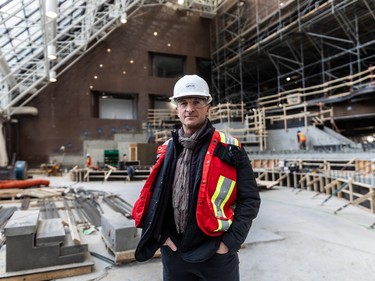 Hannes Kovac, president and chief operating officer of ARCI Investments Inc., was photographed amid construction work to renovate the forum space of the Suncor Energy Centre in downtown Calgary on Thursday, February 19, 2026. Brent Calver/Postmedia
“Our ability to attract tenants that sign 10- and 20-year leases in this building, is a commitment by the energy companies to Calgary as a city.”
Workers are now busy renovating the buildings.
The construction plans will see the addition of a performing arts amphitheatre, a large food court, an indoor garden, an exterior dining terrace, along with a new fitness facility and a conference centre for tenants.
Article content
From Kovac’s perspective, companies wouldn’t sign a long-term office lease unless they were convinced about the future of Calgary’s economy and its commercial centre.
As the city heads toward a population of two million people in the coming years — possibly by the end of this decade, according to one projection — analysts and business leaders are confident the oil and gas industry will remain a pillar of the city’s $139-billion-a-year economy.
“It’s the backbone of the city,” says Mac Van Wielingen, founder and partner of ARC Financial Corp. and former chair of the Business Council of Alberta.
“We are seeing growth in a wide variety of sectors, but it’s all still anchored by the oil and gas industry,” adds ATB Financial chief economist Mark Parsons.
The strength of the foundation is underscored by businesses making major multimillion-dollar investment decisions as they prepare for the future.
“There is a resurgence of focus on the importance of energy companies worldwide,” Kovac says.
“And being a major worldwide energy centre and hub, we will benefit as a city.”
Ambition fuels energy sector expansion
For Dean Setoguchi, CEO of Keyera, the decision to move into Suncor Energy Centre reflects a desire to find more space as the company expands its business in Canada.
The clearest sign of that ambition came last summer, when it announced the largest acquisition in the company’s history. Keyera agreed to buy nearly all of Plains’ Canadian natural gas liquids business for almost $5.2 billion.
Article content
Not only will it bolster the company’s revenues and put domestic assets into the hands of the Calgary-based company, but the move will also increase its employee count.
Keyera, which has about 700 people working at its existing Calgary offices, will have about 1,000 workers, including contractors, once the acquisition closes.
“We certainly expect to continue to grow,” Setoguchi says.
“When we look at our future for the next 10 to 15 plus years, there are other things now at our stage of growth that we think are important to our company and our people as well.”
He cites a desire for Keyera to have new offices in a central downtown location, one that’s close to public transit, while providing the business with the ability to keep growing.
Setoguchi has no doubt the energy sector will remain a foundational piece of the city’s employment and economic base.
Article content
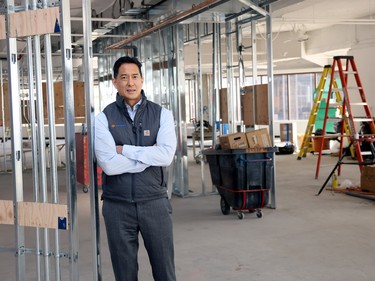 Keyera CEO Dean Setoguchi will be moving his company to the Suncor Energy Centre in downtown Calgary. He’s seen here on Tuesday, February 24, 2026. Darren Makowichuk/Postmedia
History would indicate that’s a safe bet.
From engineering firms and drillers to construction operators and financial services tied to the industry, energy has served as a catalyst for attracting investment and jobs into the community. It dates back decades, particularly after the historic Leduc oil discovery in 1947.
By 1965, the city was home to the head offices of 886 oil and gas related businesses, and by 1971, more than 10,000 local workers were directly employed by the sector, historian David Breen wrote in a 1977 paper about Calgary and the petroleum industry.
“In a visual or spatial sense, the impact of oil industry is even more dramatic than the demographic change,” he stated. “Since World War II, the city’s downtown core has been almost entirely rebuilt.”
Article content
Indeed, many of the office towers were built during various oil price cycles before the turn of the century, becoming the home base for firms tied to the oil and gas industry.
“Downtown Calgary (really) started with the discovery of Leduc, because the downtown was where the lawyers were, it’s where the banks were,” says veteran oilman Jim Gray, who co-founded Canadian Hunter Exploration in 1973 and is a member of the Canadian Business Hall of Fame.
“It’s where the Esso and Mobil and Shell and all of the big guys came down, and then we little guys filled in around it.”
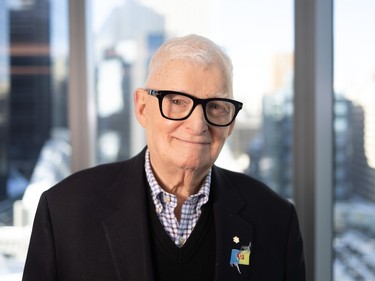 Jim Gray, an independent director of Brookfield Asset Management, was photographed at the company’s downtown Calgary offices on Wednesday, February 18, 2026. Brent Calver/Postmedia
Today, the city’s economy is diversifying, but it remains deeply connected to the energy sector’s fortunes.
Gray notes demand for energy is increasing around the world. At the same time, the new liquified natural gas (LNG) industry that’s taking off in Canada, and the expansion of the Trans Mountain pipeline, are exporting Alberta energy to Asia.
“Our oil resource is going to be an enormous value for us for a long time, and now we’re bringing new technology to it that we didn’t even dream about years ago,” he says.
“I’ve been involved in the energy business for 60 years, 70 years, and I’ve seen dramatic changes, and it’s even speeding up the changes that we are seeing.”

We apologize, but this video has failed to load.
Play VideoEmployment shrinks as production soars
Yet, it’s also true the oil price crash that unfolded a decade ago instigated sweeping change in the sector.
During the height of the oilsands investment boom in 2012, direct employment in the city’s oil and gas extraction industries and mining surged to 63,000 jobs, making up 8.4 per cent of the workforce in the Calgary area, according to data compiled by Calgary Economic Development.
Article content
After benchmark crude prices were cut in half during the final six months of 2014, industry direct employment fell to 43,200 by 2017.
Last year, it stood at 46,000, making up a smaller percentage of a larger local workforce, as the Canadian oil and gas sector has become more efficient and focused on financial discipline.
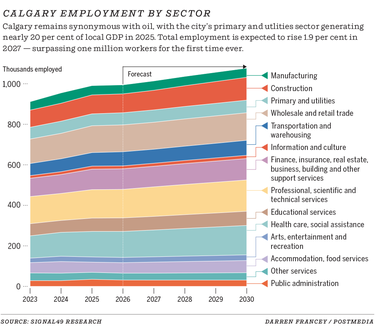
The past decade also brought about a push to decarbonize and reduce emissions from the oil and gas industry, the largest emitting sector in the country, amid growing climate concerns.
Global oil and gas consumption continues to rise.
Total gas output in Alberta hit its highest point in more than 16 years last November, while oil production continues to set records — averaging 4.1 million barrels per day last year, up almost four per cent from 2024 levels.
Alberta Premier Danielle Smith aims to see total oil output double to eight million barrels per day by 2035.
“Energy demand globally goes up every year. And people have come to realization that . . . all forms of energy are going to be required,” says Setoguchi.
“We have tremendous resources in Western Canada. Obviously, a lot of that is centred in Alberta. So, I think our energy industry and the companies that are headquartered here are going to be around for a long time.”
Back to basics
City diversification efforts in other sectors are paying dividends, with rapid growth in aerospace, tech, life sciences, transportation and logistics.
But energy, including oil and gas, power generation, renewables and clean tech, are also expected to grow.
Article content
After years of consolidation and cost-cutting in the upstream oil and gas industry, there are indications it could expand through this decade.
“We are at a really interesting moment, where after a decade of the energy industry being squeezed to death and proving itself to the rest of the country as probably the largest strategic resource the country has, we’re at a pretty unique pivot point,” said Kevin Krausert, CEO of Avatar Innovations, which operates a clean energy accelerator and training program in the city.
“The industry will stop moving from a mindset where value creation can only be realized through cost-cutting, and now into a moment where value creation can consist of value growth.”
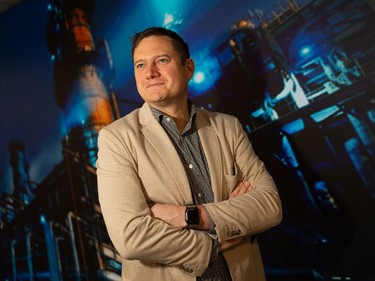 Avatar Innovations Co-Founder and CEO Kevin Krausert at his Calgary offices on Tuesday, February 17, 2026. Brent Calver/Postmedia
Geopolitical turmoil has underscored the strategic nature of energy development.
There’s now a sharper focus on global energy security and affordability, along with the ongoing push towards decarbonization and the importance of technology within the sector.
“Energy policy has kind of come full circle now,” says Van Wielingen. “It’s come home to the basics — and the basics being affordability and reliability and security, including, of course, geopolitical security and environmental impact.”
In the past year, the policy landscape has also shifted.
The United States placing tariffs on Canada has put this country in a position of needing to boost its exports to other customers, and Canada’s largest export remains energy.
Article content
Meanwhile, opinion polls show a majority of Canadians support building a new oil export pipeline, an idea being proposed by the provincial government.
The recent energy MOU between Alberta and the federal government says Ottawa will declare a new bitumen pipeline to the West Coast a priority project. However, it is “mutually dependent” on the proposed $16.5-billion Pathway’s carbon capture network in the oilsands moving ahead.
These projects would require more oil and gas exploration and production, more design and construction work, and more jobs — if they advance.
Building a carbon capture network in the oilsands, tied to a new West Coast bitumen pipeline, as well as boosting Alberta production to fill it, would likely trigger an estimated $110 billion to $120 billion of total capital investment, says Kendall Dilling, president of the Oil Sands Alliance, previously known as Pathways Alliance.
“That whole bundle, with all requisite modesty, is (a) national interest project. There’s nothing that touches it in Canada, in terms of the level of investment,” Dilling says.
“What does it mean to the city of Calgary . . . It is a massive, massive economic stimulus for the entire nation.”
Van Wielingen expects the Canadian oil industry, which was hamstrung by pipeline constraints last decade, could see about half-a-million barrels per day of additional transportation capacity advance through optimization initiatives — even before a greenfield pipeline is built.
Article content
And after several years of focusing on paying down debt, the balance sheets of most producers are far stronger than in the past, better able to withstand volatile commodity prices.
“The outlook is very positive for the energy sector in Alberta,” he adds.
“The big question, of course, is always around policy.”
New ‘energy cycle’ awaits
While the oilpatch has become more efficient, it continues to grow in size and scale.
The industry’s biggest producers and midstream companies have the scope to compete on a global basis. For example, the combined market capitalization of pipeline giants Enbridge and TC Energy, and petroleum producers Canadian Natural Resources and Suncor Energy — all based in Calgary — exceeded $450 billion on Monday on the Toronto Stock Exchange.
The industry has faced a wave of consolidation since the pandemic, with names such as Husky Energy, Seven Generations Energy, Veren and MEG Energy disappearing.
The Canadian oilpatch saw more than $31 billion of M&A activity by exploration and production companies in 2025, hitting an eight-year high, according Sayer Energy Advisors.
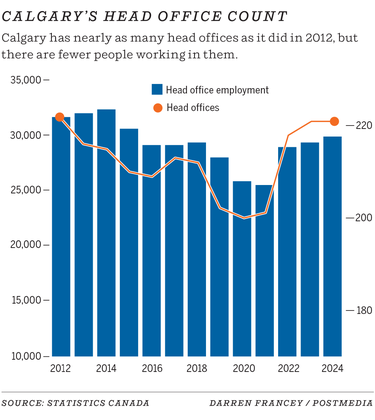
Fewer companies mean fewer head office jobs, as well as less demand for office space. While the number of head offices in Calgary in 2024 was almost the same as it was a dozen years earlier, the number of people working in them dropped by six per cent to just under 30,000.
Yet, the potential sale of non-core assets spinning out of consolidation activities — along with Western Canada’s strong inventory of premium drilling prospects — could spur new businesses to emerge.
Article content
“I’m actually expecting a new energy cycle, in terms of growth, because we’ve had so many mergers, that it will generate sales of assets, and because we have other eyeballs and investors starting to look at Canada as a place to invest for energy,” says Calgary Chamber of Commerce CEO Deborah Yedlin.
“We will see more energy companies and that part of the economy will be bigger than it is today.”
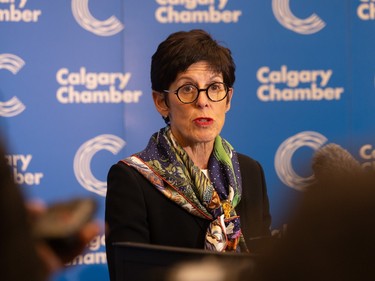 Deborah Yedlin, president and CEO of the Calgary Chamber of Commerce, speaks to media following an event on Wednesday, February 18, 2026. Brent Calver/Postmedia
And it’s not only growth from oil and gas production and related businesses that could unfold by the time Calgary reaches two million residents.
Energy production tied to new AI-focused data centres, petrochemical projects, carbon capture and storage developments, renewables — such as geothermal, wind and solar — and clean tech initiatives will help drive the city’s economy forward.
“What I don’t see changing is (that) the energy sector will continue to anchor Calgary’s economy, but the energy sector itself might look a little bit different,” says ATB’s Parsons.
“It’d be sending products to more diverse markets. You’re getting more growth in the downstream side of the business, and with the focus on decarbonization. But I also think it’s going to look more diverse.”
‘We’re in a pretty good spot’
Back at the Suncor Energy Centre, the oilpatch’s past is meeting the future.
The red granite and glass-clad buildings, completed when Alberta oil production was just slightly above one million barrels per day, are a beehive of construction work. (For a point of comparison, Suncor Energy alone produced more than 900,000 bpd last quarter.)
Article content
The clatter of activity echoes throughout the ground floor on the west tower, as renovations progress at one of the most identifiable buildings in downtown Calgary. Work on the complex is expected to be completed next year.
“It’s one of the most iconic buildings that Calgary has,” says Kovac, who also co-chairs the real estate sector advisory committee at Calgary Economic Development.
“If we get major energy companies (to) sign long-term lease commitments in our building, that is a long-term commitment by these companies to Calgary as an energy centre for the world, because our tenants are not only Canadian companies, they’re global companies.
“And that commitment, long term, makes me feel we’re in a pretty good spot.”
Chris Varcoe is a Calgary Herald columnist.

Bookmark this website and support our journalism: Subscribe now so you don’t miss the news you need to know and sign up for our free newsletters.
Article content
Share this article in your social network