
With just a week-and-a-half to go before the NHL trade deadline arrives at 3 PM ET on Friday, March 6, there isn’t a lot of game action coming out of the Olympic break to make final evaluations of players. There may have been a roster freeze in place during the international tournament, but all the league’s general managers would have been assessing the options to either improve their rosters for a playoff run or add assets with contention in future seasons in mind.
We’ve already seen a few trades happen since the freeze was lifted, mostly setups for bigger deals as clubs try to gain more salary-cap space. That’s the situation the Montreal Canadiens currently find themselves in, with about $1.5 million of cap space set to be available to them at the deadline, not enough to make a significant addition on the trade market without shipping out some salary beforehand, or as part of a deal.
Right now, the contract for Patrik Laine, which carries the second-largest cap hit of players on the roster at $8.7 million, is the biggest obstacle to getting a deal done. Just two off-seasons ago Laine’s salary was taken on because the management staff wanted to add some offence to a goal-starved roster and also acquire an asset (an additional second-round pick in the trade of Jordan Harris) to help in the future. The Habs were in the early stages of a rebuild and not expected to compete for a few years, but they put everything together about 14 months ago to go on a late-season run that has turned into consistent form.
Ironically enough, it was the first Habs game for Laine that you can look back to for the beginning of this sudden rise to playing like a top team. Since his debut on December 3, 2024, Montreal has earned a .626 points percentage, only outperformed by the Colorado Avalanche (.710), Tampa Bay Lightning (.675), Dallas Stars (.657), and Vegas Golden Knights (.636). This season alone, Montreal ranks sixth, performing even slightly better than their play in the final five months of the 2024-25 season. Though Laine has only played five games this year, the once anemic offence in Montreal currently ranks as the league’s third-best, proving that the team has quickly outgrown the need for a pure power-play specialist.
The management duo of Kent Hughes and Jeff Gorton would certainly like to move that substantial contract out, and perhaps they could get a bite from a team with Stanley Cup aspirations that needs some special-teams help. There is the option to just see out the final months of Laine’s contract and take advantage of the space in the off-season; once the deadline hits, the 23-player roster limit no longer applies and he can be activated off Injured Reserve without needing to move someone else. But given that Montreal ranks among the league’s top teams, there is some motivation to speed up the process to match the big leap the young roster has taken.
While the Canadiens are in position to be buyers, the organization has been adamant that it’s not going to sacrifice the future to address the present, so it’s unlikely to be a rental player who comes in for a high price and sticks around for just one playoff run. Since management’s approach will be future focused at the deadline, a look at the salary-cap situation needs to be as well. Instead of concerning ourselves solely with how a move affects this year’s funds, we’ll look ahead to what a longer-term addition would mean for next season.
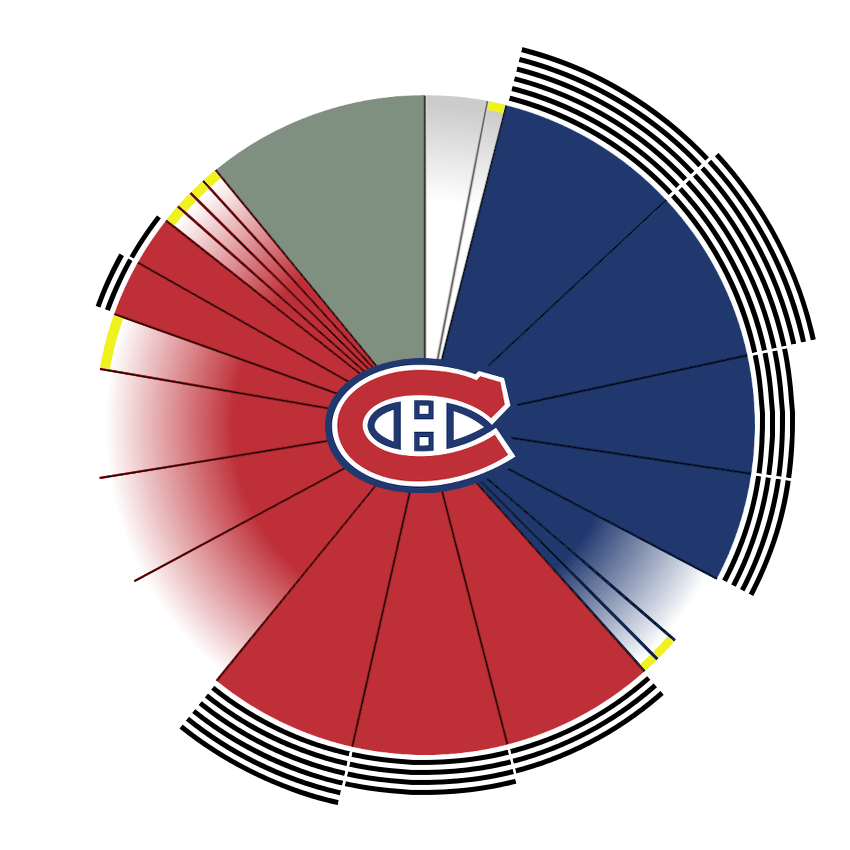
If you’ve been following along with these salary-cap visualizations over the years, the first thing that might jump out at you is how little space the goaltending takes up. For almost a decade the position took up about one-sixth of the available cap room, but next year, when the salary jumps again to a projected $104-million upper limit, that will be down to about 4%.
The defence is not only all but set for next season (Arber Xhekaj is the only member of the current corps not under contract for 2026-27), the top four are locked in for at least four additional seasons beyond that. Giving up a substantial package of two first-round picks and Emil Heineman to acquire Noah Dobson on an eight-year contract was the clearest indication that the management group saw defence as the priority to build around, and the group of Dobson, Lane Hutson, Kaiden Guhle, and Mike Matheson are in place to carry the team into the 2030s.
The top three forwards are also signed long-term, although Nick Suzuki is now almost halfway through the eight-year contract Marc Bergevin signed him to. With Laine’s contract not in the picture next year, it’s a couple of other pacts Bergevin signed that stand out: those for Brendan Gallagher ($6.5 million) and Josh Anderson ($5.5 million). At this time a year from now, we will probably be discussing those the same way Laine’s deal is right now. Yet even carrying those contracts, there is currently $11.4 million of salary the Canadiens could take on, with Kirby Dach and Zachary Bolduc the pending RFAs who would need new contracts for next year.
It seems clear that this would be the position the brass would target to make a longer-term addition. There is speculation they could have interest in acquiring Vincent Trocheck from the New York Rangers, a player still signed through the 2028-29 season who fits the future vision for the Canadiens, though not the general focus on putting a young lineup together as Trocheck will turn 33 in July.
If they could find a willing partner — not an easy thing this season with most clubs in the Eastern Conference still believing they can make the playoffs — they would have the room next season to acquire a middle-six forward with Laine’s contract off the books, even if they need to retain a portion of his salary to make the move right now.
Montreal remains a young team that is just starting to open its contending window, with every member of the core due to improve over the next few years. There’s no urgency to get a deal done ahead of the deadline, so while it would be nice to add another piece of the puzzle this season, the patient approach shown by the current regime may result in just a minor addition being made to shore up the forward depth rather than to insert a big contributor into the group.