
While many life-threatening diseases and events have some warning signs–a lump, a changing skin lesion or persistent pain or discomfort–others do not, leaving sufferers with little to no time to seek out emergency medical help.
The Canadian Task Force on Preventive Health Care estimates that, every year, 20,000 Canadians are diagnosed with an abdominal aortic aneurysm–a dangerous bulge in the wall of the aorta, a large artery that carries blood from the heart to the rest of the body.
When this balloon-like bulge grows, the risk of a sudden rupture–and severe internal bleeding–increases.
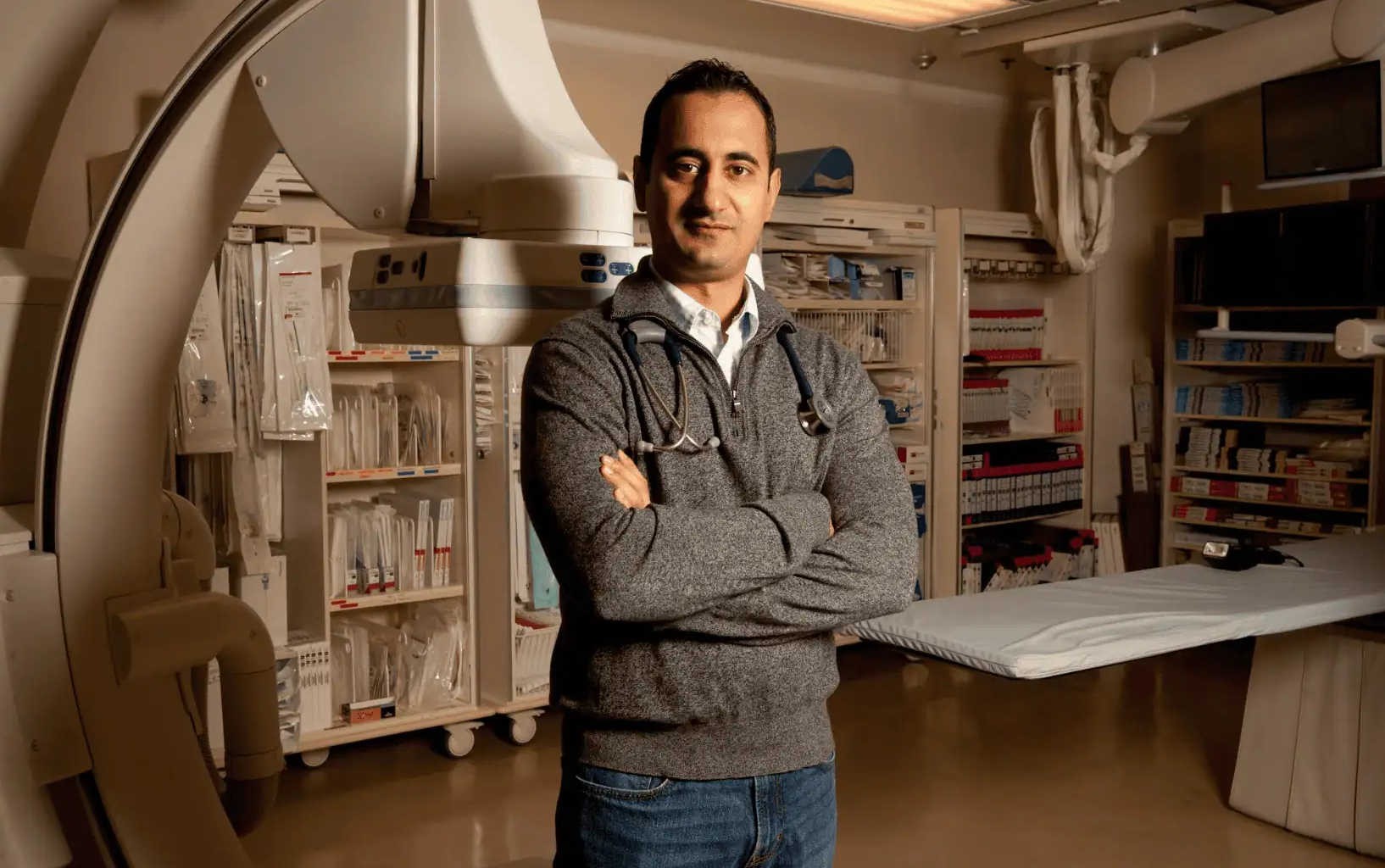
“When a rupture occurs, that is fatal in the majority of patients. Eighty to 90 per cent of every patient with a rupture will not survive,” says Dr. Varun Kapila, a vascular surgeon with William Osler Health System (which operates Brampton Civic Hospital and Etobicoke General Hospital).
Kapila, who is also the provincial lead for vascular health at Ontario Health and the associate medical director of CritiCall Ontario, tells INsauga.com that while people experiencing a rupture have a better chance of survival if they reach an operating room quickly, ruptures still carry a high fatality rate.
According to the task force, approximately 1,244 people die annually of aortic aneurysm ruptures in Canada, with more men affected by the condition than women.


The most startling thing about AAAs is that, in most people, they don’t cause symptoms, so most people are not even aware they have one. Symptoms of a fast-growing AAA can be difficult to pinpoint, but include deep, persistent belly pain, back pain or a pulsing/throbbing near the belly button. During a rupture, patients might feel sudden and severe pain in their belly, back or legs.
Fortunately, for people who might not know they’re at risk, a new screening program launched in Ontario late last year allows eligible residents to undergo an OHIP-covered screening test. Now, patients can be screened at hospitals throughout the province, including in Brampton.
“The whole point of the screening program is to prevent the rupture from happening,” Kapila says.
“Twenty-one vascular programs are able to manage these [aneurysms] and if we can find them earlier, we can change from crisis care to planned care.”
Ontario’s program, the first of its kind in Canada, invites residents aged 65 to 80 to book a one-time ultrasound (unlike cancer screenings, repeat or annual screenings are not recommended in most cases) of the abdominal aorta.
“It’s where your belly button is and it’s the largest blood vessel in your body. In general, it’s normal to be two to two-and-a-half centimetres, but when it’s more than three centimetres, it’s called an abdominal aortic aneurysm and they have the propensity to grow and as they grow, we want to fix them to prevent a rupture,” Kapila says.
Repair is recommended in men with AAA’s reaching 5.5 centimetres and for women, repair is encouraged at five centimetres.
When the program launched in September, eligible Ontarians who were about to turn 65 began receiving letters from the province encouraging them to discuss obtaining a requisition for an abdominal ultrasound screening test from their primary care provider.
This spring, the screening program eligibility criteria will be expanded to include all seniors aged 65 to 80. Last year, the province said plans are underway to allow eligible patients to self-refer directly to ultrasound labs for their abdominal screening.
As for who is at risk, the Canadian Task Force on Preventive Health Care said AAAs are four-to-six times more common in men than women. Other risk factors include smoking, advanced age and a family history of AAA. Kapila says people with high blood pressure and high cholesterol might also be at increased risk.
Kapila says that patients who find out they have a potentially concerning AAA will be referred to a vascular clinic for further evaluation.
“When a patient has an aneurysm, they’ll be referred to one of the 21 vascular sites,” he says.
“The size is important. A small one is not worrisome because the risk of rupture is very small. We’ll follow [those patients] over time, and if it gets too large, they’ll be referred, and a vascular specialist will assess the patient, offer options, and provide intervention that’s most appropriate.”
Kapila says options to correct an AAA include open surgery or a minimally invasive endovascular aortic aneurysm repair, where a stent is placed inside the aorta to prevent a rupture.
“The EVAR is a procedure we can provide closer to home,” Kapila says, adding that doctors can determine which procedure is best for a patient and make a recommendation.
As for whether younger patients can access screening, Kapila says doctors and nurses can provide screening requisitions if they have certain risk factors or concerning symptoms.
“Our primary care specialists and nurse practitioners can refer a younger patient if they have a family history, as some people benefit from screening at 55. [A rupture] is very unlikely to happen under the age of 55; on average, patients between 65 and 80 are at the highest risk.”
Should surgical repair be required, Kapila says patients who undergo EVAR tend to be discharged within 24 hours of the procedure and return to normal activities within a week. With open surgery, recovery may take longer.
“But it’s still the gold standard for repair of AAA, it’s been around for almost 70 years,” he says.
“We’re very fortunate that the types of interventions available to all Ontarians are world-class. Once patients have treatment, they have a great recovery and long-term, durable treatment.”
While Kapila hopes to see the screening program rolled out across Canada, he says he’s proud of how the province and Ontario Health have provided a new, life-saving tool to Ontarians who might never have known they were at risk of a serious medical event.
While the program is still in its infancy, he says he’s hearing positive feedback from patients.
“The response we’ve been receiving back is that this is an excellent example of a team-based approach. The system is not only ready, but patients are already benefiting,” he says.
While it’s too early to have data on the program, Kapila says he hopes to replicate results from the United Kingdom, where an AAA screening program launched in 2013 has been shown to halve ruptures in patients who undergo screening.
“In a few years, we’ll have robust data, but what we’re seeing already is the proof of concept. Patients are getting screened. Patients and providers are excited to celebrate a new screening in Ontario. This is a non-cancer program hoping to replicate results in our cancer programs,” he says.
Kapila also says the new program is a victory in the sense that it offers Brampton and other Ontario patients screening–and treatment, if necessary–closer to home.
“Almost 10 years ago, patients had to travel long distances to get vascular care, but with the new strategy and the [Ministry of Health’s] investment and support, patients can get world-class care in their own backyard. I’m really proud of that. You can get University Avenue care here.”
Cover photo of Dr. Kapila, courtesy of William Osler Health System
INsauga’s Editorial Standards and Policies
Last 30 Days: 51,245 Votes
All Time: 1,235,222 Votes
894 VOTES
Have you had to cut back on buying certain groceries to save money?
WIN A $100 GIFT CARD
Subscribe to INsauga’s daily email newsletter for a chance to win a $100 Amazon gift card.