
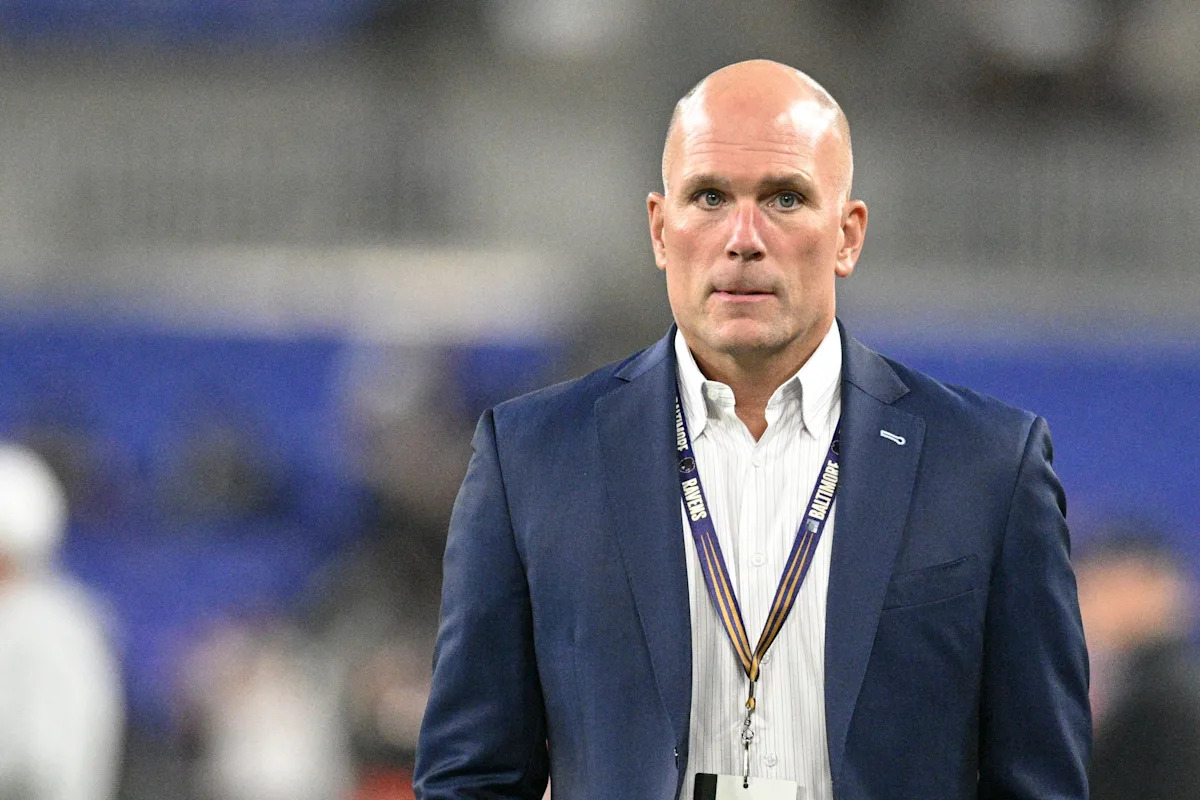
The Ravens are a gold-standard NFL franchise, and one big reason for their sustained success lies in Eric DeCosta’s draft approach, rooted in Ozzie Newsome’s strategy. Baltimore has the No. 14 overall pick in April’s draft, and the Ravens have only picked higher than 14th once in the past 20 years. Back in 2022, Baltimore landed Kyle Hamilton after the now All-Pro safety and Notre Dame All-American slid out of the top 20.
Baltimore has several needs (WR, OL, Edge, DL), but could feel comfortable with the “drafting the best player” approach that the organization has become synonymous with.
Advertisement
The legendary Ozzie Newsome was always steadfast in his “BPA” approach, allowing Baltimore to annually stockpile a deep, talented roster of players with high ceilings who can blend in and offer versatility at key positions.
According to the Russell Street Report, the Ravens use a numerical system to evaluate prospects, placing them into tiers that separate elite players from Pro Bowl players, first-year starters, second-year starters, developmental starters, backups, and practice squad caliber.
Each year, the Ravens formulate a list of roughly 140 to 180 “draftable” players with the final number usually settling around 150. The organization evaluates those 150 players, grading prospects using something like the 5.0 – 8.0 scale above, but a bit more nuanced. These grades use the tenth decimal place—some teams may get more specific and use the hundredth place, but for sake of this discussion we’re dealing with grades such as 5.8, 6.2, 7.9, etc.
So, slotting players between 5.0 and 8.0 creates 31 possible grades for 150 players, on average resulting in about 5 players tied at each grade—rarely are there any 8.0s and likely very few in the high 7s.
But the Ravens are a “vertical board” team, meaning that they assemble a list of 150 players ranked in a single list from 1-150 from which to choose on draft day. So how do we get from multiple players clumped together at certain grades to a vertical list of sorted players? There are many factors that affect this determination, but one of these considerations is assuredly the Ravens need at certain positions.
Based on the methodology, positional need usually determines a tie-breaker scenario when the Ravens are split on multiple players.
Recent examples
In 2025, Baltimore took Georgia’s Malaki Starks over South Carolina’s Nick Emmanwori, who ended up as a starter on the Super Bowl champion Seahawks. With a clear need at the safety position, Baltimore took Starks over Emmanwori, Jihaad Campbell (31), and Carson Schwesinger (33) among productive rookies selected.
Advertisement
In 2024, Baltimore went with Nate Wigigns with the 30th pick, bypassing star players like Cooper DeJean (40) and Kamari Lassiter (42).
In 2023, Baltimore went with the need and selected two-time Pro Bowl wide receiver Zay Flowers at No. 22 overall, two picks behind Jaxon Smith-Njigba (20). In 2022, it was Tyler Linderbaum.
This article originally appeared on Ravens Wire: Ravens will select the best player available in the 2026 NFL Draft