

Canada-U.S. Trade Minister Dominic LeBlanc says he sees a path to renew the Canada-United States-Mexico Agreement (CUSMA) and anticipates more specifics from the U.S. administration soon.
Gearing up to head back to Washington, D.C. next week to meet with U.S. Trade Representative Jamieson Greer and “others” next week, LeBlanc said he’s “not pessimistic about renewing the trilateral framework.”
“Renewing. It doesn’t expire, it expires in 2036. But the review is not a renegotiation,” LeBlanc said during a fireside chat at the Canadian Club in Toronto on Thursday.
LeBlanc said two of the key factors underpinning his optimism are that when U.S. President Donald Trump levied his latest global tariff, he maintained the CUSMA exemption, and because American political and business leaders are “speaking up more now.”
As the three countries prepare for formal talks the minister responsible for the file in this country said the “private government- to government- to government conversations” are “proceeding” and told the crowd they “are not discouraging.”
“The conversations are businesslike, cordial, amicable. They’re very friendly, and I think we’re getting to a position where the United States will get specific with Canada and Mexico about specific things that they may want to see adjusted,” LeBlanc said.
“We’re ready for those conversations. We’re actually anxious to have them.”
‘Not going chapter-by-chapter’
The minister also made a point of noting that CUSMA’s text “is not very specific” on what the review actually needs to be.
“It could be a half an hour meeting with Jameson Greer and [Mexican Secretary of Economy] Marcelo Ebrard and I, everything’s good, nothing to see here, let’s keep going,” LeBlanc said to some laughter, before adding that if that was to be the outcome, he and Ebrard “would be happy.”
He also said the pre-negotiation political and industrial consultations are “going well.” Canada has already finished its talks with stakeholders. They are still underway domestically in U.S.
LeBlanc let the largely business-minded crowd know that his message to industry leaders is “it’s not 2016 again” – a reference to the extensive renegotiations undertaken by the previous Liberal government after Trump tore up NAFTA, the previous free trade deal.
“We’re not going chapter-by-chapter, and this month it’s going to be this sector, and everybody goes down and waits around in hotel lobbies for updates. It’s not that, it’s a review,” LeBlanc said.
“If there’s no consensus in the review, the agreement continues on. Then there’s an annual review that starts. And if uncertainty is one of the objectives from one of our CUSMA partners, you can imagine scenarios of how this might go.”
Bilateral deals needed, in tandem
Amid speculation that Trump wants to scrap the trilateral trade pact and strike trade deals with Canada and Mexico independently, LeBlanc said the way he sees it, Trump may pursue separate bilateral deals, but that doesn’t necessarily mean the end of CUSMA.
“There have always been bilateral arrangements as between the three countries. That’s not new,” LeBlanc said. “We need to get a bilateral deal with the United States to take pressure off in the sectoral tariffs.”
The minister said Canadian officials did think they were close to a deal last fall to improve the tariff situation for steel, aluminum and energy sectors. As he prepares to head back down to D.C., he doesn’t think that option is off the table.
“Those will be bilateral arrangements, sort of adjacent to … the trilateral trade agreement,” he said.
Speaking about the broader uncertainty surrounding the coming trilateral trade talks, LeBlanc said Canada’s approach will be “to acknowledge what we can’t control and manage our way through the turbulence in the best way possible.”
‘Not concerned about Mexico’
One area where LeBlanc said he has certainty, in this context, is with Mexico.
“We’re very much aligned with the Mexicans. The prime minister and President Scheinbaum speak regularly. There’s a desire to work very collaboratively to renew the trilateral agreement, or to recommit to the trilateral agreement. So that was good” LeBlanc said.
“I’m not concerned about Mexico having a divergent interest from us in that process.”
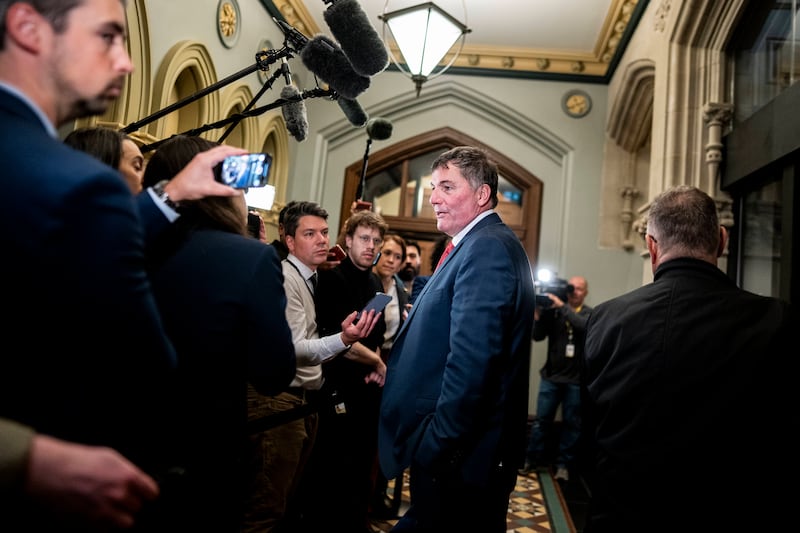 Canada-U.S. trade and tariffs Minister of Internal Trade, President of the King’s Privy Council for Canada, Minister responsible for Canada-U.S. Trade, Intergovernmental Affairs and One Canadian Economy Dominic LeBlanc speaks to reporters ahead of a cabinet meeting on Parliament Hill in Ottawa, on Tuesday, Oct. 21, 2025. THE CANADIAN PRESS/Spencer Colby Major project designations ‘soon’
After discussing the “headwinds” that he said the federal government is experiencing as it pushes provinces and territories to dismantle interprovincial trade barriers, LeBlanc pointed to the Major Projects Office as a tool to help cut through some of those logjams.
LeBlanc told the crowd that the Liberals are “close” to designating projects as in the national interest and he’s “quite confident” that doing so will “help unlock private investment.”
“Often just the sheer threat of, ‘Hey, we’re going to designate the project,’ suddenly an authorization – which a particular federal department had been taking six or seven years doing water samples all over the place – all of a sudden, when I stood in that city, at that port and said: ‘guess what? We’re going to actually expand this port, then a month later, the authorization showed up,” he said.
“So, we didn’t have to go to the juridical step of designating it, but we will. There are some examples coming very soon.”
‘Sentiment isn’t enough’
Speaking about the federal government’s efforts to diversify trade relationships beyond the U.S., LeBlanc said he feels Canadians’ impatience.
Though, he said that as it took time to develop Canada’s deep economic ties with the U.S., it will take time for businesses and governments to build up relationships with other foreign countries.
He also said that every time Carney comes back from international travel, or from speaking with other world leaders, “He’ll say to us that he’s enormously enthusiastic and motivated by how many of these people want to do business with Canada, want to explore investment opportunities.
”But, LeBlanc then added, “But that sentiment isn’t enough. We’ve got to turn it into concrete economic growth and therein lies the challenge for us.”