
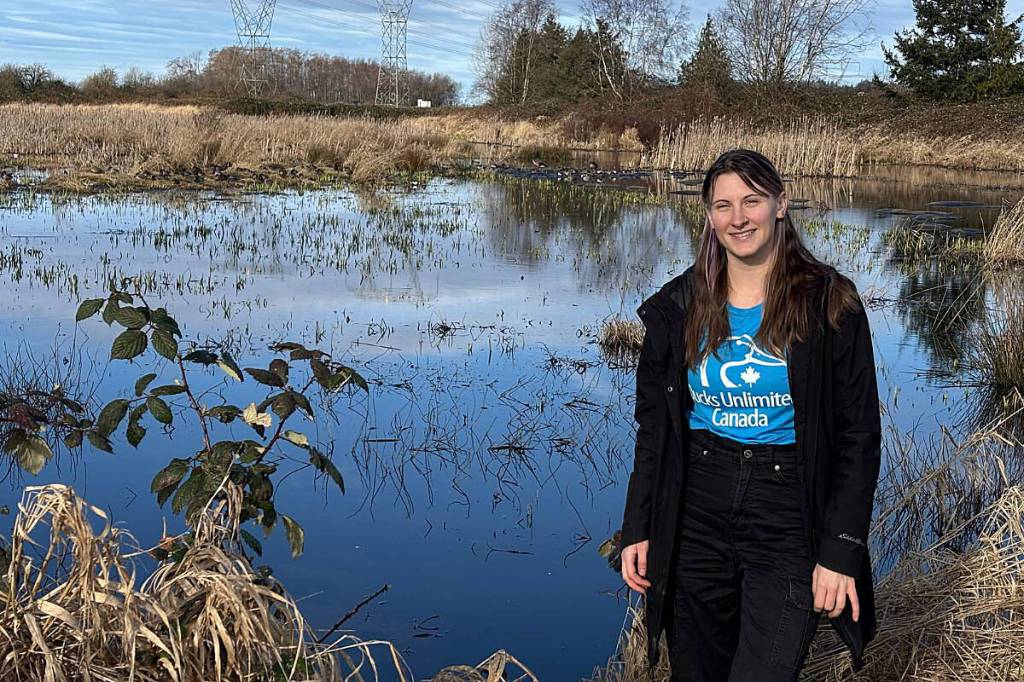
Wetland conservation team tackles invasive species in Surrey’s Serpentine Fen
Published 4:00 pm Thursday, February 26, 2026
Ducks and birds aplenty float atop a water-covered area in the Serpentine Fen.
Little do these aquatic birds know that the black tarp beneath the water’s surface is quietly working to eradicate an invasive species.
Ducks Unlimited Canada is hard at work in the Serpentine Wildlife Management Area and took the time to showcase its efforts to Peace Arch News for Invasive Species Week.The goal of this week, which ran from Feb. 23 to Feb. 27, is to increase awareness about the impacts of invasive species and how the community can come together to protect natural spaces.
“This is a great opportunity to bring awareness of invasive species to the public,” shared Megan Goard.
Goard is the conservation program specialist with Ducks Unlimited Canada (DUC) and the field operations lead for the South Coast Conservation Land Management Program, which is a partnership program funded by DUC to manage the provincially designated conservation lands on the South Coast.
She is one of the individuals behind fighting the invasive species found at Serpentine Wildlife Management Area.
“There’s a lot of people who really enjoy coming out to these sites and are noticing changes that take place, and it’s great for them to further understand the kind of work we are doing,” Goard told Peace Arch News.
Goard shared that in this specific area, yellow flag irises are the species invading this wetland area.
The Invasive Species Council of B.C. states that yellow flag iris invades ditches, wetlands, streams, lake shorelines and shallow ponds.
It is currently designated as a provincial noxious weed by the B.C. Weed Control Act. This means it is a plant that is highly destructive and injurious to agriculture, gardens, livestock and public health.
Goard explains that most people will use their hands to pull it out or dig it up, but that is super labour intensive and DUC wanted to do something to try and eradicate it all together in this area.
She said that since the Serpentine is a monoculture they wanted to test out “benthic barriers” in the areas that are being taken over by the irises. Those barriers are non-porous rubber tarps that are placed over and nailed to the ground after the plant is cut down to the ground.
“The goal is to essentially smother the plant and choke it out in a way that doesn’t get any sunlight, doesn’t get as much nutrients as it normally does,” said Goard. “It essentially kills out the plant, kills out the rhizomes so we can go in later and un-trap it, dig out whatever is remaining, and then the goal would be to revegetate the area with native species.”
She mentioned that this is a slower, more long-term process, but it will be very impactful in the end.
The barriers are also being used at their Addington site in Coquitlam.
The Addington project has been around longer than the Serpentine, and Goard says it shows what the Serpentine can become.
Goard said they’ve started planting in the Addington area and have had volunteer events to help rejuvenate the next part of the project.
Though there is not yet a planting plan in place for the Serpentine, Goard explained that when they get to that stage they will base the rehabilitation of greenlife on the base of what is already existing in the area.
“I think projects like this are a really good example of DUC’s mission,” Goard shared before explaining that the non-profit’s mission is to “conserve and restore wetland habitat and other habitat for the benefits of waterflow, wildlife and people.”
“There’s a lot of people who really enjoy coming out to these sites and are noticing changes that take place, and it’s great for them to further understand the kind of work we are doing,” said Goard.
She also mentioned that there are ways for people in the community to also help in reducing the liveliness of these invasive species.
People can help by brushing off their boots if they are out in areas where they may notice invasive species, and Goard also suggested people learn how to identify invasive species while out and about.
She also suggests that people try to avoid planting these invasive species in their gardens, which will reduce the spread.
The Serpentine project will probably take a few more years to fully eradicate the invasive species, but Goard said her team is up for the challenge.
“There’s a lot to do, but I’m excited to do it.”
To learn more about this project you can visit the DUC website here.