
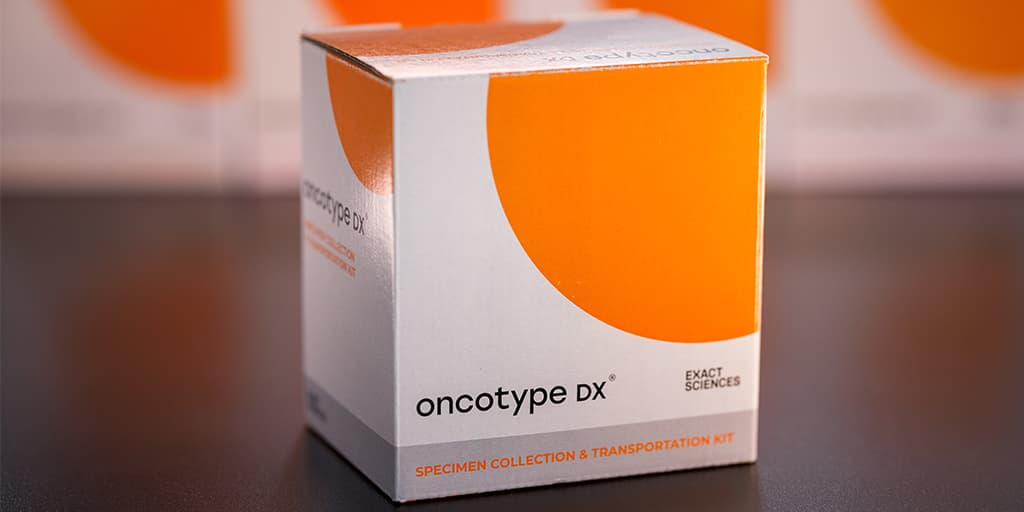
How the Oncotype DX® test’s predictive utility propelled precision oncology
In 2003, Katherine Y., a 53-year-old podiatrist, found a lump in her breast during a self-exam. The fog of a cancer diagnosis followed: back-to-back appointments, scans and pathology reports, a new, cancer-centric vocabulary to learn. Katherine underwent a double mastectomy to remove the cancer, then faced her hardest decision yet: Should she have chemotherapy to reduce the chance of cancer returning somewhere else in her body?
Standard tumor assessments suggested chemotherapy would be necessary, and Katherine heard the familiar logic: treat broadly, treat aggressively, reduce risk. But she also understood how chemotherapy could negatively impact her quality of life. What she needed was clarity.
In January 2004, Katherine became the first commercial patient to receive the Oncotype DX Breast Recurrence Score® test. She had a Recurrence Score® result of 18 — a low score indicating she likely would not benefit from chemotherapy. That number wasn’t just data — it was a turning point for Katherine and for the more than 2 million patients that have used the Oncotype DX test since then.
The immediate benefit was personal and profound: Katherine avoided months of toxic treatment and the long tail of possible side effects. Twenty-two years later, Katherine remains cancer-free*. Today, she and her husband, Mel — both retired — spend their time skiing, biking, and hiking in the Sierras with their dog, Critter.

“I feel so blessed I had the opportunity to be the first to take this test, forego chemotherapy, and learn my potential for distant recurrence. Very importantly, I wanted to help other women learn about this test so they could have a say in their own, tailored cancer treatment,” Katherine, who is now an Oncotype DX Patient Ambassador, recently shared.
Katherine’s story illustrates the human side of precision oncology: personalized treatment plans, fewer side effects, preserved quality of life, and — most importantly — peace of mind. When you multiply the effect of a better decision across millions of patients, the story becomes more than clinical — it highlights the economic value of the test.
The Health Economics Behind Better Care
After more than two decades of clinical evidence and real-world use in more than 100 countries, more than two million breast cancer patients1 and their care teams have used the Oncotype DX test to help guide their decision-making. The Oncotype DX Breast Recurrence Score test delivers personalized genomic results to help guide treatment decisions for patients with early-stage HR+, HER2- breast cancer. Twenty-two years after launch, the Oncotype DX Breast Recurrence Score test is the only genomic test proven to predict chemotherapy benefit from randomized controlled studies2, guiding personalized treatment decisions with the highest level of evidence.
Prognostic and predictive tests serve very different purposes; prognostic tests provide insight into how cancer may behave over time — such as the likelihood of recurrence — but they do not provide information about treatment benefits. Predictive biomarkers, on the other hand, help determine whether a patient is likely to benefit from a specific therapy, information that can directly guide treatment choice and support more individualized care.3
When a test can predict chemotherapy benefit and safely reduce its use, there are both clinical and financial benefits. By identifying who is — and is not — likely to benefit, the test has enabled clinicians and patients to de-escalate treatment confidently. An estimated 1.6 million4 of the 2 million patients tested worldwide may have been spared from potentially unnecessary chemotherapy, avoiding the acute and long-term toxicities of treatment.
Chemotherapy is expensive, but its true cost extends beyond treatment acquisition. There are infusion visits, supportive medications, management of side effects, as well as emergency visits and admissions for complications. There are also indirect burdens: diminished quality of life, time away from work, caregiver strain, travel costs, and productivity losses.
Using a published economic model, it is estimated that use of the Oncotype DX test to inform adjuvant treatment decisions among HR+, HER2- patients resulted in average lifetime savings of approximately $10,000 per patient in the U.S. healthcare system. Using the published economic model, based on current treatment patterns, it is estimated that use of the Oncotype DX test to inform adjuvant treatment decisions among HR+, HER2- patients (compared to clinical-pathological factors alone) could have saved more than $14 billion to the U.S. healthcare system since the introduction of the test.
A recent large, real-world analysis5 of patients with early-stage HR+, HER2- breast cancer demonstrated that chemotherapy utilization increases appropriately with higher Recurrence Score results in the U.S., consistent with guideline-based care. The Oncotype DX test strengthens decision consistency among providers, underscoring its value not only in guiding individual care but also in harmonizing expert judgment in routine practice, including across all racial and ethnic groups. The Oncotype DX Breast Recurrence Score test’s performance has been consistently validated across diverse populations, and this analysis found that chemotherapy use was generally consistent across racial and ethnic groups6, suggesting equitable application of Recurrence Score result-guided treatment recommendations.
Global Health Economic and Outcomes Impact
The Oncotype DX test has been available internationally since 2010, so the global health economics impact of this test is immeasurable. But compelling data points exist; a recent study presented at the San Antonio Breast Cancer Symposium (SABCS) in 2025 found that the Oncotype DX test significantly influenced adjuvant treatment decisions, primarily leading to chemotherapy de-escalation and strengthening decision consistency among Swiss breast cancer specialists7. Another analysis presented at the same congress estimated that Oncotype DX testing in node-positive patients across five oncology centers in Ireland over an 11-year period led to savings of more than €60 million to the Irish healthcare system8. This was calculated by specifically identifying patients who did not undergo chemotherapy, thus avoiding direct medical costs and broader societal burdens.
For more than two decades, clinicians and patients have relied on the Oncotype DX test to move beyond one-size-fits-all care and use predictive insights to make more confident, individualized decisions. With that confidence comes something patients and their physicians value deeply: the ability to pursue the right treatment plan for them. The enduring quality of the Oncotype DX test has enabled those decisions and brought clarity when it was needed the most.
*This story reflects one individual’s experience. Not every person will have the same treatment, experience, outcome, or result. The Oncotype DX test is ordered by your health care provider. Talk to your health care provider about whether the Oncotype DX test may be right for you. To learn more, visit www.breastcancerclarity.com.
References
DOF. Exact Sciences Corporation; Madison, WI. 2 million patients [REF-01010]. 2026.
EBCTCG. Lancet. 2012.
Ballman et al. J Clin Oncol. 2015.
DOF. Exact Sciences Corporation; Madison, WI. 2 million patients [REF-01010]. 2026.
Cuyun Carter G, Racz J, Gu, Ning Yan, et al. Real-word utilization of the 21-gene assay for guiding treatment decisions in patients with HR+/HER2- early breast cancer in the US. Poster presented at SABCS 2025 Dec. 10, 2025; Abstract PS2-06-21 San Antonio, TX. Accessed date Feb. 11, 2026 https://sabcs.org/events/2025/poster-session-2/
Moyon C, Berdunov V, Gouldson, et al. Clinical and economic impact of the 21-gene assay for guiding treatment in patients with HR+/HER2- early breast cancer across racial and ethnic subgroups in the US. Poster presented at SABCS 2025 Dec. 11, 2025; Abstract PS4-09-24 San Antonio, TX. Accessed date Feb. 11, 2026 https://sabcs.org/events/2025/poster-session-4/
Vetter M, Ebner S, Kralidis E, et al. Decision-Making on Adjuvant Chemotherapy in Early HR+ Breast Cancer: A Prospective Evaluation of Oncotype DX Utility Among Swiss Breast Cancer Experts. Poster presented at SABCS 2025 Dec. 11, 2025; Abstract PS3-10-10 San Antonio, TX. Accessed date Feb. 11, 2026 https://sabcs.org/events/2025/poster-session-3/
IM Browne, RA McLaughlin, CS Weadick, et al. The Societal Cost Impact of Oncotype -DX® Testing in an Irish Healthcare Setting. Poster presented at SABCS 2025 Dec. 11, 2025; Abstract PS3-09-03 San Antonio, TX. Accessed date Feb. 11, 2026 https://sabcs.org/events/2025/poster-session-3/
Author
Brian Baranick
General Manager, Precision Oncology, Exact Sciences