
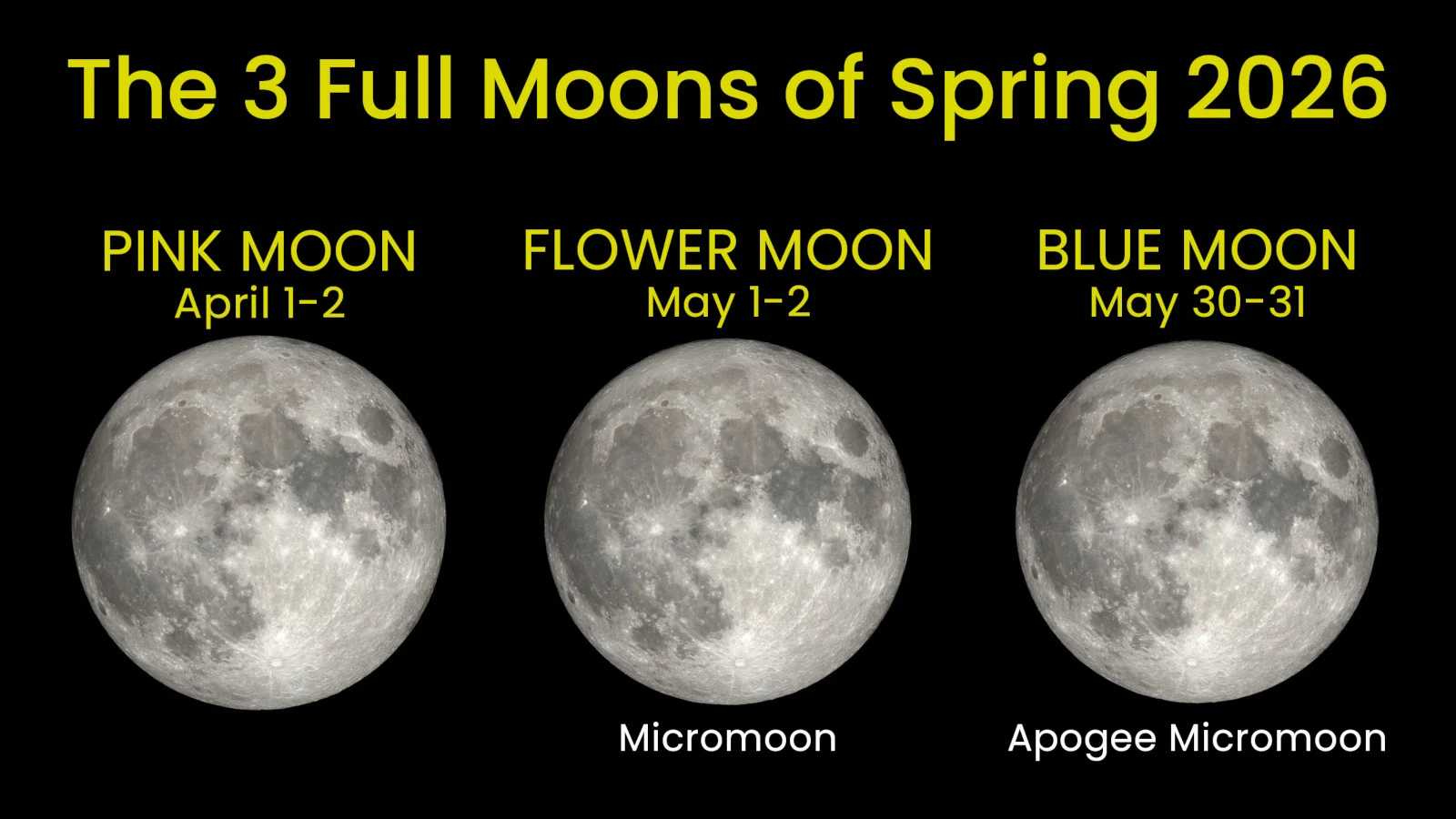
The Full Moons of Spring 2026, the Flower Moon and the Blue Moon will be two of the smallest of this year, with the Blue Moon being the apogee micromoon, the smallest and farthest of the year. (Scott Sutherland/NASA’s Scientific Visualization Studio/Fred Espenak)
With two Full Moons occurring within the same month, on May 1-2 and May 30-31, the second of those is called a Blue Moon.
This type of Blue Moon — a ‘calendar’ Blue Moon — can happen in any month that is longer than the 29.5-day synodic lunar month. Thus, we’ll see one in any month except February, with a frequency of one every 2.5 to 3 years. The last one was on August 31, 2023, and the next one (after May of this year) will be on December 31, 2028.
During a year with a calendar Blue Moon, instead of the normal 12, we will see a total of 13 Full Moons between January 1 and December 31. Since we have 12 popular names for Full Moons, this is truly an ‘extra’ one, and as a result, it is only named the Blue Moon.
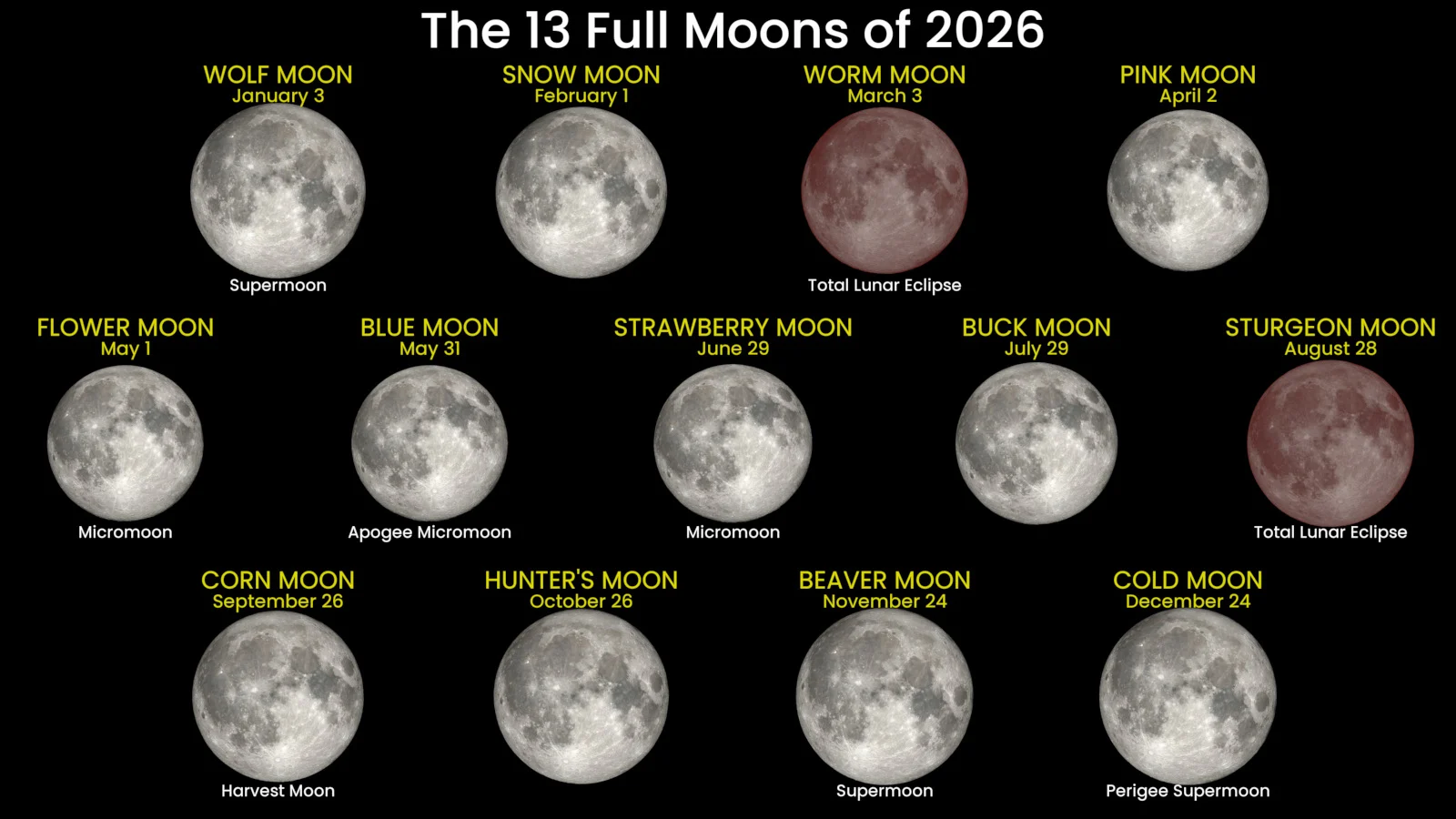
The 13 Full Moons of 2026, with their popular names, and any remarkable aspects (supermoon, micromoon, Harvest Moon, lunar eclipse, etc). (Scott Sutherland/NASA’s Scientific Visualization Studio/Fred Espenak)
In contrast, there is also the ‘seasonal’ Blue Moon, which is when we have 13 Full Moons in the course of 4 seasons (aka a Tropical Year). This gives us three seasons with three Full Moons each, and one season with four. This is the original meaning of the term, as the calendar “13th Full Moon of the year”, mentioned above, was a misinterpretation of the rule published in the Maine Farmers’ Almanac back in 1937.
Which Full Moon ends up being the Blue Moon in that year depends on their exact timing. A Full Moon will occur within the first few nights after the start of a season, and due to the timing of the ones that come after, there will be a total of four Full Moons before the season ends. The third of those four is the Blue Moon, with “Blue” being added to its popular name. Thus, since this occurs mostly in spring, summer, and fall, it usually results in either a Blue Flower Moon in May, a Blue Sturgeon Moon in August, or a Blue Beaver Moon in November.
Now, it is possible to have a winter seasonal Blue Moon, also known as a Blue Snow Moon, which would occur in February. However, this is much more rare.