
‘This is provincial downloading in a different disguise,’ Oro-Medonte mayor says during discussion around industrial, commercial and institutional locations
Editor’s note: The county does not manage waste collection in Barrie and Orillia, which are separated cities.
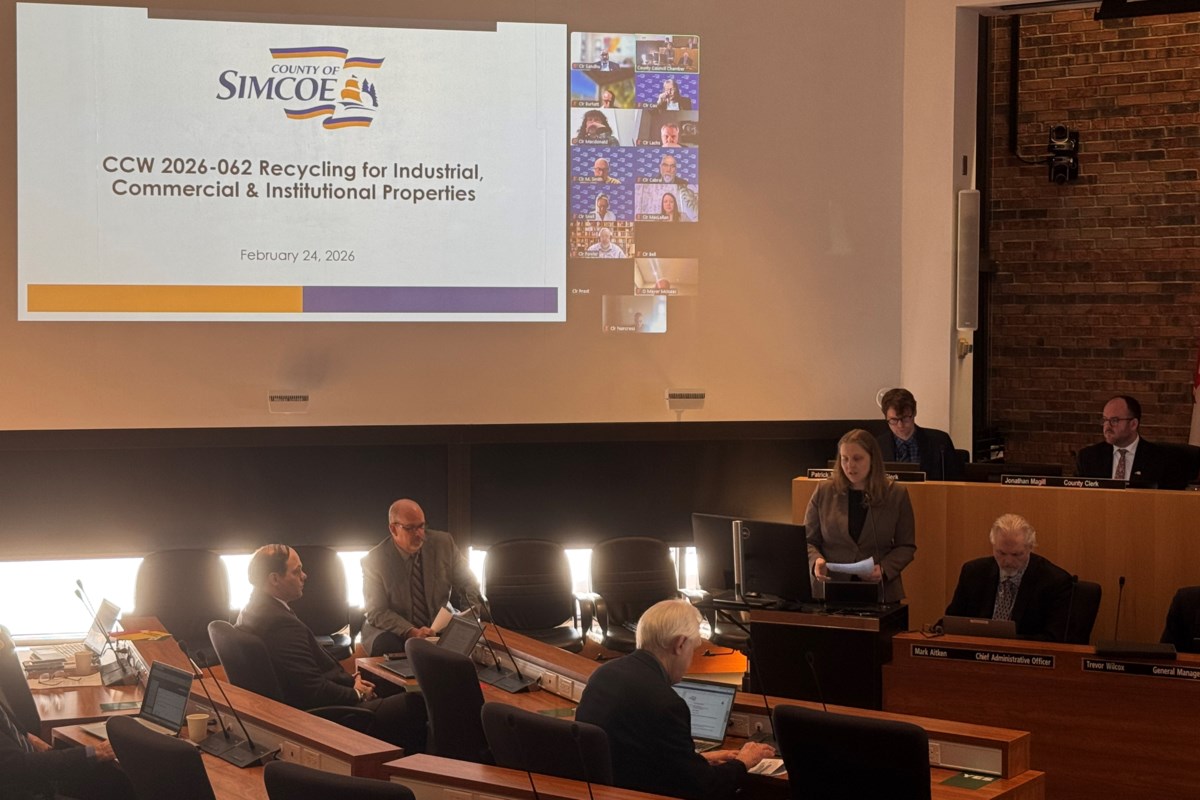
Simcoe County councillors have opted — in a vote that was not quite unanimous — to keep the status quo on recycling for industrial, commercial and institutional (IC&I) properties, choosing not to extend municipal blue-box service to the sector.
As of Jan. 1, 2026, producers are running Ontario’s recycling system, which excludes curbside collection for IC&I sites.
A staff report presented at today’s committee of the whole noted that before the transition, the county’s curbside program covered only small IC&I properties generating up to two carts of recycling every two weeks, while larger generators could participate only within those limits and were otherwise required to arrange their own recycling services.
Staff had previously been asked by council to investigate options to find ways to include the IC&I sector, which were presented to county council Tuesday morning.
“They’ve gone ahead and done a fair bit of homework and provided this report,” said Rob McCullough, the county’s director of solid waste management. “We thought it would be prudent to walk through the options and explain why we landed on the recommendation.”
Blue-box regulations clearly define which properties qualify for curbside collection and which do not, Laura Barrett, the county’s manager of collections, told councillors during a brief presentation.
Residential properties remain eligible, along with multi-residential buildings, schools and long-term care homes that were already part of the county’s program.
“Unfortunately, this leaves out the industrial, commercial and institutional properties,” she said.
Although the county was never required to service IC&I sites, Barrett noted it had historically made sense to pick them up when trucks were already travelling those routes to collect from nearby homes.
“If the IC&I properties were putting it out at the same limits as a residential unit then we collected it,” said Barrett.
Of the approximately 5,600 IC&I properties in the region, there were approximately 2,100 being serviced by the county prior to 2026.
Once the province signalled that legislative changes were coming, staff made several attempts to persuade officials to reconsider, she said, but those efforts ultimately went nowhere.
Staff’s recommendation was simply to maintain the status quo, Barrett told county council, however they will continue to advocate to the province to make changes to the legislation.
“We continue to believe that the producers should be responsible for that pop can that was disposed of at home versus at a business,” she said. “It’s the same pop can.”
Although staff understand the option may not address immediate concerns, Barrett said legislation has been passed that could be implemented to require producers to allow an option for producers to collect on behalf of the municipality.
As of now, however, not much information is available on that legislation, she added.
“We don’t know how that is going to be interpreted, but we do think it is probably a little bit of a glimmer of hope there that maybe there is some movement,” Barrett said.
In addition to the recommended option — which is maintaining the status quo while continuing to press the province to include small generator IC&I material in the blue-box system — county councillors were presented with several alternative approaches. However, Barrett said proceeding with anything but the recommended option would require all taxpayers to subsidize the cost of recycling service just for the IC&I sector.
Those options included:
provide a separate county service for the curbside collection of recycling to IC&I properties;
provide 20 kilograms of free recycling drop-off, bi-weekly, for approximately 5,800 IC&I properties;
provide 20 kilograms of free recycling drop-off, biweekly, for approximately 640 non-profit IC&I locations;
provide a financial subsidy to help offset the cost of private recycling services for approximately 5,800 IC&I properties;
provide a financial subsidy to help offset the cost of private recycling services for approximately 640 nonprofit IC&I locations.
Midland Mayor Bill Gordon called the decision a “head-versus-heart” one for many councillors, adding that although his heart pointed him toward the options that would provide assistance to local nonprofits, his head was directing him to support the staff recommendation as the “responsible option.”
“This isn’t our monkey and it’s not our circus anymore,” he said. “We were stripped of this. We did a fantastic job for decades, and everybody recognizes that. They know exactly where the problems are coming from.”
Gordon said he was uncomfortable with the idea of raising the levy on all ratepayers to cover a service the IC&I sector would receive alone — particularly when residents are already paying provincial taxes for that very system to be delivered.
“We need to stay in our swim lane,” he said. “My heart wants to help out the nonprofits specifically. Not that I have any axe to grind with IC&I — they are critical to our economy — but if I was going to put tax money on to this to make the government look good in this hour of not looking good it would be for the nonprofits. I need to lead with my head on this, which is to side with staff.”
Tiny Mayor David Evans said that while it had been convenient for the IC&I sector to receive service in the past, the decision ultimately comes down to dollars and cents.
“For us to try to be all things to all people just is never going to work … especially when we don’t get any money for it. Garbage to me is a user-pay system. It’s no different than water or any other municipal service,” he said. “I am not willing to put that added burden on all of the taxpayers for something that only affects a small minority of them.”
Oro-Medonte Mayor Randy Greenlaw agreed, adding that supporting anything but option one would be sending the wrong message to the province.
“This is provincial downloading in a different disguise,” he said. “We need to stay in our lane on this one. This is no different than the OPP download to municipalities.”
Bradford West Gwillimbury Mayor James Leduc was of a different opinion, saying he preferred the option that would offer a recycling subsidy for local nonprofit organizations.
“The subsidy is not a lot. It’s $52. To me, that’s not a huge number. We are talking about churches, legions, food banks. Things that give out to our community all the time,” he said. “To subsidize this … and take these 640 units, help them out, that money goes right back into our communities.”
When asked why Circular Materials doesn’t include IC&I in the program, staff said it basically comes down to trying to save money.
That requirement, said McCullough, was not built into the legislation by the province.
“To be clear, we went beyond our mandate. It continues to make all the sense in the world because it made sense to continue to collect small quantity IC&I,” he said.
“I think we have been partially successful with some of our lobbying efforts, but at this point the province has been unwilling to look at IC&I, thinking each business should provide for their own methods of recycling,” McCullough added.