

MK
Millar Kreklewetz
More

Millar Kreklewetz LLP is a super-boutique Canadian Indirect Tax, Customs & International Trade firm, with a client base comprised of national and international leaders across all industries. In 1999, L’Expert Magazine called us a Canadian “brand name” for Indirect Tax and International Trade and nothing much has changed in 2024!
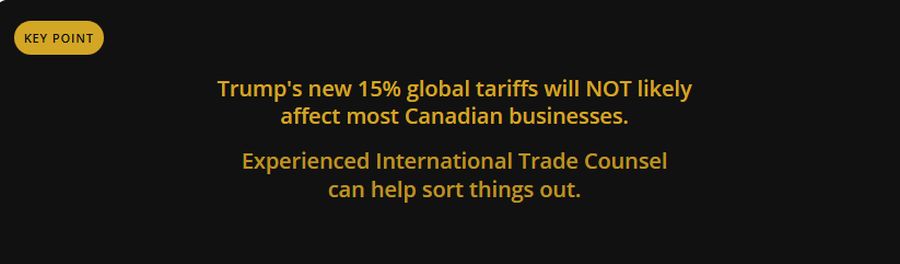
Much of the current commentary surrounding the new US tariff measures has overlooked a central point – namely, that broad-based US tariff actions do NOT apply to Canadian-origin goods that properly qualify under CUSMA.
Canada
International Law
To print this article, all you need is to be registered or login on Mondaq.com.
Article Insights
Robert Kreklewetz’s articles from Millar Kreklewetz are most popular:
with Senior Company Executives, HR and Finance and Tax Executives
in Canada
with readers working within the Accounting & Consultancy, Healthcare and Property industries
Much of the current commentary surrounding the new US tariff measures has overlooked a
central point – namely, that broad-based US tariff actions do
NOT apply to Canadian-origin goods that properly qualify under
CUSMA.
There are certainly some exceptions like in militarily strategic
sectors (like steel and aluminum) and in sensitive economic sectors
(like automotives and lumber) but the wider narrative suggesting
sweeping tariff exposure for Canadian exports to the US is probably
overstated. We provide additional insight below.
What Tariffs Currently Affect Canada?
Canada has generally been subject to sector-specific US tariff
measures, including:
Steel and Aluminum – Section 232
tariffs impose 50% on steel and aluminum, including certain
derivatives. The reason for these tariffs is to support the US
steel and aluminum domestic industries, which are view (quite
rightly) as militarily strategic.
Copper – Section 232 tariffs impose
50% on semi-finished copper products and copper-intensive derivate,
reflecting US concerns about supply security and domestic product
capacity.
Wood Products / Cabinets – Section
232 tariffs impose a 10% on softwood lumber and time and a 25%
tariff on upholstered wooden products, cabinets and vanities. This
is another industry in which the US has identified as crucial to
its national defence and critical infrastructure products.
Automotive – Section 232 tariffs
impose 25% on vehicles and auto parts, with partial relief for
CUSMA-qualifying content. The automotive industry has been viewed
as being of national economic importance dating back to Reagan-era
tariffs on Japanese autos.
How Will Trump’s 15% Global Tariff Affect Canada?
It is critical to recognize that Trump’s new 15% global
tariff framework is directed primarily at
“non-preferential” imports – namely, imports to the
US that are not already covered by trade agreement.
What this means is that CUSMA-qualifying goods exported to the
US by Canadian businesses should remain exempt of the new global
tariff structure as per section 14(l) of President Trump’s
presidential proclamation of February 20, 2026.
Accordingly, Canadian goods that are manufactured or
sufficiently produced in Canada and exported under the CUSMA
preferential regime will NOT be subject to any duties in the US and
will be FULLY EXEMPTED from the 15% global tariff!
Are My Goods CUSMA Compliant?
CUSMA’s Rules of Origin are designed to preserve North
American manufacturing. Businesses producing goods in Canada and
meeting those origin thresholds should continue to benefit from
duty-free treatment.
Now comes the hard part: determining CUSMA qualification. One
generally finds that a proper and legally defensible CUSMA
certification will require:
Review existing certificates
Mapping inputs and supply chains
Applying product-specific Rules of Origin
While these rules are detailed and technical, Experienced
International Trade Counsel can be leveraged by businesses to
establish and maintain defensible origin positions.
Download a PDF copy of this Blog here.
The content of this article is intended to provide a general
guide to the subject matter. Specialist advice should be sought
about your specific circumstances.