
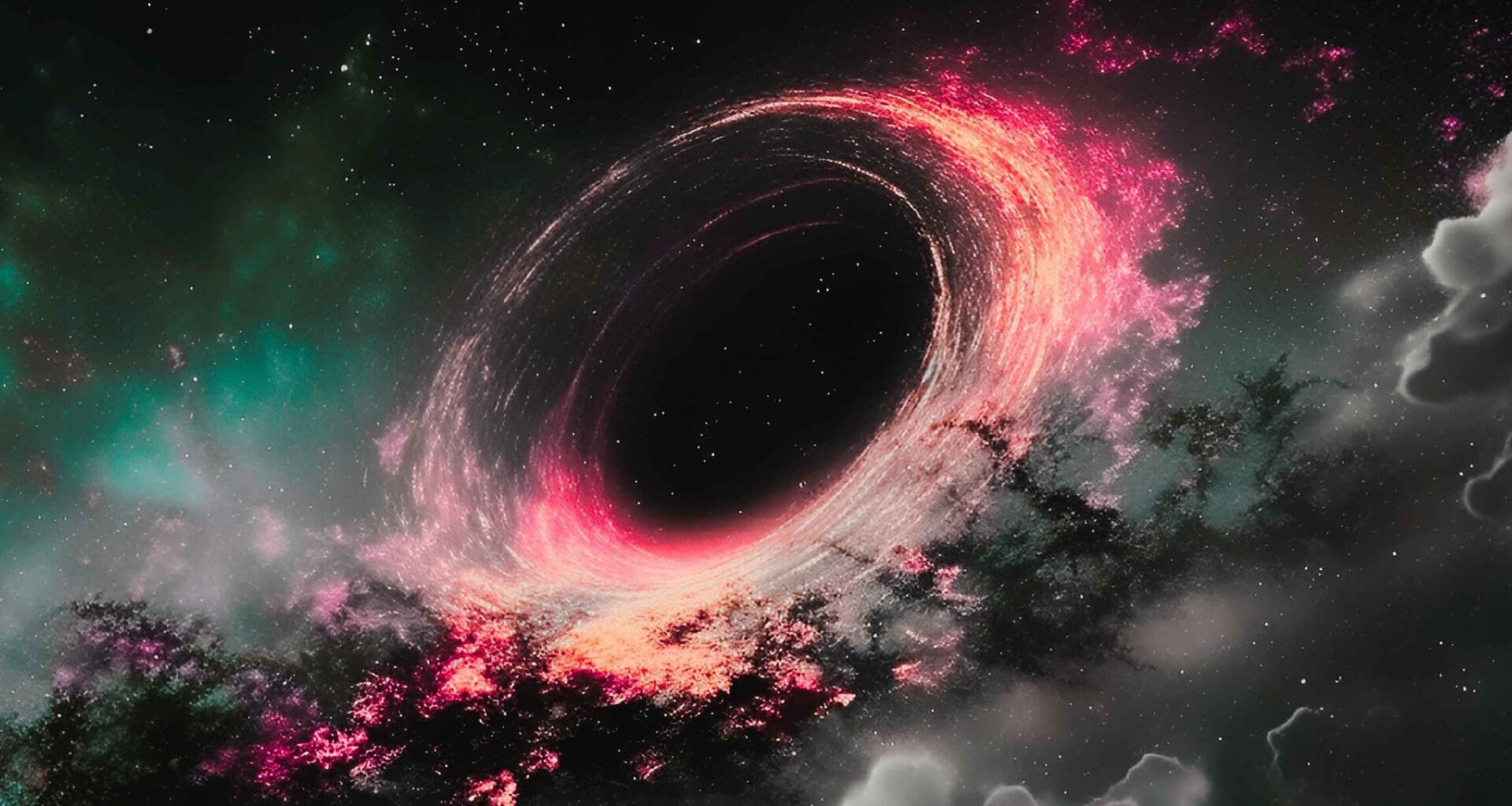
Researchers report that the mysterious little red dots the James Webb Space Telescope detected are actually young supermassive black holes hidden inside thick clouds of gas.
When scientists account for that surrounding gas, the objects turn out to be far less massive than first thought, shrinking earlier mass estimates by about a factor of 100.
What Webb actually saw

In the sharp infrared spectra of many little red dots, a hydrogen line shows a narrow peak with very broad wings.
Working from that line shape, researchers at the University of Copenhagen in Denmark (UCPH) traced the broad wings to thick gas.
The group found that light bounced off electrons inside the cocoon, widening the line without extreme motion.
With the cocoon in the way, the line wings stopped being a measure of gas speed, and the focus shifted to the surrounding gas.
Why the wings widened
Instead of racing gas, electron scattering – light bouncing off free electrons – can smear a line into long, smooth wings.
Each bounce changes a photon’s direction and energy a little, so many bounces spread the line out on both sides.
When the UCPH team tried fitting the data with a simple bell-shaped curve, the kind often used to describe random motion, the remaining differences traced out a clear W-shaped pattern on the graph.
That W-shaped pattern meant the model was missing something important in the center and the edges of the line. An exponential curve followed the data smoothly without those mismatches.
Earlier estimates treated the whole width as motion, so the same data inflated apparent speeds to thousands of miles per second.
Masses drop sharply
After researchers removed the scattering effect, the narrow core indicated black holes ranging from 100,000 to 10 million times the Sun’s mass.
From that calmer core, the team inferred how fast nearby gas orbited, and that speed anchored each mass estimate.
For the first time, the work tied these little red dots to black holes this small, not the enormous ones many expected.
Smaller starting masses make it easier to explain how some black holes became giants so soon after the first stars formed.
Inside the cocoon
From the line wings, the team inferred cocoons only a few light-days across, wrapped around the bright center.
Because the cloud contained so many free electrons, it became thick enough to block most X-rays from escaping.
Even so, intense heating and radiation stripped almost all electrons from the gas, leaving it highly energized.
In that state, photons bounced around until the cocoon rerouted their energy into the wavelengths Webb sees best.
If the shell recycled most of its power, the black hole would appear quiet in radio waves and X-rays.
Black hole growth phase
The study suggests these black holes are growing close to the Eddington limit, the point where the light they produce becomes strong enough to push outward against the gas falling in.
Gas spiraling inward heats up and shines, and that light can slow the inflow when it pushes on electrons.
Driving the system that hard also tends to cool the region that makes hard X-rays, making an already hidden source dimmer.
If this phase is common, it could be where supermassive black holes put on their weight before galactic structures settle.
Why dots looked galactic
Most of the visible light came from nebular emission, glow from gas recombining after ionization, not from new stars.
Because that glow is strong in hydrogen lines and continua, it can create the steep color change that drew attention.
A sharp bend near the Balmer limit, a hydrogen wavelength edge that changes the slope, gave many spectra a V-like shape.
Once most light comes from gas around a black hole, the host galaxy’s star count becomes hard to read from colors alone.
A clue that misled
Before the cocoon idea took hold, a separate study framed hydrogen wings as proof that something compact was swallowing matter.
In that framing, an active galactic nucleus, a black hole feeding in a galaxy’s center, powered light and drove the line width.
“Such extreme speeds are a smoking gun of an active galactic nucleus,” wrote Rodrigo Nemmen, an astrophysicist at the University of São Paulo, Brazil.
The work kept the black hole explanation but reinterpreted the wings as scattering, leaving only modest gas motions near the core.
Surveying the red dots
After Webb’s first science images arrived in July 2022, little red dots began appearing by the dozen across deep surveys.
For this study, the authors focused on 12 objects with the cleanest spectra, then stacked 18 more for a combined signal.
Spanning redshift, a distance clue from stretched light, from 3.4 to 6.7, the set stayed tiny and usually point-like.
Because the team chose only high-quality spectra, the result may not describe every little red dot that Webb has found.
What could come next
Soft X-rays can be absorbed by thick gas, so they may never make it out of the surrounding cloud.
The study suggests that even higher-energy X-rays might be reduced before escaping, especially if the black hole is feeding rapidly and producing fewer of those strongest X-rays to begin with.
Signs of gentle outflows also appeared in some lines, hinting that the cocoon may start to thin without blasting apart.
Future multiwavelength work will need to catch these objects at different angles and ages, to see when the gas clears.
A shorter origin story
By treating the wings as a scattering signature, astronomers can slot red dots into a younger, smaller stage of black hole growth.
As Webb and follow-on observatories collect spectra, the test will be whether cocoons like this show up around many early black holes.
The study is published in Nature.
—–
Like what you read? Subscribe to our newsletter for engaging articles, exclusive content, and the latest updates.
Check us out on EarthSnap, a free app brought to you by Eric Ralls and Earth.com.
—–