
A pietà is supposed to evoke compassion — the word derives from the Italian for “pity” — so the majority of the devotional sculptures depict the Virgin Mary cradling the crucified body of her son, Jesus. It took some creative chutzpah (and an impulse for experimentation) to deviate from the norm, but that is what Fenwick Lawson did when he sculpted Jesus lying at his mother’s feet in the Chapel of the Nine Altars, at the eastern end of Durham Cathedral, in 1984.
Influenced by Michelangelo’s Pietà Rondanini, an unfinished, rather abstract marble work in which Mary supports the emaciated body of her son, Lawson’s sculpture conveyed Mary’s sorrow through the natural splitting of the wood. Up close the scars were seared viscerally into the beech. Jesus’s right arm is deliberately incomplete; the left rises up as if to grasp his mother. Lawson’s work was draining — emotionally as well as physically. He tried to put himself in the position of the child and thought of Mary as his own mother.
Lawson was a strong, burly man, with ribbons of muscle from years spent sculpting, but he had a remarkably tender touch. He used chainsaws to hack down trees, chiselling away at the large flanks of wood until figures emerged, but there was a thoughtfulness to every mark because he wanted to conjure the pain and the fragility of life. His sculptures — most of them in churches — were contemplative. Visitors lingered and loitered; the hands, feet and heads of his figures of Jesus and Mary were often so worn down by touch that they had become shiny.
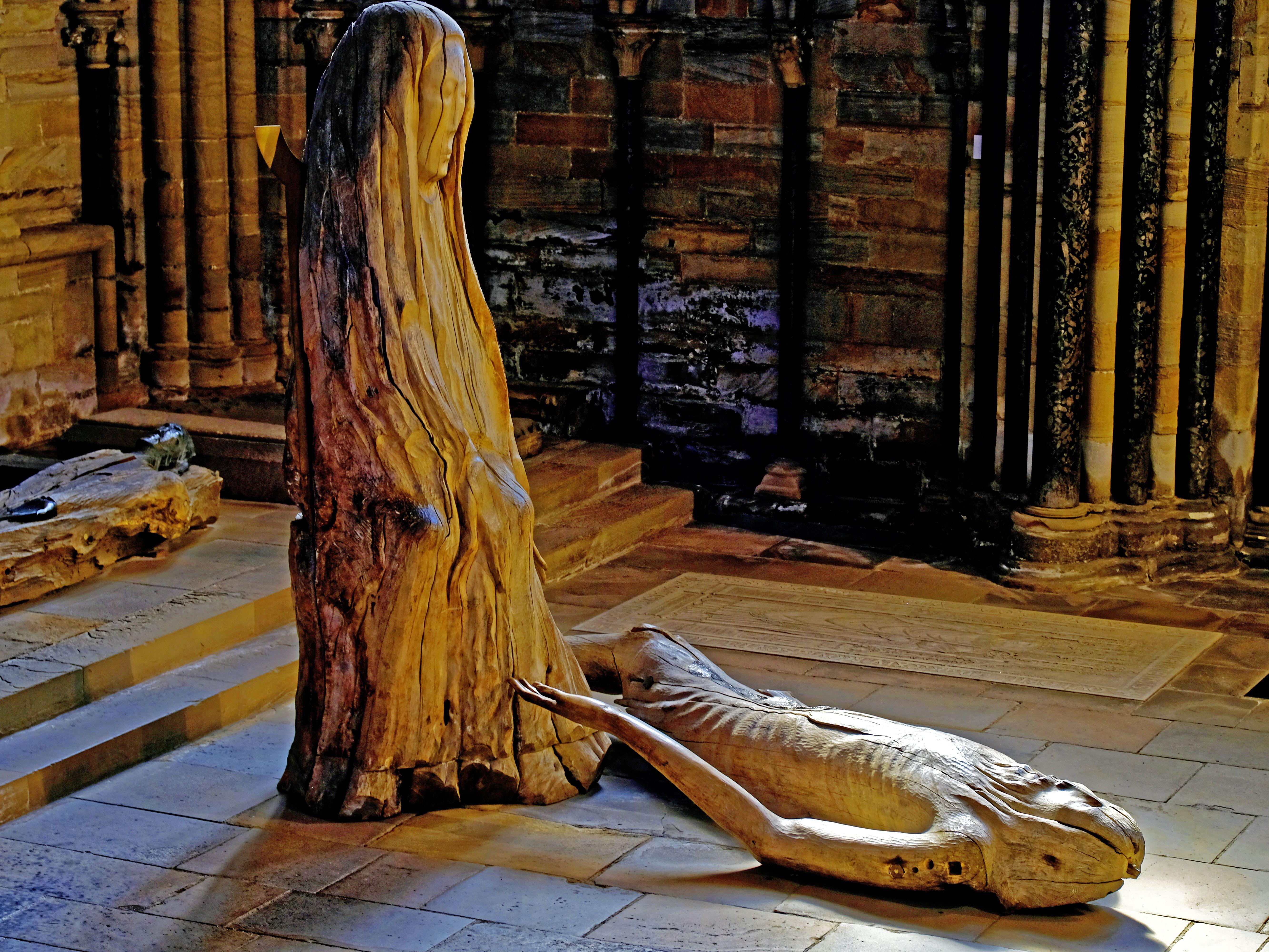
The pietà at Durham Cathedral
ALAMY
Lawson looked a little like a wizened figure from the Bible himself, with his snowy beard and craggy features. He was a gentle man with an open, affable face, but there was a relentless single-mindedness to his work, as he chipped away religiously at his sculptures.
As a teenager he had been a lay preacher in a Methodist church. He converted to Catholicism to marry his wife Joan, though by the time he carved Cuthbert of Farne in the 1980s, located in Durham, he had become more of an ecumenical Christian: he believed that denomination was not as important as Christianity itself. He preferred to depict Christ rising rather than bleeding with a crown of thorns.
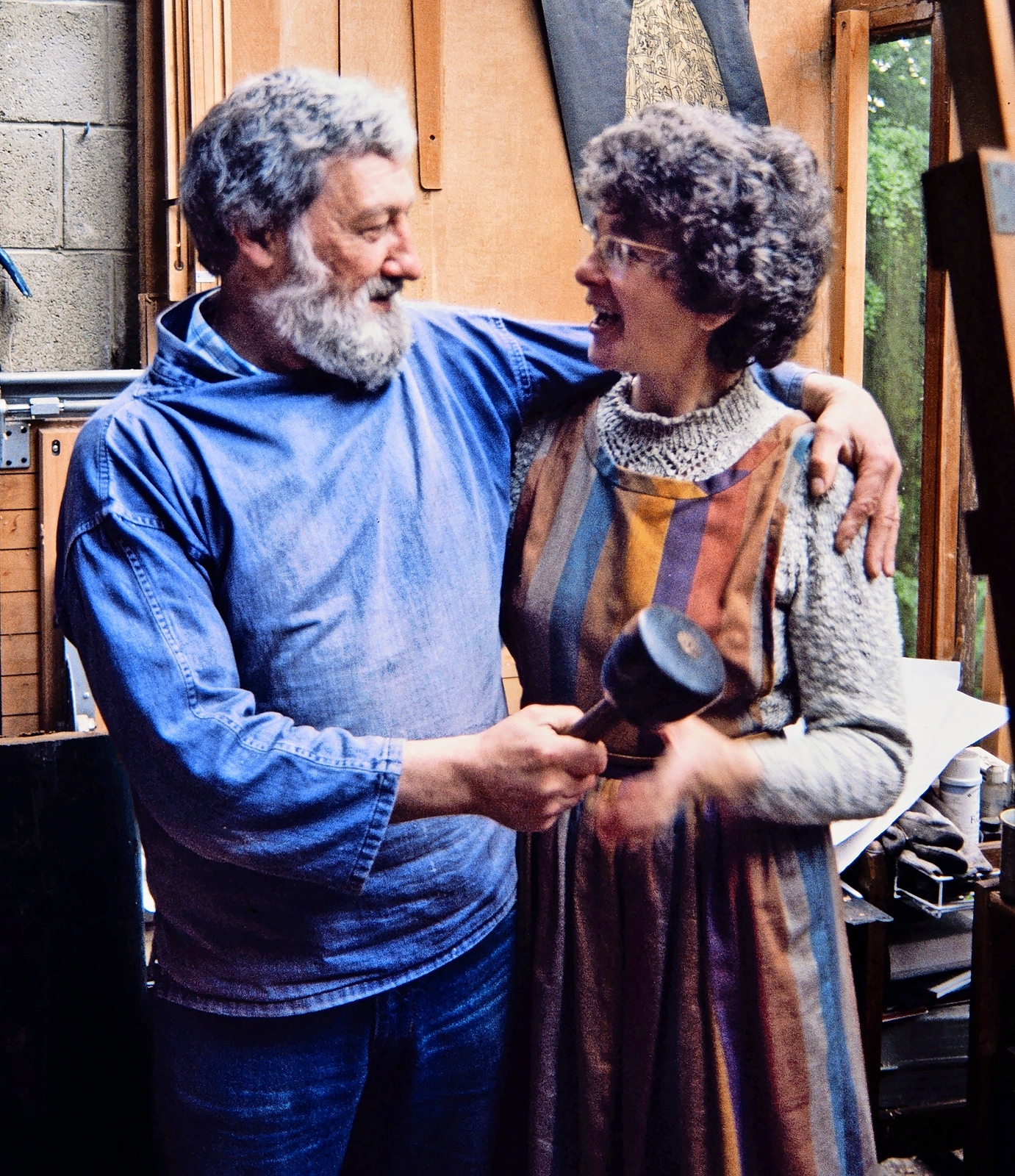
Lawson with his wife Joan
VINCENTE STIENLET
What drew Lawson to religious subjects was a keen sense of injustice. Indeed it was the need to communicate “humanity” that led him to deviate from neo-brutalism and the “art for art’s sake” maxim at the crux of his career in the 1960s. He carved a figure from elm called Condemned after his daughter Anna was arrested at a miner’s protest in 1984; Cry for Justice — The Scream (1985) was inspired both by Edvard Munch’s masterpiece and the 1972 photograph known as “The Napalm Girl”, of a nine-year-old girl during the Vietnam War.
Lawson was a spiritual man. When his Durham Cathedral pietà was exhibited in the South Transept of York Minster in 1984, the roof was struck by lightning and caught fire directly above the carving, causing molten lead to sear Mary’s brow and knees and the wood of her head to split. Jesus was left singed and burnt. Lawson felt his sculpture had been enhanced by the fire. “The pietà,” he said, “taught me that there are language systems other than my own which can reinforce the content.”
• Mystery of how lightning struck York Minster in 1984
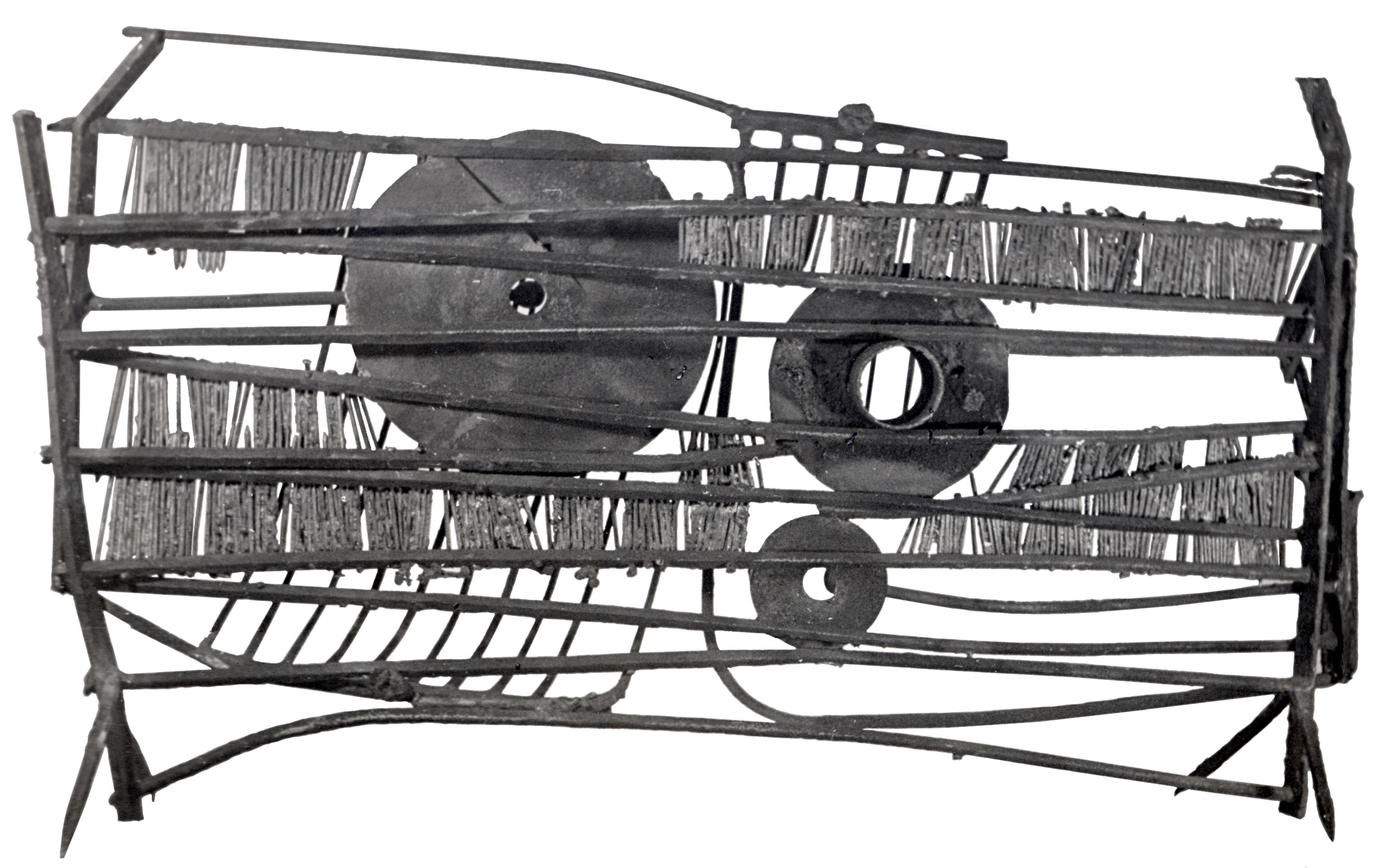
One of his early works
HOWARD LITTLE
When Lawson first started out he had no idea what “fine art” was. Perhaps it was this that made his work so original. The day after he was born, in 1932 in South Moor, Co Durham, Fenwick Justin John Lawson’s name had been put down for the pit. His father George was a miner — the lowest paid in the pit because he had been crippled by a horse and cart — and his uncle Jack was a bare-knuckle fighter. His mother Eleanor (née Oliver) came from a family of strict Methodists.
He grew up in a one-bedroom flat above a pub and was always escaping into nature. Fenwick ran wild. He sat in hedgerows so that he could feel the wind, foraged and ate hawthorn leaves so that he could “taste” the country.
Fenwick found it hard at grammar school — in his mining village they had their own dialect and he struggled to understand what anyone was saying — but his creativity was noticed and at 18 his headmaster assigned him to the Durham county council architects’ office.
By 1951 he was studying at Sunderland College of Art and four years later at the Royal College of Art in London. His tutor was John Skeaping, a sculptor who had been married to Barbara Hepworth and saw potential in Lawson’s career as a modeller. So did Sir Jacob Epstein, who became a mentor of sorts and a great influence on him. The rich iconography in churches and cathedrals drew Lawson in, in particular the medieval tombs at Westminster Abbey. Woodworking became a particular fixation, though Skeaping did not approve and refused to supply him with wood.
In the early 1950s he married his childhood sweetheart, Joan (née Rooke), a teacher in the northeast. They moved to London where, rather than a traditional roofed abode, Lawson offered a Second World War landing craft that had served officers during the Normandy landings and was punctured with bullet holes. They converted it into a houseboat and called it HMC Keel Row (Keel Row was a northeast folk song about men transporting coal on the River Tyne). To find the cheapest mooring Lawson canoed up and down the Thames, eventually settling on a working boatyard under Kingston Bridge in southwest London. The boat was tied to an oak post on which he had carved “Christ the King”. His mother intermittently sent food parcels of apple dumplings and corned beef pies down from Durham.
Lawson’s career was deviating from the norm too. Though Epstein and Skeaping offered him a studio in London, he wanted to forge his own path. After travelling across France, Italy and Greece, where he was inspired by sculptural masters such as Michelangelo and Donatello, he returned to the northeast to teach at two schools, St Aidan’s and St Joseph’s, then became the first lecturer in sculpture at Newcastle-upon-Tyne College of Art. When this merged into Newcastle-upon-Tyne Polytechnic in 1970, he became a principal lecturer and head of sculpture before retiring from teaching in 1984.
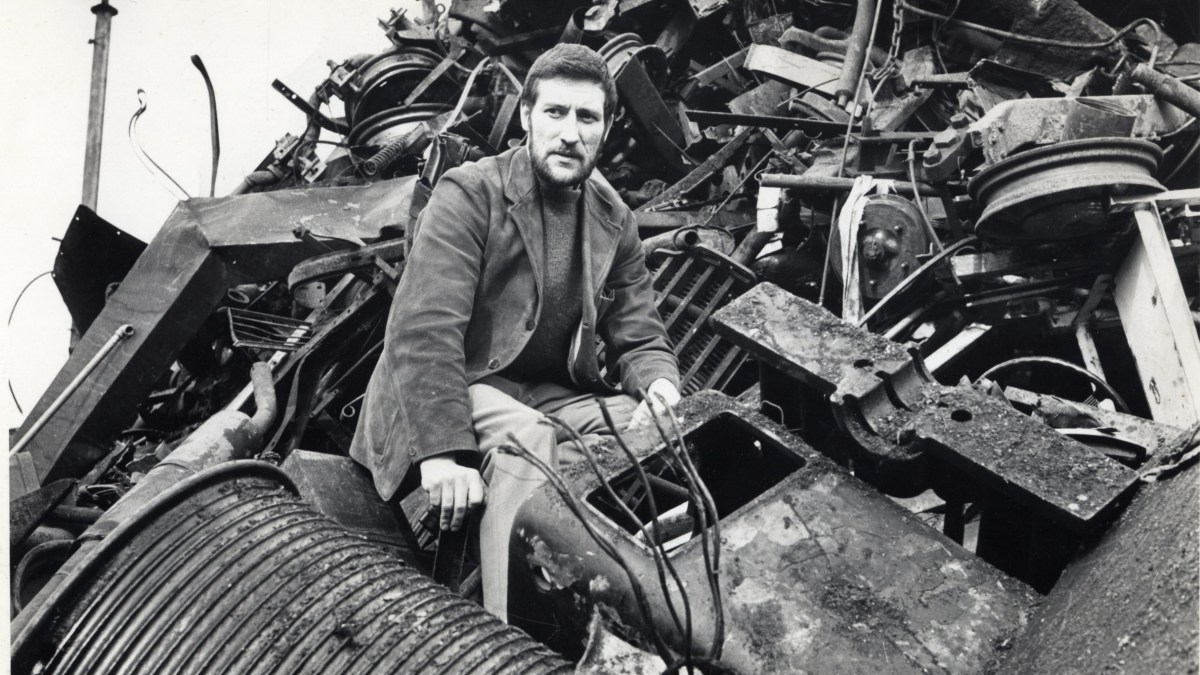
At the time of his first solo show at the Laing Art Gallery in Newcastle (1964), Lawson was established as one of the emerging generation of “neo-brutalists”. His work, largely in welded and distressed scrap metal, was non-figurative, inspired by Auguste Rodin’s definition of sculpture as “the art of the hole and the lump”. He would rummage through scrap yards, find enamelled oven shelves, car bonnets or metal pipes and take them back to the studio to weld, hiring a man with a horse and cart to transport the pieces.
By the 1970s, however, Lawson began to believe that such work was not signalling anything but itself — it was art for art’s sake. His focus had returned to woodcarving and he began exploring religious themes with a strong moral content. Much of his later work was concerned with what Robert Burns termed “man’s inhumanity to man”.
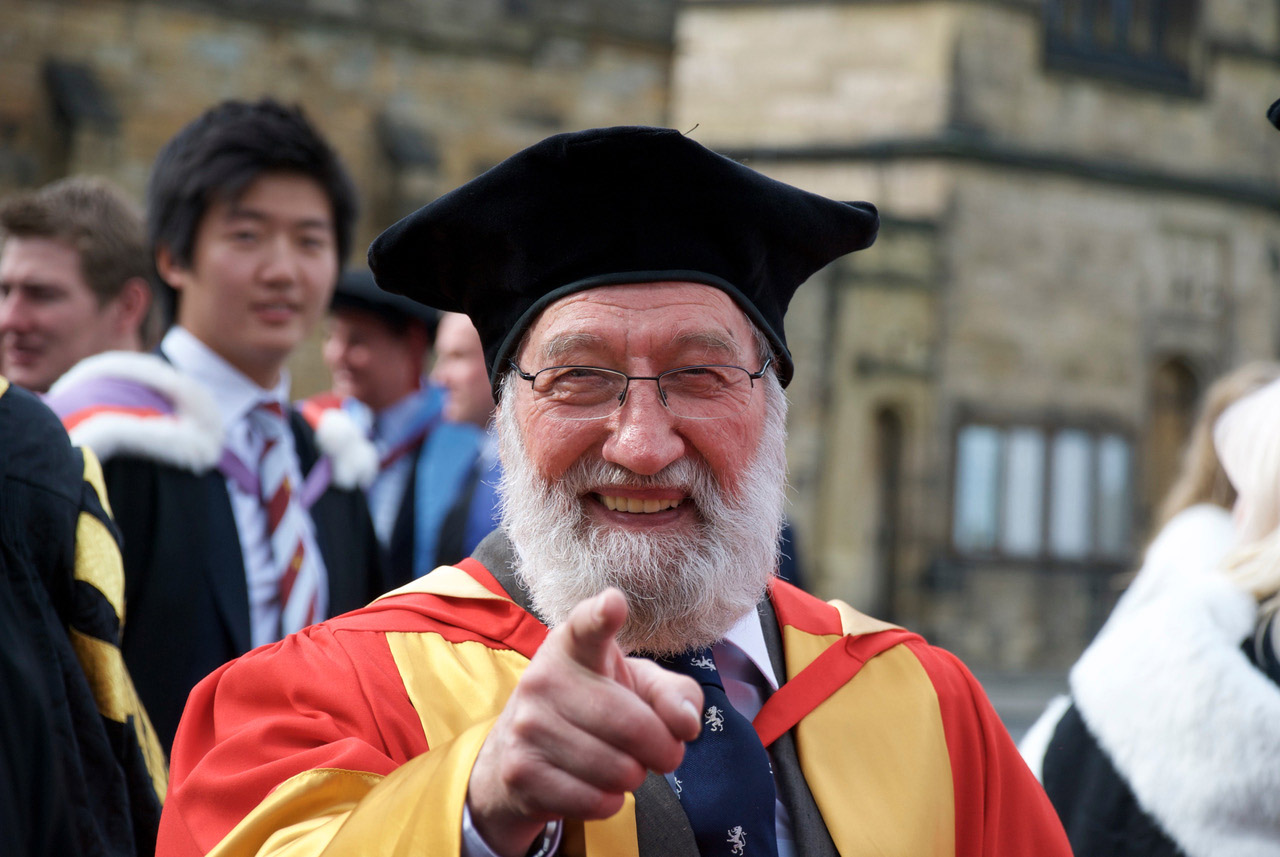
Lawson being made an honorary doctor of letters by Durham University in 2008
TERRY HARVEY
Most of Lawson’s work was created in his cottage high above the banks of the Wear. Joan’s loft, in which she made handmade quilts, was just below his studio — she liked to keep an eye on him while he worked with dangerous equipment. Wood was expensive and his family would come home to find doors missing, the risers cut out of stairs, plaster stripped from the ceiling — any material Lawson could get his hands on. The brass on the Durham pietà came from a coal box that had been on their fireplace. He bought another identical one and swore that it was the same. “He was a wonderful nightmare,” recalled his daughter, Anna, an artist, writer and poet. She survives him with Joan and three other children: Gerard, the principal landscape architect for Durham county council; Justin, a GP and a fellow of the Royal College of General Practitioners; and Greg, a violinist, composer and conductor.
Lawson was closely tethered to his birthplace and many of his most thoughtful works appeared in Durham. He preferred his sculptures to be in public positions — not on a plinth but at ground level, so that those passing by could engage with them. As well as the pietà he produced altars, stained glass windows, lecterns, baptismal fonts and processional crosses, and he regularly collaborated with architects.
Many of his best-known sculptures were depictions of the great Northumbrian saints, Cuthbert and Bede. There was the sombre wooden sculpture of monks carrying Cuthbert’s coffin in the parish Church on Holy Island, or the 6ft bronze version in Millennium Square in Durham. The Journey featured six monks carrying the body of St Cuthbert as they fled from the island of Lindisfarne during a Viking invasion, eventually ending up in Durham towards the end of the tenth century.
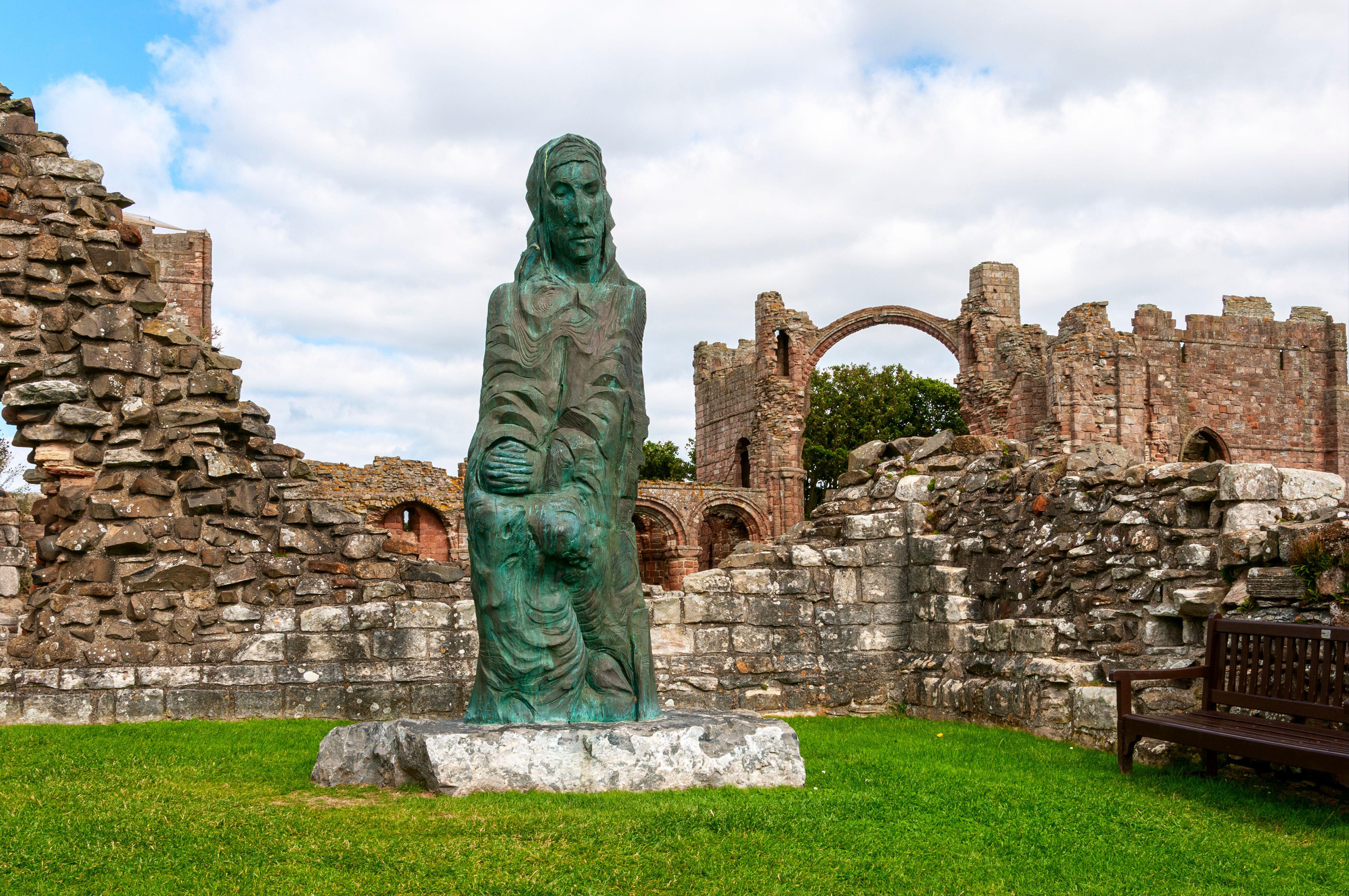
A statue of St Cuthbert at the outer court of Lindisfarne Priory
ALAMY
When it was unveiled by Princess Anne in 2008, the 76-year-old sculptor said in an interview with the BBC that he saw it as “a kind of baby. The piece has been born in privacy, and carved in the quiet of the studio… To some extent it’s being exposed and that exposure is a little bit nerve-racking.” By 2015 that quiet had been spoiled by the sound of rowdy students and the sculpture, much to Lawson’s horror, was regularly desecrated with vomit and urine. A petition to have it moved to the nearby cathedral came to nothing.
The Journey also reflected the way that Lawson’s mining ancestors would have had to carry each other after disasters down the pit. Once asked why he never produced sculptures of miners, Lawson responded that any one of his pious figures could stand for a miner. “Humanity is my theme,” he said.
Fenwick Lawson, sculptor, was born on May 19, 1932. He died on January 23, 2026, aged 93