
Photograph courtesy Lilias Folan
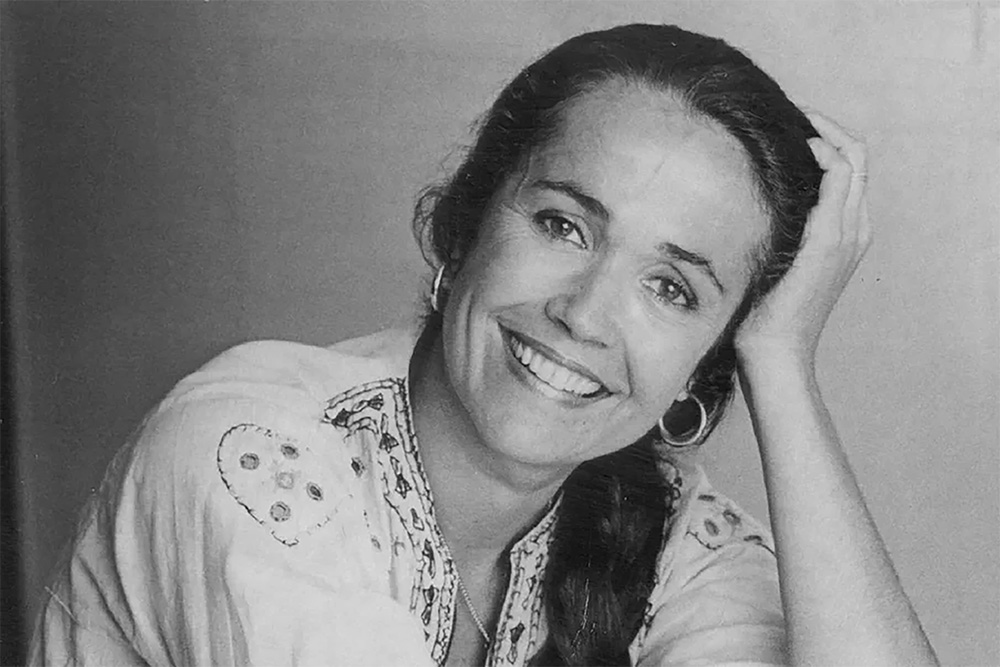
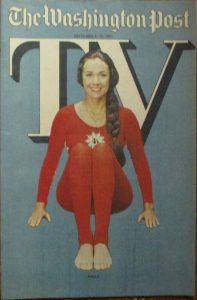
The First Lady of Yoga. The Julia Child of Yoga. The Johnny Carson of the Yoga World. Lilias Folan—an Indian Hill mother of two, artist, and former fashion model—earned these monikers from a bare-bones sound stage on Chickasaw Street in Clifton Heights in the 1970s. Starting at public broadcast station WCET, then spreading nationally in an astounding breakout, the thirtysomething with a trademark side braid became so famous for her exercise show that when one fan addressed a letter to “The Yoga Lady, Cincinnati, Ohio” in 1974, the Post Office knew to exactly where to deliver it, along with the 100-plus letters Folan was receiving each week.
Thousands of Cincinnatians recall clearing space in their living room to sit in lotus position and then stretch like a cat, guided by the friendly, limber woman in matching leotard and tights speaking directly into the camera. With only six TV channels in the city until 1981, you couldn’t not encounter Lilias, Yoga and You. The original Channel 48 series aired daily before Sesame Street, so lots of kids rolled around on the floor alongside their moms as they waited for Kermit and Cookie Monster.
Folan’s folksy, unscripted show birthed broadcast yoga as we know it. Psychology Today estimated her audience at a million people a day. She twisted into elegant positions on The Today Show, The Mike Douglas Show, and The Phil Donahue Show. She wrote three books. She penned a newspaper column and was paid to promote a mattress brand and office chairs. In the 1979 film Being There, she inspired Peter Sellers to attempt a headstand.
In addition to some 500 episodes of her show, Folan also released videotapes for newfangled gadgets called VHS players. In the 1970s and ’80s, no one was more instrumental in turning Americans on to yoga.
Photograph courtesy Lilias Folan
Folan taught classes and workshops well into the 2010s, but if her name is new to you, it’s in part because she never got her full due. The 2009 book Yoga in America makes just three passing mentions of her in its 300 pages. A 2024 article in The New York Times refers to her as a “housewife,” an oft-repeated dismissal of her in the press.
Folan herself didn’t let worldwide recognition—or later, lack of it—go to her head. Her comfort on the roller coaster of celebrity was akin to her preternatural ease with the camera. She was a natural with warm magnetism. “I really tried not to dance with fame,” she says, still radiant at 90 years old, now residing in a Loveland assisted living facility.
Folan is seated in comfortable clothing on a couch in her small apartment, next to a stack of spiritual books: Universal Mother, Reach and Receive, and the Bible. She’s enjoying a favorite lunch of Skyline chili.
She is tall and lean, with short white hair, a prominent forehead and chin, and warm brown eyes. Folan wears her wedding band along with other rings and a few necklaces. Her landscape paintings of Martha’s Vineyard hang on the walls, and a dresser hosts a shrine for Christ, Buddha, and her personal guru, Sri Swami Chidananda.
“I had the experience of being known all over the world,” Folan says between bites of a coney. “I had to look at fame and understand it. I try to avoid the word proud. I’ve always known I was put on this planet to do this sharing and this journey. I learned to think of myself as an instrument.”
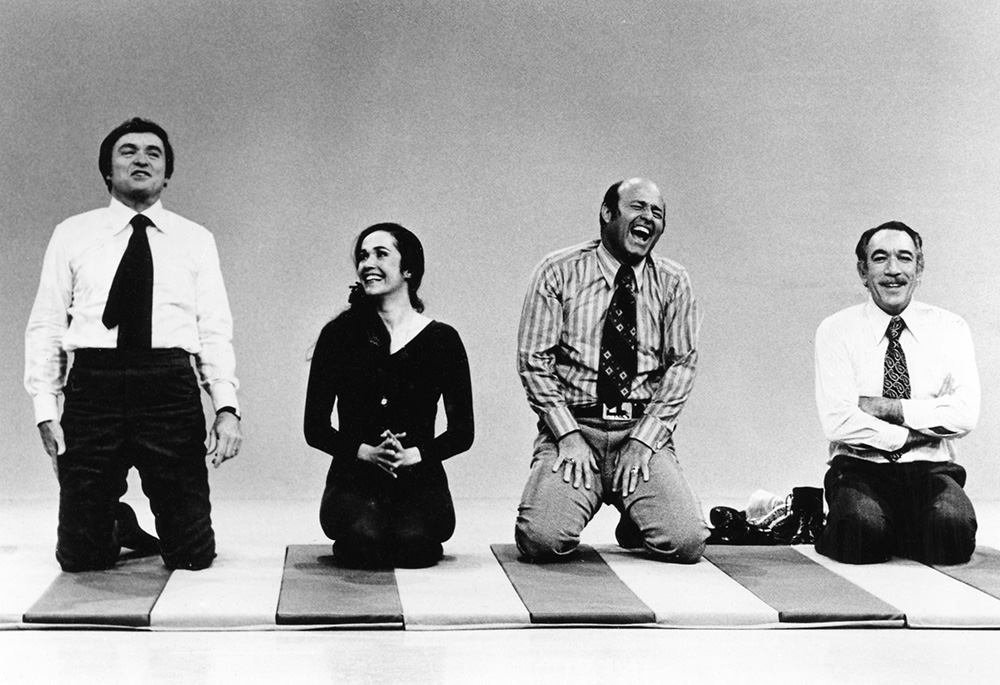 Lilias Folan helped popularize yoga in the 1970s and ’80s via national TV appearances (with Mike Douglas, Joe Garagiola, and Anthony Quinn)
Photograph courtesy Lilias Folan
You know yoga. Everyone and his goat has done it. In addition to the main forms taught today—vinyasa (a.k.a. flow), iyengar (poses held for long durations), kundalini (life force energy, or chi), and hatha (a mix of everything)—you can also find hot yoga, aerial yoga, and naked yoga. Take your pick from the 100 or more spots around the Cincinnati region at which to imitate a tree and chant “Om.”
Still, the definition of yoga is murky, even controversial. When the practice originated in India several millennia ago, it wasn’t conceived to tone your abs. It was a part—some say a minuscule part—of a spiritual path, devised so that sitting for long periods of time in meditation wouldn’t be uncomfortable. The word derives from the word for yoke or union. “You don’t do yoga to get a hot body,” one teacher likes to say. “But if you do yoga, you get a hot body.”
Yoga came to the U.S. from India a century ago and took off in earnest during the counterculture 1960s and ’70s. A number of tradition-bound coteries freaked out, fearing it was a cult. Outside one of Folan’s early 1980s workshops in San Francisco— she traveled frequently for live appearances—protesters picketed with signs that called the practice “the work of the devil.” The Folan family had to un-list its home phone number due to harassing calls and even death threats.
Even today, some Christian congregations—including Cincinnati’s own growing megachurch, Crossroads—warn against the otherworldly allure of yoga. “I will not follow teachers who try to lead me into meditation and their own spiritual practices while doing yoga,” writes Alli Patterson, leader of Crossroads Women.
Lilias Antoinette Moon never set out to become famous or to ever have an occasion to stand on her head. A “Boston Brahmin” born to wealthy jet-set parents, she came out at a debutante ball at the chichi 21 Club in New York City. She had artistic and athletic talent, but she was also a classic poor little rich girl.
“My bringing up was very, very difficult,” she says. “I was given away as a kid. They didn’t care.” Her socialite mother married five times in 10 years. From age 9, Lilias and her older brother were shipped off to boarding schools and summer camps. “One of the most difficult things I had to face is I was not wanted on the planet. It was painful.”
She studied art and photography at prestigious Bennington College in Vermont. Then she flew to Italy to study “Italian art and Italian men, in that order,” she quipped to one reporter. She visited a lot of churches but had no revelation as to what to do with her life.
Running out of money, she moved to New York City and did some modeling and worked in publicity at Vogue magazine. Shortly after, she was introduced to Bob Folan, an executive at a transportation company, nine years her senior. Lilias married him three months after their first date. “The universe gave me a wonderful lover and friend who really helped me ground myself,” she says, smiling and closing her eyes at the memory. “He was practical, and I wasn’t.”
The couple relocated to southwestern Connecticut, moving between coastal cities just north of New York City. They had two boys in quick succession. Lilias showed her art in a couple of galleries, but the transition to full-time mom was tumultuous.
“I woke up one spring morning…with a profoundly disturbing thought: I have everything. I have a kind and loving husband, two handsome, healthy sons, a white house, two cars in the garage, a boat on Long Island sound, and a golden retriever. Yet I am not happy. Why?” she writes in her second book, Lilias: Yoga and Your Life. So she started “working on myself: marital therapy, parenting therapy, sex therapy, mother-daughter therapy, workshops to heal the inner child.”
There were physical ailments, too: headaches, backaches, insomnia, a lack of energy. Her doctor couldn’t find anything amiss medically; what sounds today like postpartum depression was, at the time, brushed off as “the blahs.” His Rx: Find an exercise program and lose some baby weight.
Folan read a book called Yoga, Youth, and Reincarnation, a 1965 treatise by Jess Stearn. Further inquiry, she’s said, taught her that yoga is not “eating nails or extra sensory perception, and it has nothing to do with astrology.” Intrigued, she found a class at her local Y, then sought more in-depth fare in Manhattan. “There were gurus who came in,” she says of the Indian swamis who were starting to tour the U.S., such as the Maharishi Mahesh Yogi. Teacher training wasn’t offered at the time. “It was more like sharing,” she said of the classes she took.
She started to discern what she did and didn’t like about the instruction. “In the ’60s, the yoga classes were quite different than they are today,” she wrote. “There might have been 50 students on an outdoor platform and we were all doing the same yoga postures the same way. Ages 20 to 80, all different sizes and shapes and many different fitness levels. Yet we were not offered any variation in the way we did our postures. Only a few cautions were spoken.”
Besides clearing up her physical woes, yoga provided something deeper Folan yearned for: ritual. “The root of that word is rita, which means that which brings art and order to the moment,” she says. “I love that.”
By the late 1960s, yoga was wending its way from American cities into suburbs and beyond. Sri Swami Chidananda, president of the Divine Life Society, an Indian ashram with international outposts, would become Folan’s lifelong mentor. Unlike a surfeit of Indian gurus who would eventually attract a celebrity following, drive Rolls Royces, and/ or be accused of sex crimes, Chidananda has survived history with his reputation intact.
“I got alarmed when she really got into it,” Bob Folan told The Cincinnati Post newspaper in 1992. “It was unconventional, and she hung around with all sorts of crazy people. I was afraid, I suppose, that she was getting involved in something I didn’t understand.”
Folan was a serious student. She plunged into the physical, mental, and spiritual aspects of yoga. In time, Native American rites, dancing, and singing would make it into her more intensive workshops. She made two trips to India, where she was told, We here in the East have taken yoga as far as we can go. Now it’s up to you in the West to take it like a ball and run with it.
Instinctively, Folan knew to leave the more esoteric aspects of her practice at home. Chanting and meditating wouldn’t become a part of her classes, at least at first. In interviews she stressed that she was not only still a Christian but yoga helped her better understand Christ’s teachings.
Folan’s classes were a hit. She found her “center” through it all to carry on raising her kids and hosting dinner parties that ended with charades and dance parties. It was all hunky dory until Bob threw her a curveball: He’d gotten a promotion at work, and the family was moving to Cincinnati. She didn’t want to go. “Bob said you could see my heel marks in the dirt all the way from Connecticut,” Folan says, laughing.
Longtime friend Anne Zaring says, “Lilias was reluctant to come to Cincinnati and leave her yoga students. Bob asked my husband to call her to tell her how wonderful Cincinnati is. We had them over for dinner and had a nice conversation. It helped her turn the corner, because she didn’t know Cincinnati or anyone.”
Skyline helped, too. It was love at first bite.
After settling into a plush home— five bedrooms on an acre and a half—Folan taught yoga classes at churches and YMCAs and quickly built a following. “She geared it toward the students,” recalls Barbara Chaney, who took a class in her teens along with her mother. “My mom’s knees were too bad to get on the ground, so Lilias was very accommodating for students who needed chair yoga. You could do the class even if you couldn’t get on the ground.”
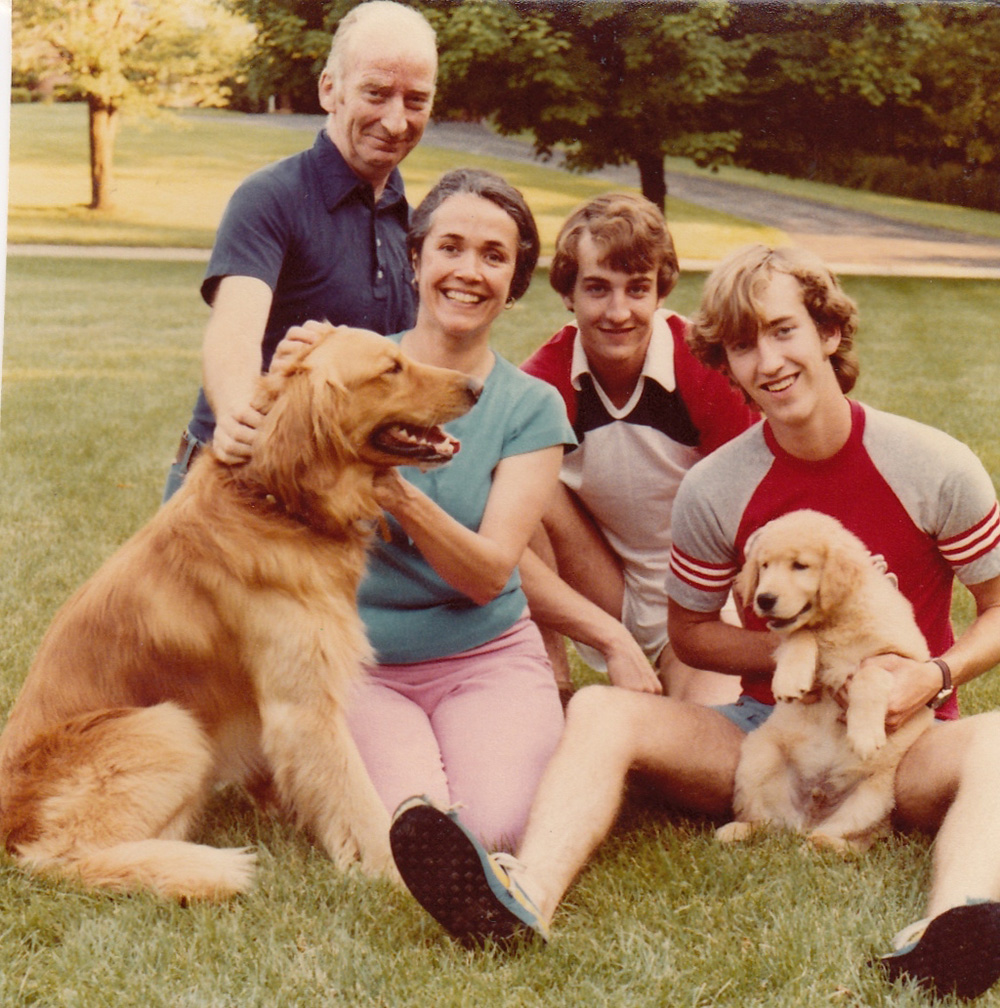 Lilias’s family in Cincinnati (husband Bob and sons Matt and Michael).
Photograph courtesy Lilias Folan
Another student, Merle Goorian, was so impressed that she suggested to her husband, TV producer Len Goorian, that Lilias’s class could translate to a TV show. A star was about to be born. “After a while in the business, you know when something is right,” Len told The Cincinnati Enquirer in 1988. “[Folan] was physically very attractive, very intelligent, and she had a very natural personality that just came through.”
Still, the concept of a TV series centered on a woman with zero broadcast experience was a stretch—no pun intended. There had only been one syndicated yoga show on the air to date, out of California (Richard Hittleman’s Yoga for Health). Goorian struck out pitching the show to the local network affiliates but found a taker at WCET.
“It’s what I was born to do,” Folan says matter-of-factly, finishing up her lunch. As her son Matt clears up, she asks coyly if there might be some rum to add to her pop. There isn’t, but I make sure to bring a bottle of chardonnay to our next visit.
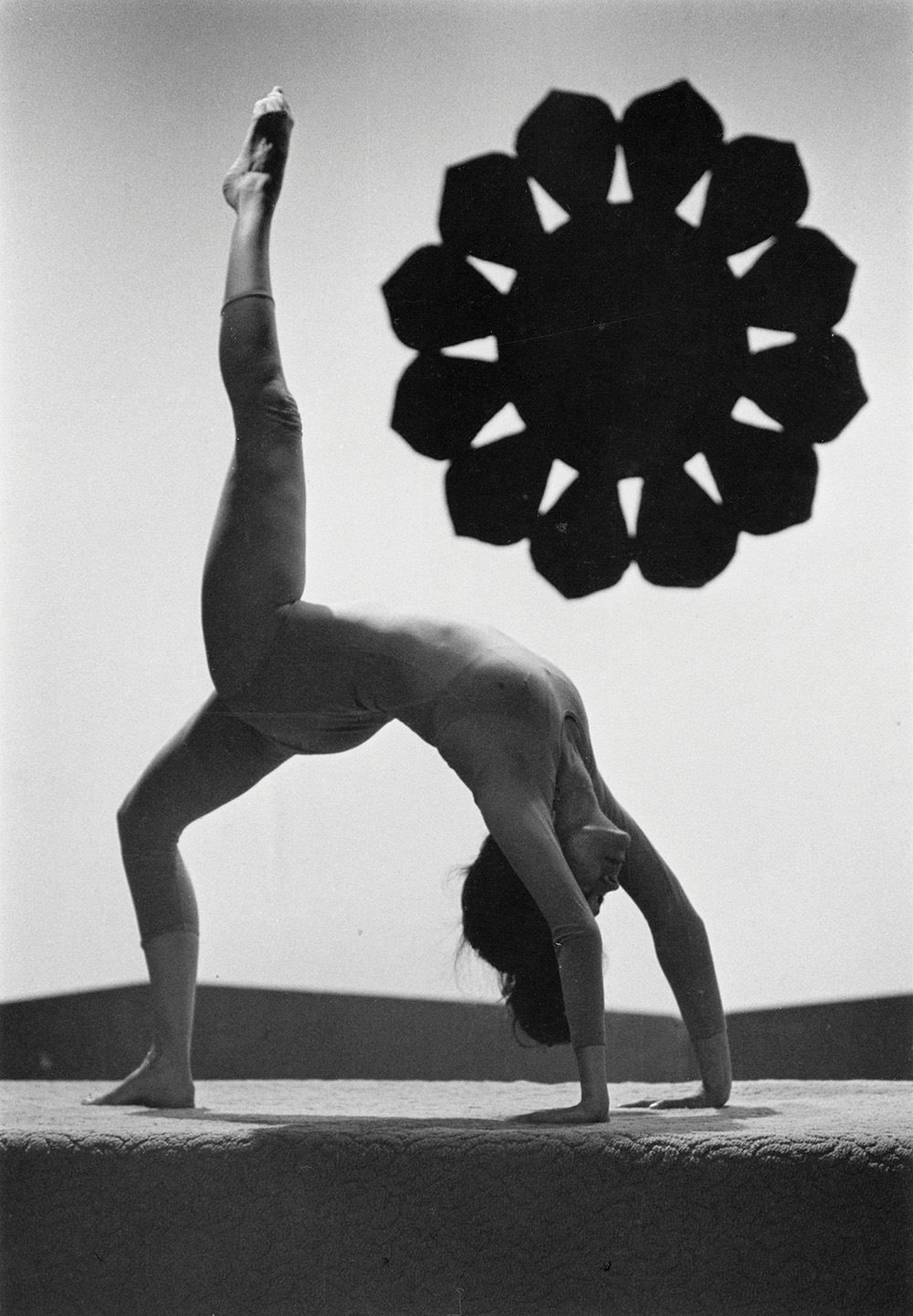 Folan on her show, “Lilias, Yoga and You”
Photograph courtesy Lilias Folan
What strikes you about Folan’s TV show episodes going back 50 years—there are dozens on YouTube—is not so much how dated they look as how contemporary they can seem. Though slower in pace than most current online shows, such as Yoga With Adriene, the routine is similar to many beginner courses.
Folan’s method has never been about a hard body or one-handed handstands; it was always about de-stressing and looking inward. “If I could give you one tool, just one tool, it is how to relax,” she says at the top of one show. “It is something that’s learned. It is a thought process. It takes some time.”
Self-observation, she has written, is what separates yoga from purely physical workouts. For millions of viewers, Folan was a companion as much as a teacher. “We overrate some people who are able to make things accessible in simplistic ways,” says Rob Dorgan, an author, yoga instructor, and lifelong fan. “But when their legacy endures, there’s something more there.”
Lilias became an honorary family member to Cincinnatians along with Uncle Al, The Cool Ghoul, and Hattie the Witch. Unable to confine her guidance to the studio, she would often approach someone in an airport or in line at Kroger and gently modify their posture or suggest a pose to alleviate some obvious discomfort. “I just can’t help myself,” she says, shrugging.
Lilias, Yoga and You was a refreshingly unpretentious respite from the limited TV fare of soap operas and laugh-track sitcoms. Looking like the cool girl next door, she dispensed mind exercises along with the physical: “Who am I?” she asks earnestly in one episode. “Why am I here on this Earth? Do I indeed have something to do on this planet?”
Lilias, Yoga and You was the first successful yoga show on public television, according to its director, Taylor Feltner. “She pretty much created the mass market for yoga with the show,” he says. “Somebody came back from Japan and said they saw a Lilias show broadcast in Tokyo.”
The show ran for a full 15 years, in part because stations had hundreds of episodes to rebroadcast. In 1985, “only” 40 stations signed up for new episodes, Feltner remembers. Lilias, undeterred, announced in press interviews that she sought an underwriter. “When PBS station executives came to Cincinnati for an annual meeting, she solicited underwriters and gave the execs stretching seminars,” says Feltner. In 1987, with a set updated with potted plants and the addition of voiceovers, she launched Lilias!, which kept her guiding exercises on TV until 1993.
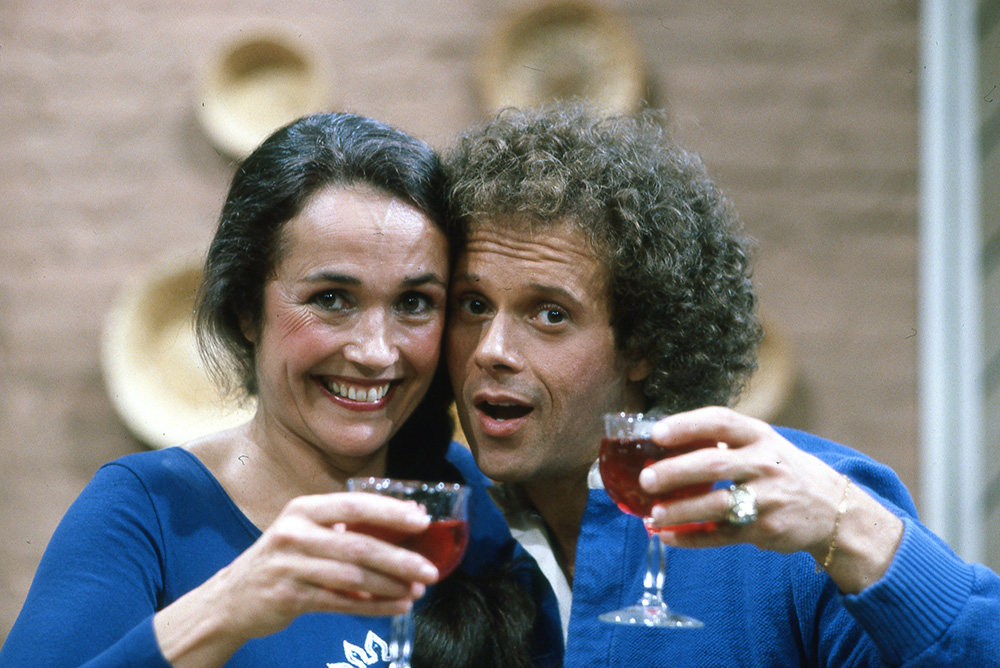 Lilias with Richard Simmons
Photograph courtesy Lilias Folan
Folan’s schedule for workshops and appearances was booked for an entire year in advance. She conducted yoga cruises, consulted for corporations, and led workshops in places as far-flung as Australia and Russia. “My dad was her assistant,” says Matt Folan. “He had a little company with a secretary and two employees. He managed everything for her out of his office.”
Bob didn’t do yoga; he preferred hunting. Neither of Lilias’s sons were into it either. “Was it a moneymaker?” Feltner asks. “Not really. It covered its own costs and made a little money for the station.”
Folan’s motherly style of yoga contrasted with the high-energy pace and body-consciousness emerging in 1980s fitness trends such as aerobics and Jazzercise. American culture was on steroids, as the expression of that time suggests. Exercise goals were more “buns of steel” than baddha konasana. The ’90s further intensified workouts with hot yoga, power yoga, and Madonna standing on her forearms.
Folan’s public persona receded along with her yoga-for-all ethos. Celebrities started to cash in; Jane “Feel the Burn” Fonda came out with her own yoga video in 1993, appearing on its cover wearing a single braid in her hair.
Just before turning 70, Folan published her final book, Yoga Gets Better With Age. It was 2005, and yoga was starting to come full circle. The physical and mental benefits had been medically proven, and more diverse demographics and institutions continued to take it up. Schools have tapped its power to calm jittery kids.
Lilias, ensconced in her sunny home, doesn’t do workouts any longer. But mindfulness is her first activity each day. “My practice right now is to be grateful,” she says. “Life’s been challenging, and it can be very challenging to find gratitude. I lost my sweet husband of how many years. But I’m not gonna run from it. So before I get up, I sit in the bed for a moment”—she nods to her bed, across from her couch—“and I really do pause. I breathe for a bit and focus on the breath and I find the feeling of, I am grateful for this moment.”
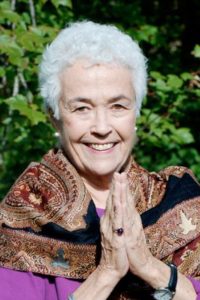 Lilias Folan today.
Photograph courtesy Lilias Folan
Folan’s legacy lives in the thousands of students and instructors who carry on her unique approach to well-being. “She has had a profound effect,” says Katy Knowles, who owned and ran four area yoga studios at which Lilias taught until 2015. “I’m tearing up. I would not be the person or teacher I am if it wasn’t for her.”
Adds Dorgan, “I am at the altar of Lilias. She was able to make yoga very accessible to a lot of people. Her background is deep and intense with all these big yogis, but she always made it something we could touch.”
Lilias continues her spiritual studies, as the books on her couch attest to. “A teacher is just a grown-up student,” she says. She intends to continue to on her path in the afterlife. “It’s not about believing it,” she says of life after death. “Belief is what one thinks. There is an afterlife. I know it in my whole body.”