
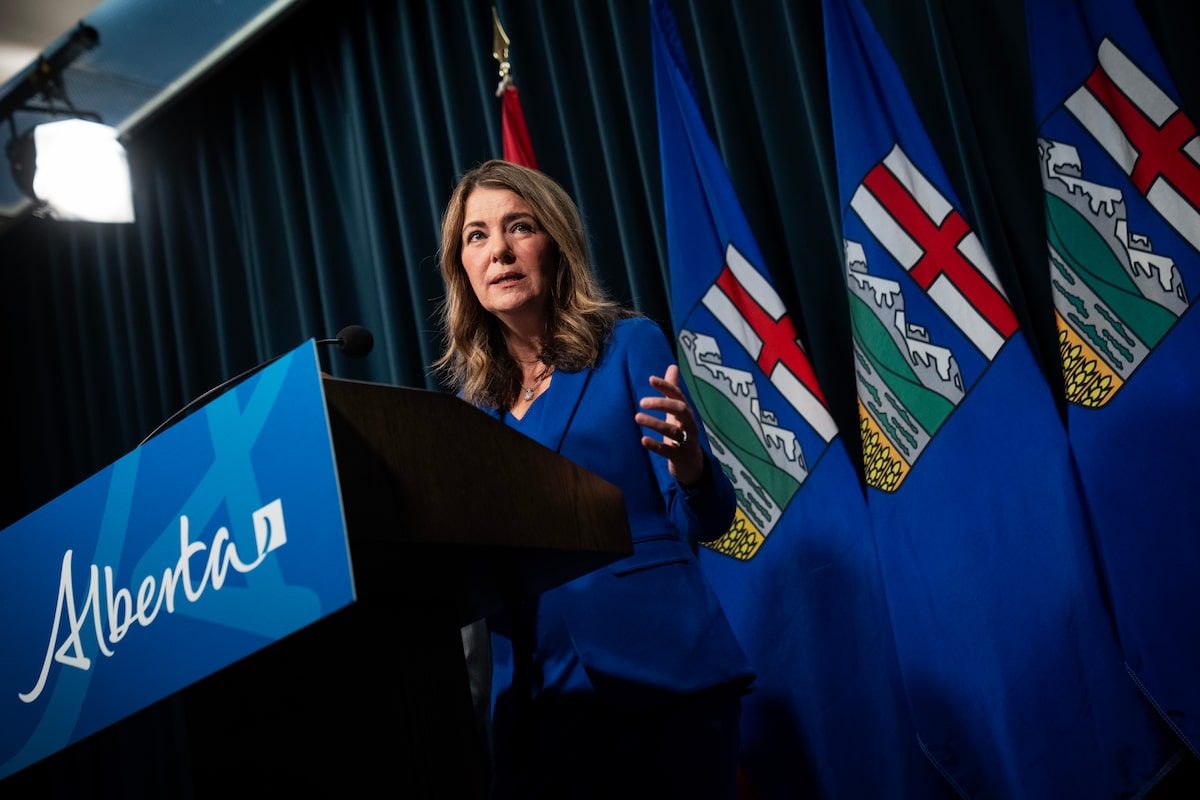
Alberta Premier Danielle Smith answers questions at a news conference in Calgary, Feb. 20.Todd Korol/The Canadian Press
Alberta Premier Danielle Smith has partly pinned her province’s fiscal troubles on unfettered immigration allowed by Ottawa, but the provincial budget doesn’t clearly show how the province’s rapidly growing population pushed it into deficit.
With Alberta’s resource rollercoaster pointed downward, provincial Finance Minister Nate Horner on Thursday tabled the budget with a $9.37-billion deficit alongside minimal cuts, record spending and few measures to shore up revenue. He acknowledged that the province’s financial future still largely depends on the price of oil, over which it has little control.
Immigration is scarcely mentioned in the budget, but it paints Ottawa’s severely curtailed policies on bringing in newcomers as “a significant drag on the economy,” noting Alberta is expected to shed 30,000 temporary residents in 2026, down from the net gain of 21,500 in 2025.
Slower population growth “will lead to more moderate growth in consumer spending and the demand for services in the province,” says the document.
In Alberta’s latest population update, the province gained a net 179 international migrants while also receiving nearly 2,000 people from Ontario and more than 1,000 each from Saskatchewan, Manitoba and Atlantic Canada.
Alberta Budget 2026: Province paints rosy oil price forecast despite resource-driven shortfall
Last week, Ms. Smith said depressed oil prices and the strain on education and health by newcomers were joint issues to blame for Alberta’s financial troubles – an argument she is using to set the stage for a fall referendum on immigration policy.
Those referendum questions propose limiting services to Canadian citizens, permanent residents and “Alberta-approved” immigrants, and requiring non-permanent residents to live in Alberta for a year before being able to access public social-support programs. It also proposes charging non-permanent migrants fees for using the health and education systems.
Despite slower growth, Alberta is coming off a multiyear population surge unlike any it’s seen over the past century, which was welcomed and encouraged by Ms. Smith at the time, who aspired to see the province reach 10 million people by 2050. The province continues to advertise itself as a destination with its still-active Alberta is Calling campaign, while Ms. Smith in 2024 wrote to then-prime-minister Justin Trudeau asking for greater allocations of newcomers who wished to become permanent residents.
Opinion: Smith and Poilievre find someone to blame for their problems: immigrants
The number of new residents, however, has forced the province to adapt its services while also providing a sudden boost to personal income-tax revenue. Population growth peaked in 2024, and the Premier has said classrooms and hospitals are overflowing partly because of the influx.
This year’s budget earmarks $34.4-billion for health care and $10.8-billion for education, both of which make up more than half of the province’s expenses.
The Alberta government has offered limited clarity on non-permanent residents’ cost to its systems.
Mr. Horner on Thursday said he didn’t have a breakdown of how much newcomers cost Alberta’s bottom line.
“I think we’ll comb through the data in a lot greater detail in the days and months ahead, but I don’t have a specific number.”
Last week, Ms. Smith estimated it cost Alberta roughly $500-million to have the children of temporary residents in its kindergarten to Grade 12 system this year, and the province estimated health care costs, excluding those tied to hospitals, clock in at $100-million annually for non-permanent residents.
The province did not respond to a request on Friday for an explanation on how those numbers were calculated.
Opinion: Referendum uncertainty risks undermining Alberta’s economy
Speaking at the Calgary Chamber of Commerce on Friday, Mr. Horner said it takes time for the province to absorb such a large number of newcomers.
Rapid population growth over a handful of years “can really cascade,” Mr. Horner told Chamber president Deborah Yedlin in front of an audience of Calgary business leaders.
Ms. Yedlin, when asked afterward whether population growth is one of the biggest strains on Alberta’s finances, said: “No.”
Alberta’s aggregate population growth over the past decade has been less than two per cent – lower than the decade prior, Ms. Yedlin added.
“The reality is it is lumpy. People come at different times in the economic cycle, but if you look at it as a continuous distribution, it means that you have to continuously invest in the things we need,” she said.
Trevor Tombe, an economics professor at the University of Calgary, said he finds it unlikely this year’s $1.9-billion boost to health care spending is a response to population increases because young families tend to be a key part of the population boom, adding that Alberta has among Canada’s youngest population.
Dr. Tombe said Alberta’s 2021 estimates for the number of people living in the province aged 65 and older – those most likely to need health care – by 2026 were largely on target.
“That rise in spending – because it’s dominated by health – can’t be directly connected to the population dynamics we’re seeing,” he said.
Last summer, Dr. Tombe sat on the Alberta Next Panel, which circulated the province to take residents’ temperature on how it could change its relationship with Ottawa. Ms. Smith, who chaired the panel, has said her government’s referendum questions on immigration were borne largely from what she heard on that tour.