
Published February 27, 2026 10:52AM
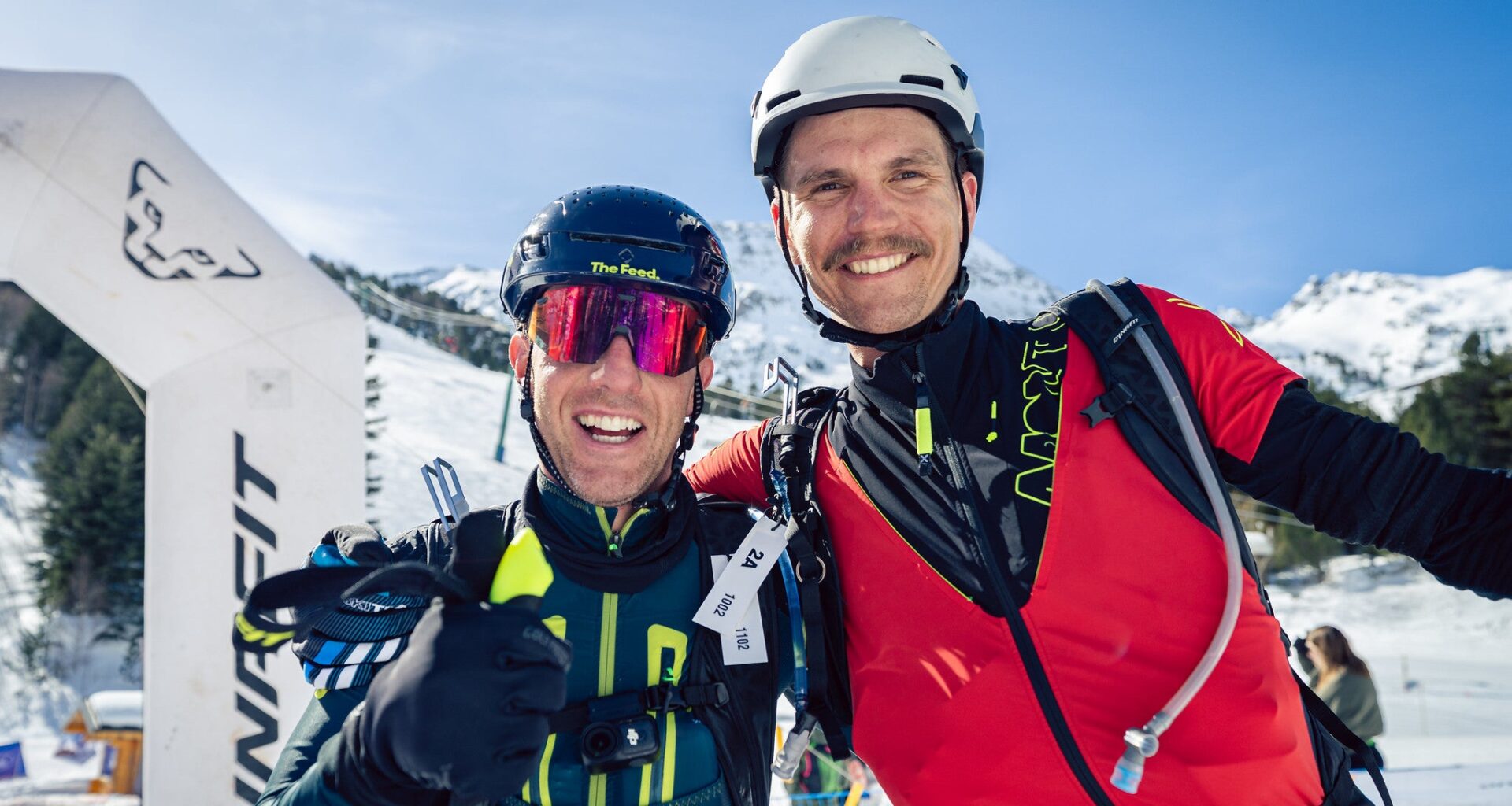
“I can’t find my fucking ski!” I yelled down to Amund Jansen as I roamed aimlessly through the snow at 2,600m above sea level. I had just crashed hard on the final descent of the first stage of La Travessia dels Refugis, an ISMF (International Ski Mountaineering Federation) Europe series race in the middle of the Pyrenees. My ski had shot off, and both my race partner, Amund, and I looked down an expanse of white disrupted only by a few outcroppings of rocks and the tops of trees; we couldn’t see anything resembling it. As I plodded around in a fruitless attempt to find the 64mm wide and 164cm long piece of hot-pink and black colored carbon, I began to think, maybe I should rename this calendar “Way to Fail at Everything.”
A week earlier, I had literally found myself eating shit and getting pummeled by the best gravel riders in the world in Girona, Spain. Now I found myself aimlessly wandering around the peak of a snow-covered mountain in Andorra, getting humbled by another international field in a completely different discipline.
“I guess you should start walking down,” Amund said as he began to pull out his avalanche shovel to see if the ski had been buried somewhere. I did, and as I stumbled, sank, and trudged through deep snow toward the finish line 3.5km below, under bluebird skies, I thought to myself, how the hell does a guy from Ottawa end up here?
Andorra
As a country, Andorra is an anomaly. Don’t feel insecure if you have never heard of it. The only reason I knew of the place before I first visited it in 2016 for an altitude camp was that I played a random geography game in college and became weirdly interested in microstates. The size of Andorra is 468 km², while the size of Ottawa, the city I grew up in, is 2,779 km². Sandwiched between France and Spain, the country is a pinprick on a map in the heart of the Pyrenees. To a person from the Ottawa Valley, nothing about the country makes sense. There are no freeways, unless you are on the peak of a mountain; you never see the horizon, and towns and dwellings seem to be either hanging from cliffs or jammed into any semblance of flat terrain.
The country is a place of contradictions. Its rugged beauty, the dominance of ski resorts, high altitude, and vast trail networks make it a playground for the physically fit. However, its low tax rates and affinity for cigarettes and cheap booze have also given its largest city (Andorra la Vella) the air of an airport duty-free shop. Like moths to the flame, smugglers, smokers, and alcoholics come to Pas de la Casa, the highest town in the country—and closest to the French border—to fill up their cars with cheap gas and buy cigarettes for 30 cents to the euro.
For the aforementioned reasons (taxes, high altitude, and epic riding), the tiny country has become home to countless athletes and a large percentage of the professional cycling peloton. I’ll sometimes find myself looking out my back window only to see Tom Pidcock shredding down the trail adjacent to my house. At the grocery store, I will be waiting in line as Pauline Ferrand-Prévot checks out in front of me. Randomly, while dropping my kids off at a summer camp two years ago, I ran into MotoGP star Aleix Espargaró, who was also in cycling kit, so we rode the classic five-hour “Three Nations Loop” — a loop that takes you across both the French and Spanish borders of Andorra — together. Growing up, I didn’t know a single professional athlete or Olympian. It wasn’t until I started to excel in running that I began to meet and brush elbows with those I aspired to be, yet even at school drop-off in the tiny parish of Canillo, population 4,000, I will bump into athletes of this caliber.
So, naturally, it was during school drop-off that the idea for the first major challenge of my 2026 calendar took form.
Amund
For the better part of two years, I have crossed paths at school drop-off — more than I should have — with Amund Jansen. A Norwegian polyglot and former rider for Jumbo Visma, Jayco-Alula, and Uno-X, Amund’s last four years in the pro peloton represent how fine the line is between success and failure that pro cyclists walk. Had the wind blown a different way on a certain day, or had I not connected with the right person, I know there is a strong possibility I would not have become a pro cyclist. Had Lars Petter Nordhaug not crashed before the 2011 Vuelta, Chris Froome, the greatest grand tour rider of his generation, would not have been selected for the team, he would not have had his breakthrough performance (finishing second overall at the race), and he likely would not have been re-signed by Sky.
By the end of 2020, at just 25 years old, Amund was on track to become a marquee rouleur in the pro peloton. He had won some big races, including being part of the Tour de France TTT-winning Jumbo Visma, and had signed a good contract with Team Bike-Exchange; however, a tightness in his right hip was starting to hamper his pedal stroke. Relative to other endurance sports — especially running — there are few overuse injuries in cycling, but the Tommy John equivalent in the sport has to be iliac artery endofibrosis (IAE). It is the boogeyman of the pro peloton. Hard to diagnose and gradual in its onset, the injury is caused by a narrowing and thickening of the iliac artery due to the impingement of the hip from the unnatural motion of pedaling a bike for a thousand hours every year. Mentally, IAE is a mind-fuck. Those who have the condition describe an inexplicable loss of power and cramping in their legs. Prior to diagnosis, riders often start thinking they are not fueling properly or that they are a head case. The loss of confidence alone that comes from this injury can be debilitating and take ages to recover from; so too can the surgery required to repair it. Few pro cyclists have fully recovered from the injury and returned to their former level.
Amund was one of these riders plagued by IAE. Since first being diagnosed with the injury, the former Norwegian National Champion’s palmarès reads as one would expect: a litany of DNFs, unremarkable results, and sparse race days. Add to this the fact that he also fathered three kids in the last five years and was therefore subjected to all of the same germs that I have been battling for the past half-decade, and more often than not, instead of being at a bike race, between stomach bugs, broken bones, and surgeries, Amund and I would sheepishly bump into each other at school drop-off far more than we would have liked.
Due to the injury, Amund decided to end his career this past season, and although this was not the way or time he had hoped to end things, he is one of the few pro cyclists I have not worried about in post-retirement life. The guy is wicked smart. From investing to linguistics, I have always loved picking his brain while going for a ride. On a recent run on the trail “Gall de bosc” (Catalan for Grouse but literally translated as Rooster of the Forest: I only know this because of Amund), Amund spontaneously took me through the etymological history of the trail’s namesake.
For the first months after my inguinal surgery, I was in a funk. I was not working out regularly, my career ended in the most lackluster manner, and the question of “What am I going to do with the rest of my life?” occupied much of my headspace. What helped pull me out of this was connecting with Amund. After school drop-off, we started going for these quasi cardio, quasi exploratory mountain bike rides. Most of the time, we were underbiked, sprinting up some crazy gradient or riding a line along a cliff’s edge on a trail I never knew existed. A trail run with Amund isn’t just an invigorating jog; it begins out of the gates full gas and is something greater than 15 km on a hardly runnable path, with at least 1,000 m of vertical elevation gain. In short, his style of exercise is a micro-dose of a Shackleton expedition: scary, epic, massively fatiguing, and its completion registers a hit of dopamine, adrenaline, and endocannabinoids that leaves you higher than my bipolar drama teacher when she was off her meds.
This is my favorite style of “exercise.” If my ride, run, or ski takes me somewhere new, pushes my limits, and at one point makes me feel a bit scared, it is a great day out. Only in Andorra could I find a dad going through basically the exact same transition as me at the exact same time, with a VO2 max capable of making me suffer on epic terrain — and as a Norwegian, he could ski.
As part of my “Way to Race” calendar, I wanted to kick off the season at what is known as the “Tour de France” of skimo, Pierra Menta. However, to participate in Pierra Menta, or most iconic skimo races, you need a partner. I had shelved the idea when I first started planning this year, but in Amund, I realized I had found the perfect match.
Skimo
I love ski mountaineering (skimo). Prior to getting into running, I had dreams of moving out west to British Columbia and living as a ski bum. Downhill skiing is something I have always loved to do, but I neglected it for the better part of 20 years. As both a runner and a cyclist, the sport presented too much risk and too much time in the wrong climate. I don’t like to use the word “sacrifice” in association with my former pursuit of being a pro cyclist; however, not skiing came close to feeling like one.
Seeing white-capped mountains during spring races took my mind right out of whatever European road I was fighting for position on, and having my introductions to Chamonix, St. Moritz, and the Dolomites all be during the Tour de Suisse, Tour de France, or Giro just felt wrong. After the 2021 Olympics, I cracked. Elly and I had moved to Andorra several years earlier, but due to the birth of our son, and our daughter soon starting school, we could no longer easily travel to warmer destinations during bad patches of weather, and I was faced with spending the entire winter in the mountains. Knowing that there would be days when I just couldn’t ride due to snow, and hearing that skimo was an excellent form of cross-training, I bought a set of skimo skis.
The sensation of climbing up a mountain outside the confines and crowds of the resort and then skiing back down on pristine ungroomed snow is pure. It’s this sensation that every resort or skiing brand tries to capture and sell to you, but by virtue of being manufactured, it can never truly accomplish. In skimo, I had found my true passion. My winters, after discovering the sport, completely changed. No longer did I look at rain in the forecast with gloom; instead, I would rub my hands in eager anticipation of the fresh powder falling at higher elevations. As I would push myself on the climbs, knowing that the sport would be making its debut in the 2026 Olympics, I would dream of competing in the discipline.
The sport belongs in the games. Relative to other events in the Olympics — I’m looking at you, curling — skimo represents one of the most elemental forms of winter sports. It’s literally about who can get up and down a snowy mountain — or mountains — the fastest. Unfortunately, this year, the iteration that made it into the Olympics is a watered-down version of the sport. The sprint discipline is exciting to watch, but there is no conquering of peaks or testing yourself against the elements. Comparing it to races like Pierra Menta is like comparing a TikTok video to a Paul Thomas Anderson film; both are entertaining, but one actually takes you on a journey. Biased, the sprint version also does not suit my skill set.
Therefore, although attempting to make the 2026 Olympics in skimo was off the table, I still wanted to see what the sport was all about, especially once I started to read about one of the sport’s biggest events, “The Tour de France of Skimo”: Pierra Menta.
Having both won stages at the real Tour de France, Amund and I decided to email the race and see if we could get entry. Fortunately, Sébastien Blanc, the race organizer, is a fan of cycling and got us in. So, there Amund and I found ourselves, entered into arguably the world’s most iconic ski mountaineering race, having never actually done any version of the sport.
Yes, we had done some training sessions together, but to think that those training sessions were anything close to a skimo race would be like a VIP thinking his ride with a WorldTour team on their rest day of the Tour de France was the same as doing an actual stage of the race. We would use big skis, heavy boots, and often stop at the top of the mountain to change and eat sourdough that Amund had baked that morning. We knew we were both wildly underprepared and massively inexperienced, so in order to prepare for Pierra Menta, we decided to enter the hardest event we could find in our own backyard: La Travessia dels Refugis (TDR), a two-day, 40 km race over nine of the highest passes in the country. Physiologically, we were both confident we could do it, but since we got our Dynafit boots and skis a week before the race, we were far less confident in our ability to manage the equipment and the nuances of this exotic sport.
The Race
Being thrown into the deep end when you can’t swim is a savage way to learn something, but the results of the action are binary. This was the approach Amund and I took to stage 1 of TDR. Covering 19 km and 4 mountain passes in the backcountry is a challenge just to complete, let alone compete in. There is a reason why it is mandatory to race with, and always stay within eyesight of, your partner, along with carrying avalanche trackers, shovels, probes, first aid kits, whistles, emergency blankets, and mandatory extra layers. As we scrambled to get everything organized in the back of my car, I think both of us secretly thought maybe we had bitten off more than we could chew. However, there was also another part of us that knew, just months earlier, we had been professional athletes who had both completed what is considered by many to be the hardest endurance test on the planet, the Tour de France. Our emotions pre-stage seesawed between overconfidence and strong anxiety.
Those emotions were equally valid and put on display on the first climb of the day. We started well behind the leaders, but from the beginning, Amund and I surged past other skiers in the opening ascent and started closing in on the front pack. However, just as I started to catch the front group, my bag, which I had never used before, came apart. I hadn’t mounted the bladder properly, and all of its contents exploded onto the snow behind me. Angry racers who I had just passed were forced to ski around what looked like the checkout aisle of an REI. I scrambled to pick up my shell jacket, zip ties, multi-tool, and all of the other things I had hurriedly packed an hour earlier and told Amund I would catch up. I did, but once we crested the first climb, many of our competitors passed us as we clumsily took off our skins and fiddled with our bindings for the first descent.
Although we had a bumpy start, for the rest of the stage, things began to go smoothly for us. We lost time on our transitions, but we got better with each one, and we were flying everywhere else. As we found our rhythm, skimo racing began to sink its claws into me. I was hooked. We hurtled down untouched slopes (I hit 72 km on my toothpick-wide skis), glided by frozen lakes, and climbed up to some incredible peaks in beautiful weather.
Coming over the final pass of the day, I was already on a high. All we had left was a long but relatively tame descent to the finish, and we would have landed among the top 10 on our first outing against some accomplished racers. However, in the first 500 m of the descent, I had just completed a steep section and was looking for the flags marking where to go next, when I lost my balance, my ski caught an edge, my left knee twisted, and I went flying. When I got up, my knee was sore, and I could only find one ski; my other was completely gone. This is how I ended up having to walk, occasionally crawl, and sometimes ski on one ski, the final 3.5 km of the course.
Amund was never able to find my ski, and we finished the stage dejected and over an hour behind the race leaders. With a finishing time of 2 hours and 56 minutes we were well out of contention. We had spent 45 minutes looking for the ski and walking down the mountain. I was wrecked post-stage, my knee was sore, and as I went to a local sports shop to drop an obscene amount of money to replace my lost ski, I received a call on my phone. A racer, some two hours behind, had found my ski sitting in the middle of a chute.
The finding of that ski forced me to change my attitude on this entire project. I was damn lucky that somebody found the thing, and I was damn lucky to be doing this incredible sport. The next day, wizened, excited and knowing what we were getting ourselves into, Amund and I skied far better. We stuck the front group over the first climb, and aside from my sore knee slowing us down on the descents, we had a great race. We kept a high pace on all the climbs and Amund, who was on a particularly good day, had me suffering on the final ascent.
Finishing eighth on the day, the skiers in front – I have come to learn that most skimo racers are avid cycling fans – came over to shake our hands and take photos with us. Impressed with our first outing, and knowing we had both won stages at the Tour, they were eager to share tips and tell us where we could make big improvements.
“If I could have been paid as much as I made in cycling, to race skimo, I definitely would have done that,” Amund said to me as we drove past the glistening peak we had just descended. I agreed. We were both on a high, in that amazing state of euphoria post-completing something new and challenging. A place that I spent an entire running career, and much of a cycling career chasing; a beautiful state where your mind wanders into a world of what you have just done, how much more you can improve, and, with a bit of work, all of the exciting possibilities.
Up Next: Pierra Menta Ski Mountaineering Race I March 11-14