
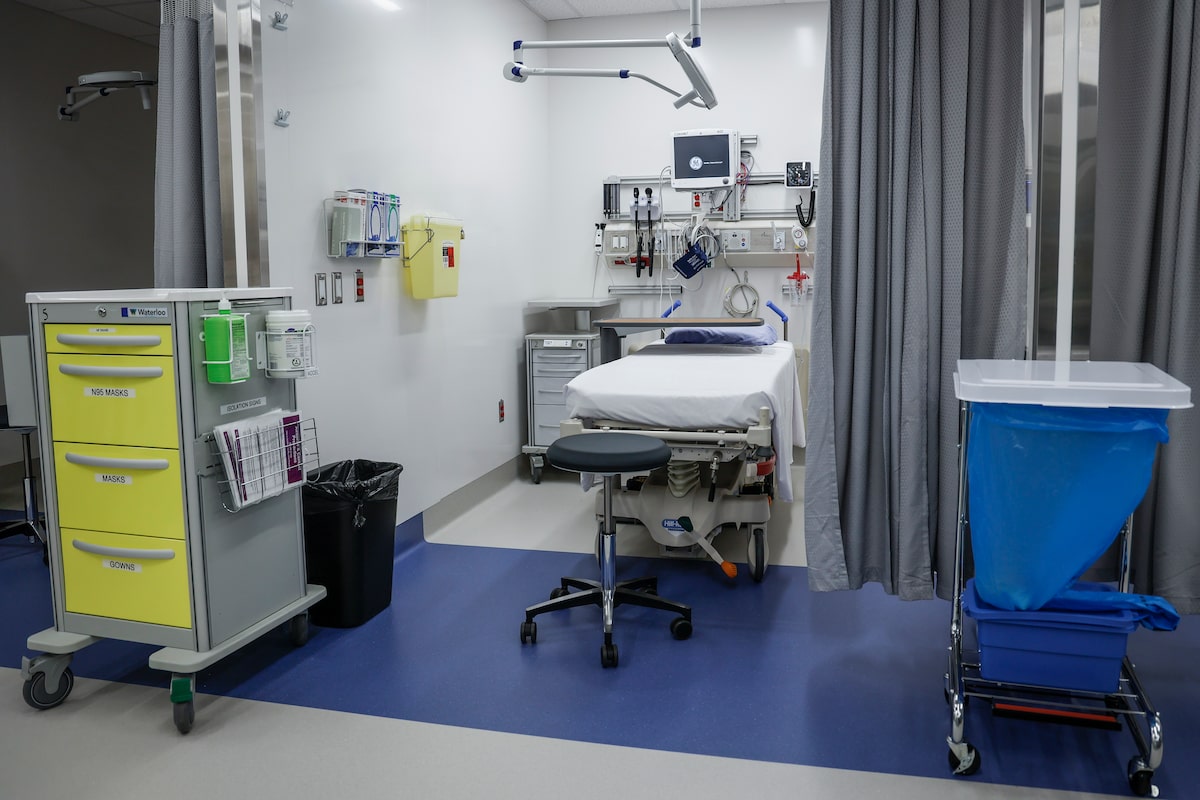
Alberta has estimated that it costs $100-million a year to provide insured health services to non-permanent residents.Jeff McIntosh/The Canadian Press
Alberta’s fall referendum on immigration and the Constitution will ask Albertans to weigh in on whether health care access for some newcomers should be limited.
Premier Danielle Smith, who critics say is stoking division and anti-immigration rhetoric, has defended the proposals as a way to reduce pressure on social systems that have come under strain because of rapid population growth.
Questions on the October ballot include whether Albertans support a law excluding some newcomers from accessing provincially funded programs, such as health care, and charging non-permanent residents to use the health and education systems. The referendum will include nine questions in total.
Here is a look at Alberta’s existing health policy and how it compares with other jurisdictions.
What is the health care cost of newcomers to Alberta?
Alberta has estimated that it costs $100-million a year to provide insured health services to NPRs. That figure excludes hospital care, which is the most expensive aspect of the health system.
The Premier has placed significant blame on immigration for the fiscal strain on the system, positioning limits on health care for some newcomers as necessary to lessening the burden on taxpayers. (NPRs pay taxes.) Alberta forecast a $9.37-billion deficit and outlined record spending on Thursday. More than $34-billion is budgeted for health care in 2026-27.
Robert Falconer, a research fellow at the University of Calgary’s school of public policy, said the health-related referendum proposals might save money if adopted into policy, but those funds won’t go far when it comes to reducing the deficit.
“If you think of this in terms of a household budget, it would be like cutting back on your fast food budget, while still having significant payments on your mortgage,” he said.
Mr. Falconer also noted the “healthy immigrant effect,” a well-documented phenomenon where immigrants arrive with better health than the Canadian-born population. Simply put, he said, immigrants use fewer health services than non-immigrants, and cost the system less.
Gary Mason: Faced with fiscal woes, Danielle Smith takes aim at immigrants
What are the eligibility requirements for health care coverage in Alberta currently?
Temporary residents from outside of Canada may be eligible for coverage under the Alberta Health Care Insurance Plan if they establish residency in Alberta, intend to live in the province for 12 consecutive months and have an acceptable Canada entry document.
Within those 12 months, an individual must be physically present in Alberta for at least 183 days. Employers who hire temporary foreign workers must provide emergency health insurance at no cost until the employee is eligible for AHCIP.
International students may be eligible for coverage if they have a 12-month study permit that is valid for an Alberta educational institution, and will reside in the province for at least one year.
Those with a study permit that is valid for more than six months but less than 12 may also be eligible if their school provides a letter that confirms their enrolment and intent to reside in Alberta for at least one year.
Coverage typically starts three months after arrival to Alberta.
Refugees and asylum claimants in Alberta receive health coverage through Ottawa’s Interim Federal Health Program until they are eligible for provincial insurance.
Statistics Canada estimated Alberta was home to 281,857 NPRs by last October. This represents roughly 5.6 per cent of Alberta’s population, a percentage expected to dwindle in coming years.
Andrew Willis: Referendum uncertainty risks undermining Alberta’s economy
How does health care coverage for newcomers in Alberta compare with other provinces?
Public health care coverage varies across Canada.
Some provinces and territories provide coverage immediately for newcomers, while others have waiting periods. It also differs depending on the specific type of work or study permit an individual holds.
International students in Manitoba, for example, are not eligible for provincial coverage and must enroll in private insurance. Whereas Quebec only covers students from countries that have signed a social security agreement with the province, such as France, Denmark and Sweden.
In British Columbia, international students must purchase iMED private insurance during the three-month wait period, costing $237 or $338 for one-term exchange students. Once eligible for provincial coverage, these students must pay a monthly premium of $75.
Temporary foreign workers in Ontario may be eligible for coverage if they work full-time with an Ontario employer on a work permit that is valid for at least six months, and are physically present in Ontario for 153 days during any 12-month period. The waiting period is typically three months.
There is no waiting period for temporary workers in some provinces, including Saskatchewan, Prince Edward Island and Newfoundland.
What impact will the referendum have on Alberta?
Immigration expert Sharry Aiken, a law professor at Queen’s University, said even if the referendum does not amount to policy changes, it will deter immigration. She said Alberta is “rolling up the welcome mat” and signalling that immigration is a drain to the economy, despite evidence suggesting the contrary.
She said the proposals drive an idea that immigrants should belong to a “second tier” in Canada, in which they would not benefit from the social safety net that everybody else does. Limiting health care access could actually increase costs, she said. Leaving illness untreated could lead to higher emergency costs, for example.
Additionally, Prof. Aiken said Alberta could be subject to legal challenges if it moves forward with the proposals, because health is essential to the Charter right to life, liberty and security of the person.