February 27, 2026
In 2019, shortly before the COVID-19 pandemic reshaped daily life, Abacus Data partnered with Co-operatives and Mutuals Canada (CMC) to conduct a large-scale national study on how Canadians viewed co-operatives and what role they played in the country’s social and economic fabric.
Six years later, in late 2025, CMC, along with the Co-operative Housing Federation of Canada (CHF Canada), returned to the field to ask many of the same questions again.
The context could not have been more different. A global pandemic. Persistent inflation. A deepening housing crisis. Growing economic uncertainty. For many Canadians, institutions that once promised predictability and security now feel strained or unreliable.
And yet, amid all this change, one thing stood out clearly: Canadians’ belief in the co-operative model has remained remarkably strong.
More than that, in a moment defined by instability and loss of control, co-operatives increasingly stand out as institutions that still offer what many Canadians say they are searching for most right now: stability, fairness, and a meaningful say in the decisions that shape their lives.
The findings below are from a survey conducted with on behalf of CMC and CHF Canada with n=5,012 adults in Canada from Sample size: 5,012 Canadians from November 5 to 17, 2025.
Key Finding #1: Co-operatives Put People Back in Control
Across Canada, a growing number of people feel that life is being shaped by forces beyond their control — rising prices, housing pressures, and decisions made far away from the communities they affect.
In our broader research at the end of 2025, nearly half of Canadians said life feels more unpredictable than it used to. That sense of unpredictability is not abstract. It shows up in concerns about paying bills, finding stable housing, planning for retirement, and trusting institutions to act in their best interest.
In updating the research from 2019 we found a fundamental shift- the last 5 years have pushed Canadians into two sides of the control continuum- both those with and without a sense of control have risen sharply.
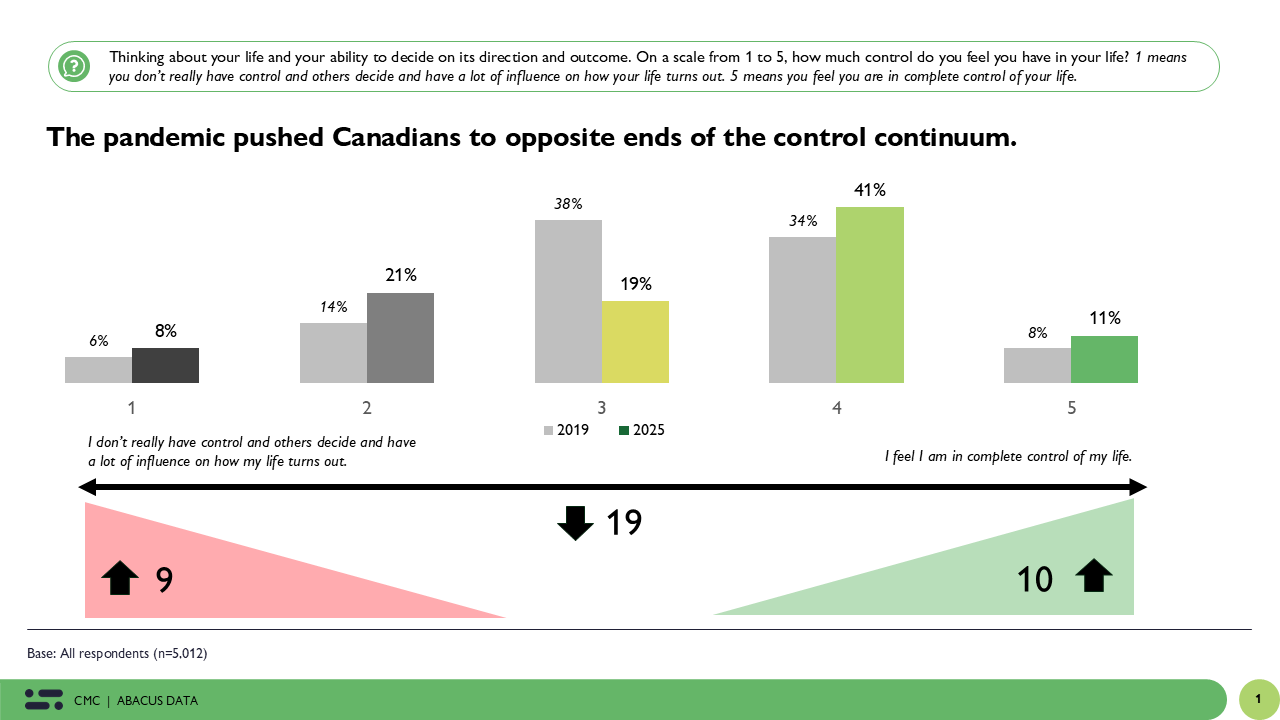
This erosion of control matters. When people feel powerless, trust declines and optimism about the future weakens.
Co-operatives fundamentally challenge that dynamic.
Unlike traditional corporate models, co-ops are built around shared ownership and participation. Members have a voice. Decisions are made with community needs in mind. That structure resonates powerfully at a time when Canadians say they want more influence over the systems that affect their lives.
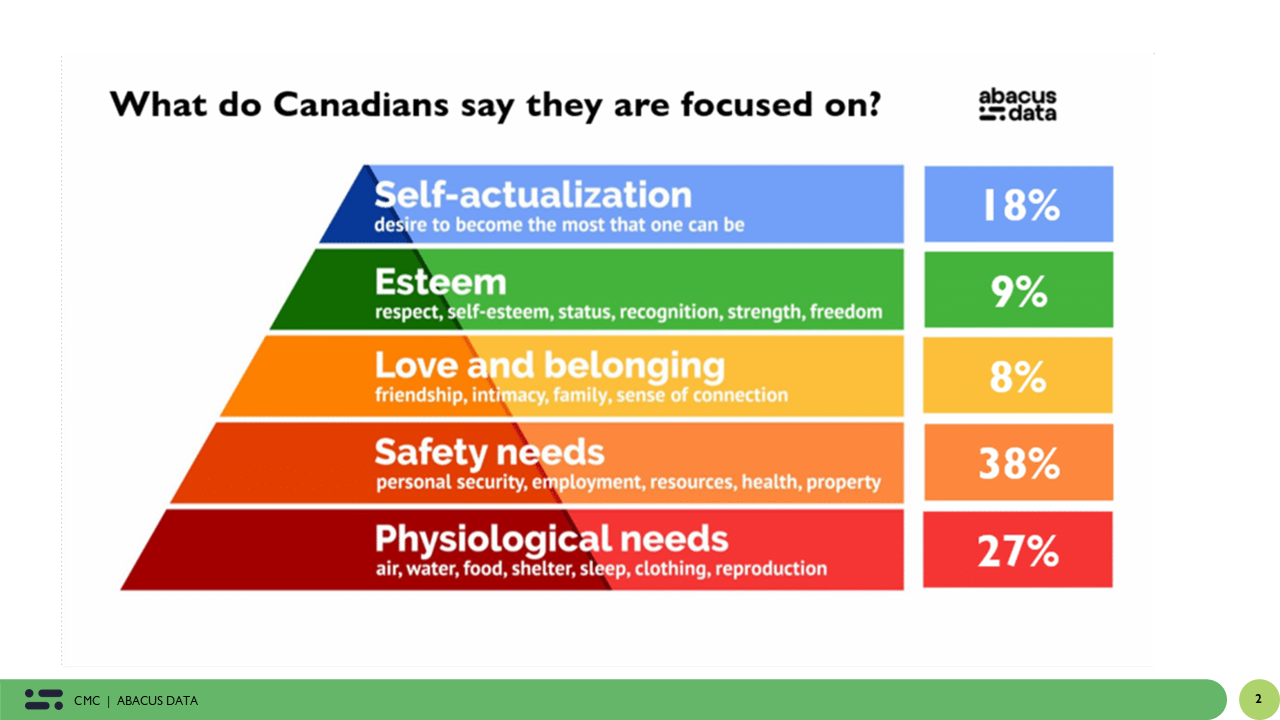
This finding aligns closely with Abacus Data’s research on Maslow’s hierarchy of needs, which shows that many Canadians are now focused on meeting their most basic needs (affordability, housing security, and economic stability) before they can think about anything else.
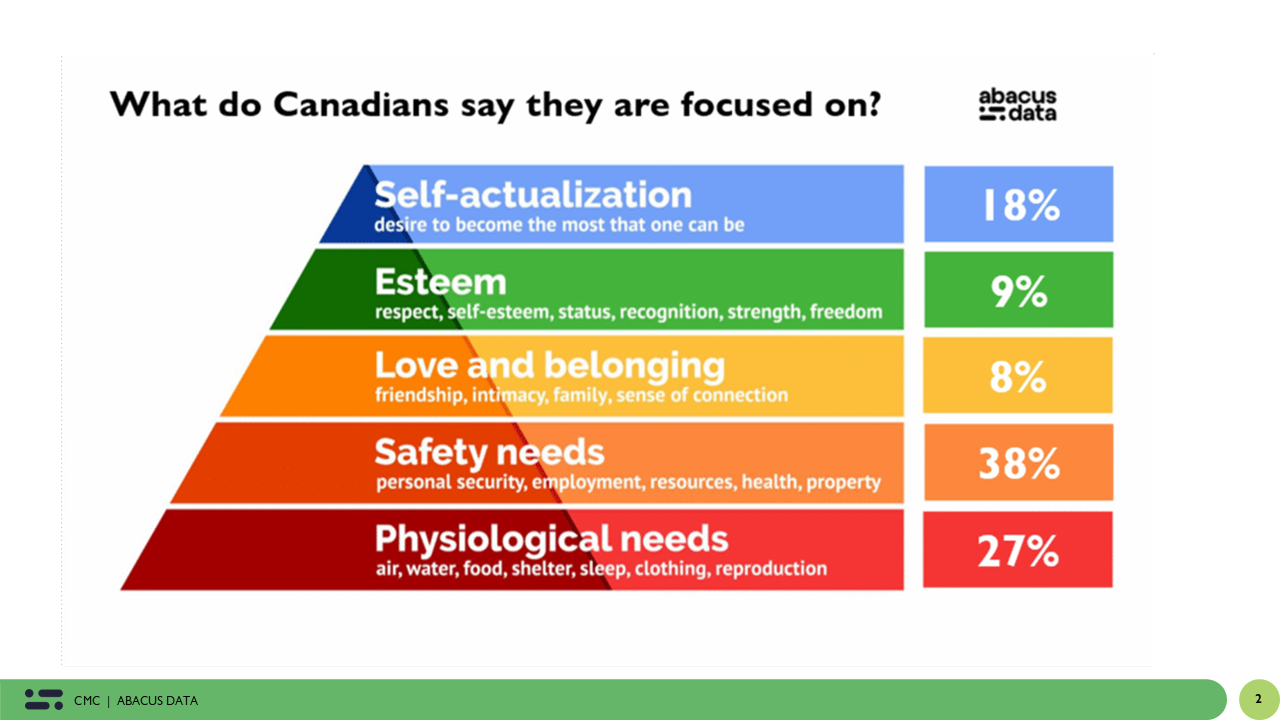
Co-operatives help restore a sense of agency at exactly this level. By allowing Canadians to actively participate in institutions that provide housing, services, and financial stability, co-ops help people regain a feeling of control even as broader systems feel increasingly out of reach.
Key Finding #2: Canadians Need Stability. Co-ops Deliver It.
Economic pressure is no longer confined to specific groups. Canadians across regions, ages, and income levels describe a shared experience of lack of control.
Essentials like housing and food feel harder to secure. Costs rise faster than incomes. Long-standing institutions no longer feel dependable in the way they once did.
Directly from our survey with CMC/CHF:
90% of Canadians agree many essentials, including housing, feel harder to secure than they used to.
86% agree the systems and institutions we rely on feel less stable than they used to, making it harder to build a secure life.
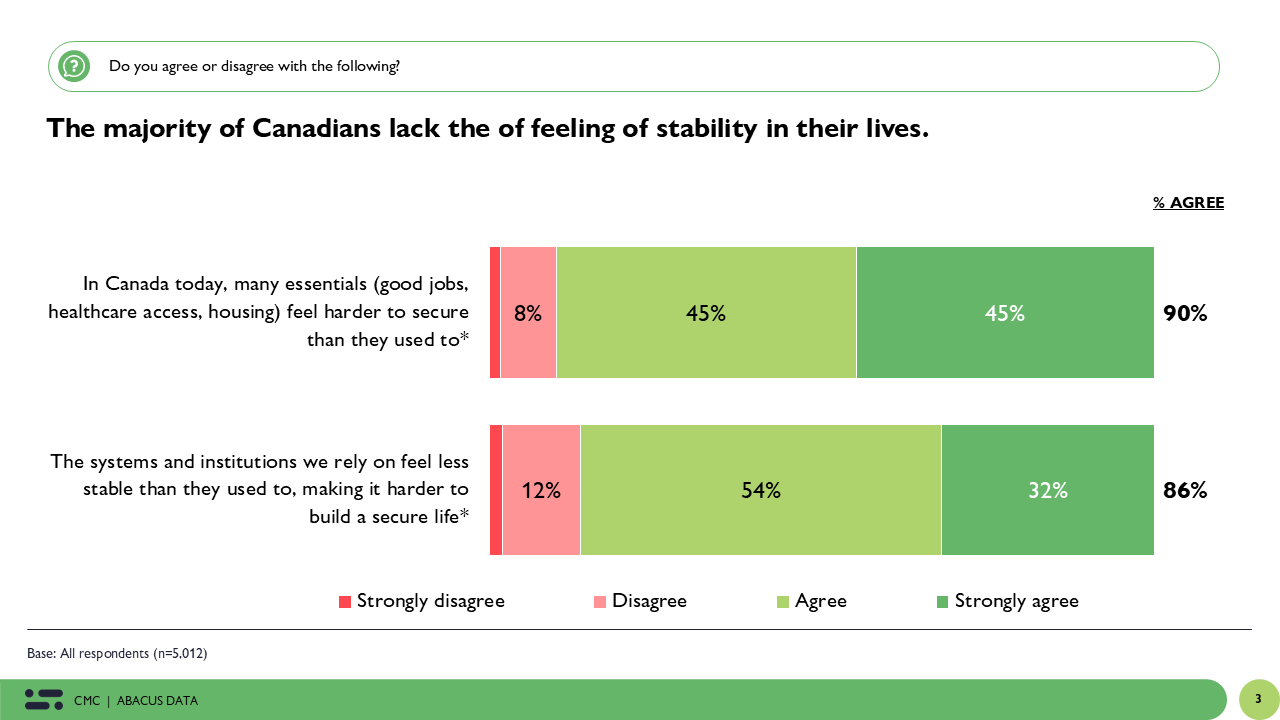
In this environment, Canadians are not necessarily looking for disruption or transformation. Instead, they are seeking something much simpler — stability they can rely on.
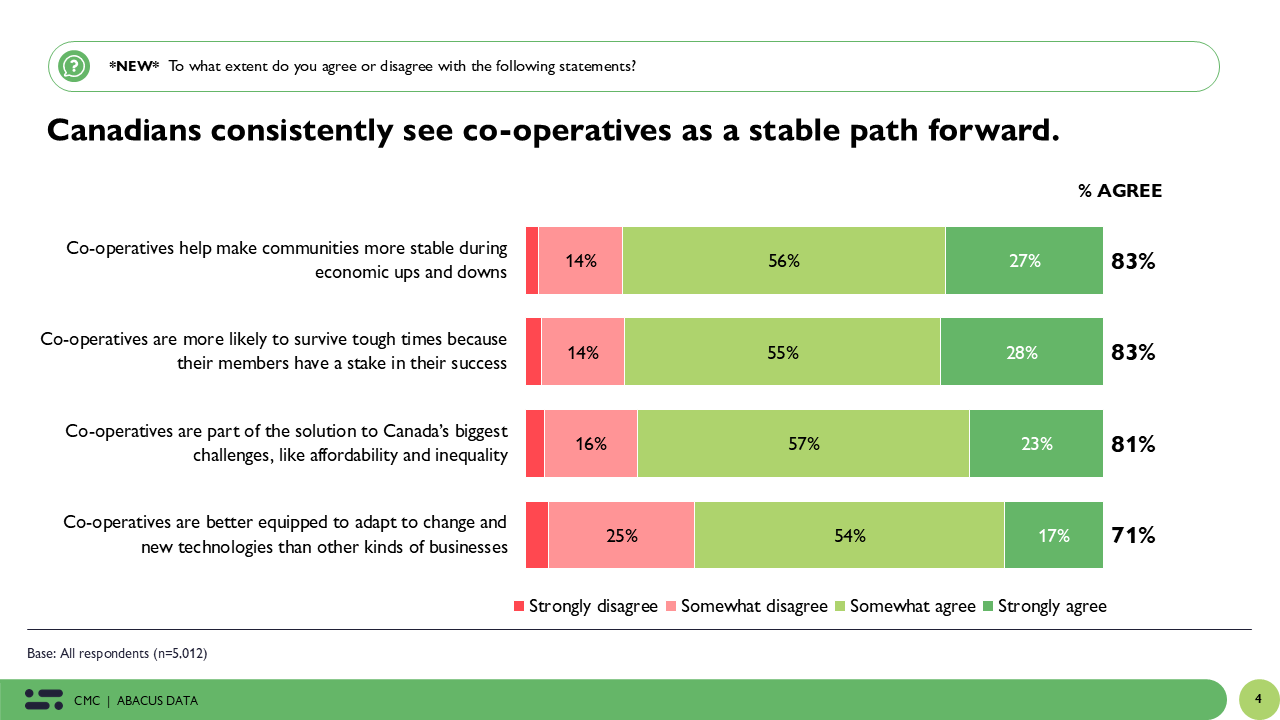
This is where co-operatives stand apart. Canadians consistently see co-operatives as a stable path forward, even in uncertain times.
Across multiple measures, large majorities of Canadians agree that co-operatives provide stability where other models often fall short. More than eight in ten Canadians (83%) agree that co-operatives help make communities more stable during economic ups and downs, and the same proportion believe co-operatives are more likely to survive tough times precisely because members have a direct stake in their success.
This confidence extends beyond resilience alone. A strong majority of Canadians (81%) see co-operatives as part of the solution to some of Canada’s biggest challenges, including affordability and inequality. Even when it comes to change and innovation, areas where traditional businesses often claim an advantage, seven in ten Canadians (71%) agree that co-operatives are better equipped to adapt to change and new technologies.
Taken together, these findings point to a consistent and deeply held belief: co-operatives are not just stable institutions, but adaptable, resilient, and relevant ones. At a time when many Canadians feel existing systems are struggling to keep up, co-operatives stand out as a model people trust to endure and evolve through uncertainty.
For many, co-operatives feel like institutions designed to endure not just survive the next quarter.
Key Finding #3: Canadians Want More Co-operatives — and Want In
Support for co-operatives is not passive. Canadians are clear: they want more of them and they want to participate.
Seven in ten Canadians (71%) say they would like to see more co-operatives operating in Canada.
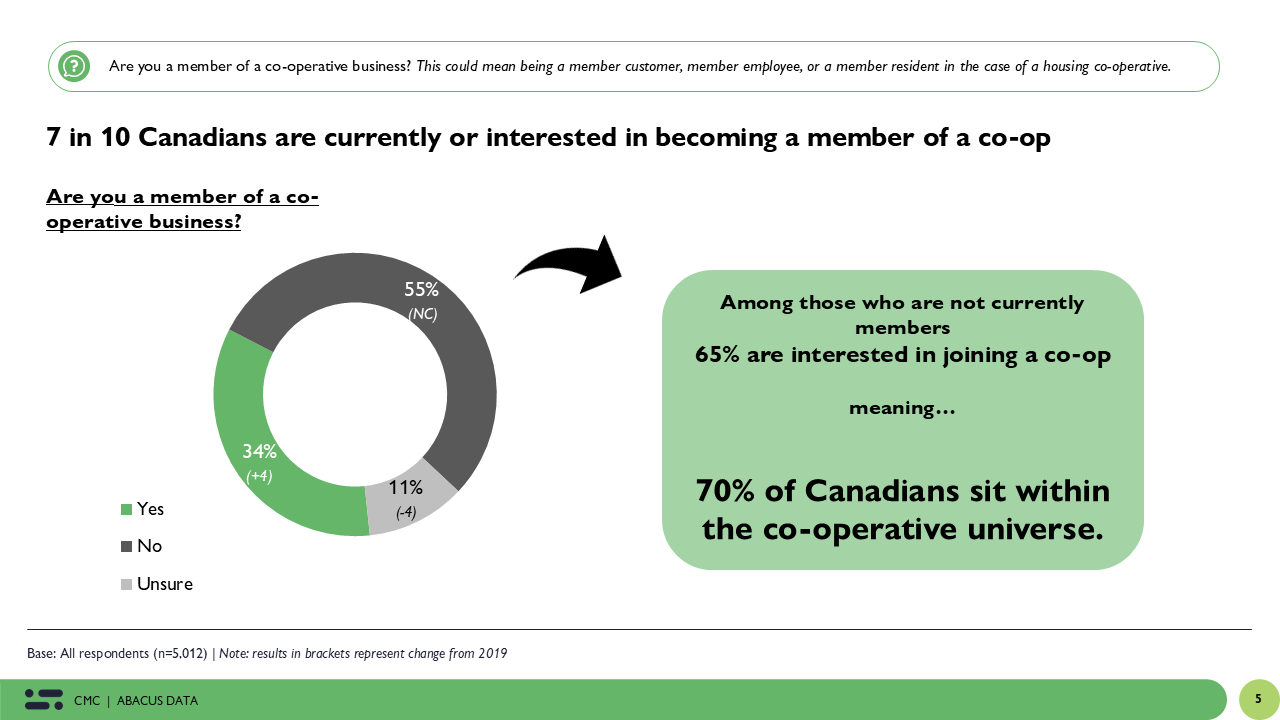
Today, one-third of Canadians — more than 14 million people — are already members of a co-operative, including approximately 250,000 Canadians living in housing co-ops. Just as notably, another third say they are interested in joining one.
Taken together, this means 70% of Canadians sit within the co-operative universe either as members or potential members. In a country experiencing growing polarization, that breadth of appeal is rare.
Co-operatives cut across age, geography, and ideology in ways few other models do. They are seen not as partisan or niche, but as practical solutions to shared challenges.
Key Finding #4: Co-operatives Strengthen Communities: And That’s What Canadians Value Most
Canadians consistently point to the same reasons why co-operatives are appealing as businesses and institutions.
They keep money local.
They reinvest in members.
They provide services, like housing, that reflect real community needs.
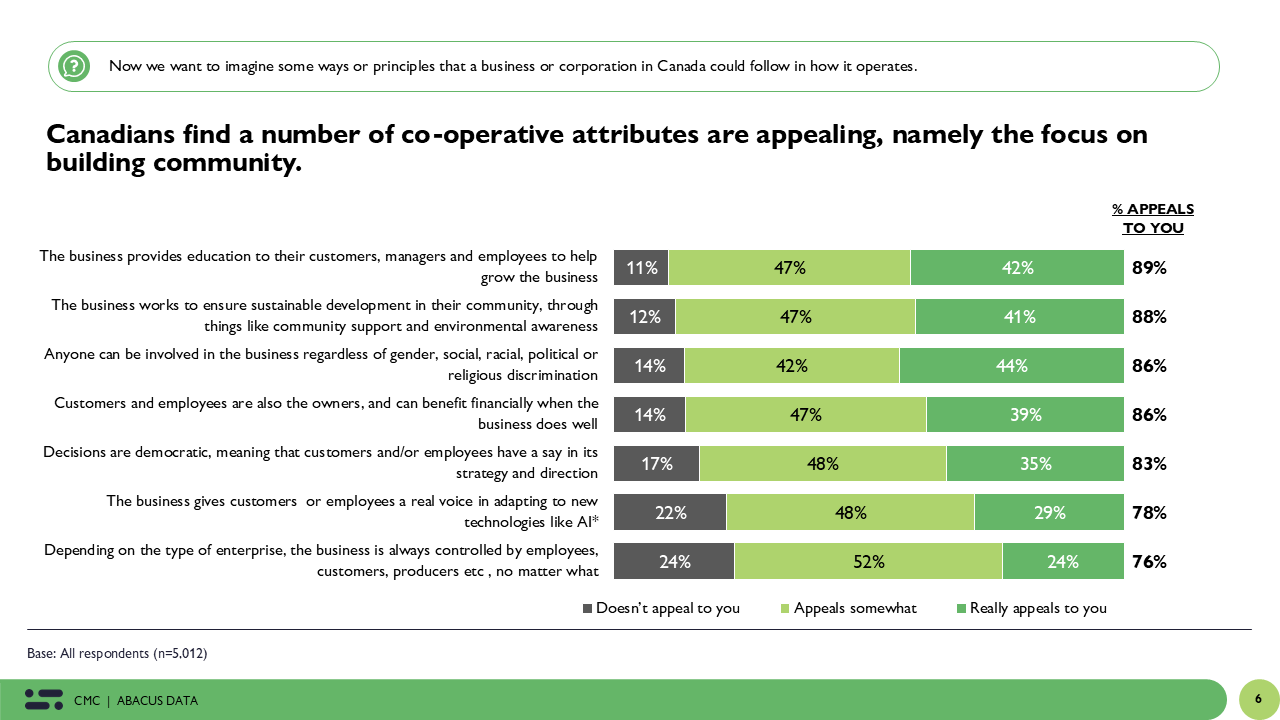
In a moment of national fragmentation, co-operatives are widely viewed as connectors rather than dividers. Young and old, rural and urban, left and right, Canadians across the spectrum recognize co-ops as organizations designed to help communities look after themselves.
This community-rooted nature is not a “nice to have.” It is central to why co-operatives continue to earn trust at a time when many institutions struggle to do so.
Bigger Than Any Single Finding: Co-operatives as a Solution to Instability
Beyond any individual data point, this research tells a larger story.
Canadians increasingly see the wider adoption of co-operative values as necessary to fixing systems that no longer deliver stability or fairness. As economic pressure grows and traditional models feel less reliable, co-operatives are viewed as a credible path forward not a return to the past.
92% of Canadians agree stability comes when people have a secure home in a strong community- like the housing co-operatives can provide.
84% agree stability comes when people have collective ownership or shared decision-making in the organization that affects their lives.
At a time when many Canadians feel life is becoming harder to control, co-operatives offer something tangible: shared ownership, shared responsibility, and shared stability.
And in today’s Canada, that combination matters more than ever.
Methodology
The survey was conducted with 5,012 Canadian adults from November 5 to 17, 2025. A random sample of panelists were invited to complete the survey from a set of partner panels based on the Lucid exchange platform. These partners are typically double opt-in survey panels, blended to manage out potential skews in the data from a single source.
The margin of error for a comparable probability-based random sample of the same size is +/- 1.3%, 19 times out of 20.
The data were weighted according to census data to ensure that the sample matched Canada’s population according to age, gender, educational attainment, and region.
Abacus Data follows the CRIC Public Opinion Research Standards and Disclosure Requirements that can be found here: https://canadianresearchinsightscouncil.ca/standards/
About Abacus Data
We are Canada’s most sought-after, influential, and impactful polling and market research firm. We are hired by many of North America’s most respected and influential brands and organizations.
We use the latest technology, sound science, and deep experience to generate top-flight research-based advice to our clients. We offer global research capacity with a strong focus on customer service, attention to detail, and exceptional value.
And we are growing throughout all parts of Canada and the United States and have capacity for new clients who want high quality research insights with enlightened hospitality.
Our record speaks for itself: we were one of the most accurate pollsters conducting research during the 2025 Canadian election following up on our outstanding record in the 2021, 2019, 2015, and 2011 federal elections.
Contact us with any questions.
Find out more about how we can help your organization by downloading our corporate profile and service offering.