
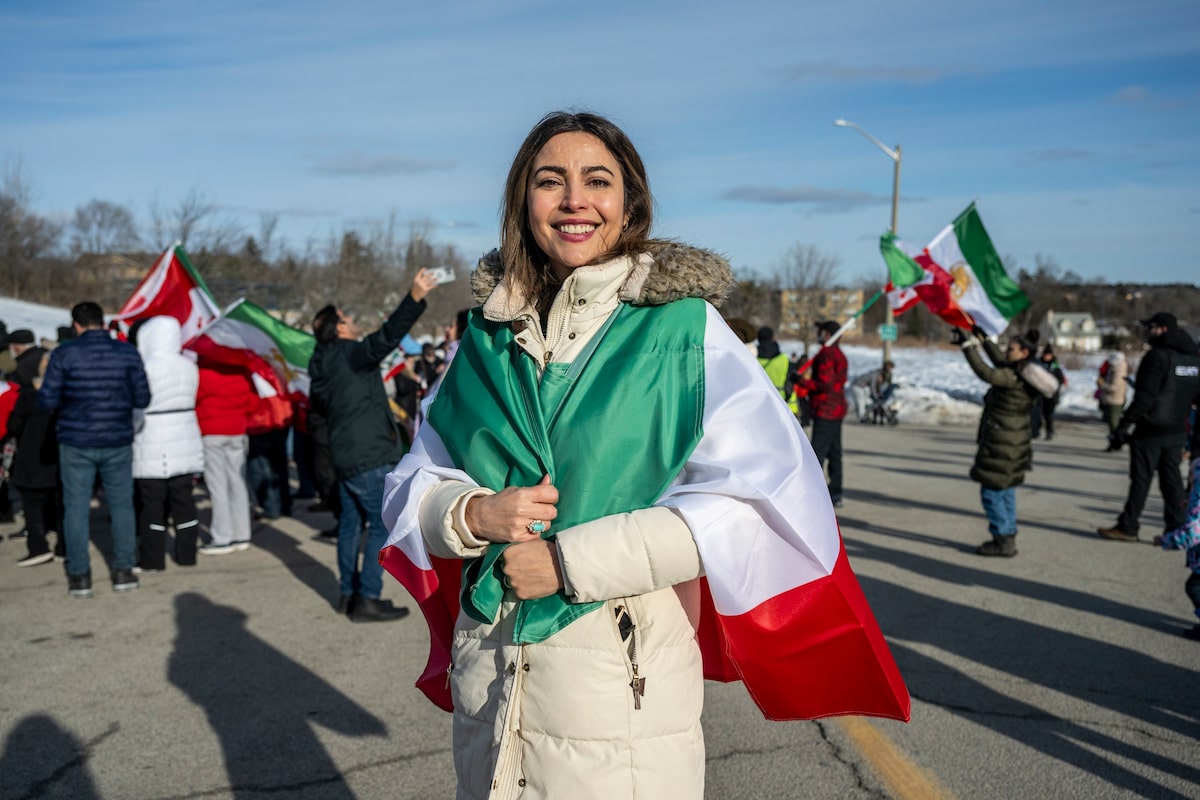
Iranian-Canadian Bahar Tarzi takes part in a demonstration against the Iranian government, in Richmond Hill, Ont., on Saturday.EDUARDO LIMA/The Globe and Mail
Bahar Tarzi woke at 4 a.m, to her social media feed buzzing with news that bombing had started in Iran. She immediately roused her still-sleeping husband and 13-year-old son with joyful shouting echoing in her Barrie, Ont., home: “It’s happening! It’s happening.”
“I have been praying for this,” said Ms. Tarzi, the founder of Iranian Canadian Social and Cultural Council. “We want an end to this dictatorship.”
In Toronto, Zara Marzban, 36, woke early to a call from her sister. That wasn’t unusual: she’s spoken to her family every day since coming to Canada four years ago. But she answered anxiously, sensing something had happened.
“They are bombing,” her sister told her. “But we are ok, we are safe in the houses don’t worry – but the connection will be lost.”
Ms. Marzban leapt out of bed, scouring social media for news, understanding all too well what this could mean for young women if the attack leads to regime change. Growing up in Iran, she’d been forced to wear a hijab started at age nine, and always felt under constant scrutiny. “As a woman, I didn’t feel safe there.”
Mersad Katebi already had plans to join a Saturday protest against the Iranian government, when he picked up his phone and heard his 24-year-old cousin, back in Iran, announce with excitement that the war had started.
“I was like, oh, wow,” says Mr. Katebi, 21, who left Iran five years ago, to study engineering in Toronto. “It’s a feeling of happiness and joy.”
By Saturday afternoon, all three had joined thousands of other members of Iranian-Canadian community, dancing and cheering across kilometres of Yonge Street, in Richmond Hill, north of Toronto.
What had been planned as a protest was now festive and uplifting, to the soundtrack of honking horns and thumping dance. A few people wore “Make Iran Great Again” caps. Many more swaddled themselves in the Iranian tricolour flag, including Mr. Katebi. Waving a smaller flag, Ms. Marzban, smiled broadly among the jubilant crowd, her hair covered only by a grey wool tuque.
Across the country, many Canadians with Iranian roots expressed the same hope: that this foreign military intervention would be enough to weaken a violent and oppressive dictatorship and give the people a chance to restore democracy to their native country.
Other member of the Iranian diaspora, watching from Canada, were more trepidatious, pointing out that Iran is a large and complex country, and that using foreign military action to bring about regime change could have unintended consequences and might further destabilize the Middle East.
Analysis: Which regime? What change? Iran’s complexity means there are no magic bullets
“This is so risky and there are so many unknowns,“ said Sasan Issari, a social worker and assistant professor at Trent University, who wants an end to the Iranian regime, but is not convinced that dropping bombs will accomplish it.
He worries, for instance, that civilian deaths from American and Israeli bombs may galvanize anti-Western extremists. And he pointed out that a current internet blackout in Iran, means it will be easy for disinformation to spread.
“History has shown that when you bomb people to give them freedom, it has the opposite effect.”
Pouya Morshedi, a part-time lecturer in sociology at Acadia University who has studied the Iranian revolution of 1979, said he has dreamed for years that the regime might one day be gone, but war is uncertain and dangerous.
“The only way that we can have hope for the future in Iran is through the people who are inside Iran,” he said. “They make the decisions, they make the change, instead of those groups who want to “liberate” them in quotation marks.”
Mr. Morshedi, who has lived in Canada since 2018, heard from family members living in a city in southern Iran on Saturday morning, before the Internet was shut off in Iran. They were huddled in an apartment on the ground floor of a building, waiting out the bombs, for what might follow.
What that might be – even if the regime falls, Mr. Morshedi said, is far from clear, and potentially full of conflict.
Reza Hadisi, an Iranian-American professor of philosophy at the University of Toronto, said he fears a repeat of what occurred after the invasion of Afghanistan, where a hardline regime was toppled only to return years later.
Opinion: Will the U.S.-Israel attack help end Iranians’ suffering – or make it worse?
In Iran, people are “just so angry, so desperate, that they say ‘anything is better,’” Prof. Hadisi said. “I understand their anger, but I just worry that with war, who knows how it will go?”
U.S. President Donald Trump, who had been threatening military action after the Iran government killed thousands of pro-democracy protestors in January, justified the attack by claiming Iran had continued to work towards a nuclear arsenal with the goal of building missiles that could reach the United States.
In a Saturday morning statement, Prime Minister Mark Carney declared Canada’s support for the intervention, calling the Islamic Republic the “principal source of instability and terror throughout the Middle East” and saying the regime must never be able to develop a nuclear weapon.
Ms. Tarzi, for her part, says she is grateful that Mr. Trump decided to take action, and happy that her chosen country is supporting the decision. She believes that diplomacy was never going to work with a tyrannical regime willing to respond to peaceful, anti-government demonstrations by killing thousands of the country citizens, many of them young people.
As those student protests began again this week, she said, fears among her family there had only grown that young people will continue to die – with or without the bombs, she said, their lives were at risk.
“The country was living under a blanket of sorrow.” she said. Her family has stopped buying cakes for birthdays; Valentine’s Day passed without young people exchanging gifts or chocolate. “Every night they were crying.”
But not today, she said. At the rally, Ms. Tarzi received a call from her sister in Tehran, who had heard reports – later announced officially by the United States – that the head of the regime, Supreme Leader Ayatollah Ali Khamenei, had been killed. Her loved ones were safe, and together, her sister confirmed. “Everyone is happy and celebrating.”
On Saturday evening, Ms. Tarzi, her husband and son, were planning to join friends at a community centre in Richmond Hill. There would be more dance, she said, more celebration at the prospect of an optimistic, “new day for Iran.”
“We want to share our joy with each other,” she said. “Now is the time of the people.”