


Listen to this article
Estimated 4 minutes
The audio version of this article is generated by AI-based technology. Mispronunciations can occur. We are working with our partners to continually review and improve the results.
Youth in Montreal’s east end are more susceptible to social isolation, financial precarity and issues accessing higher education because of a lack of public transit services in the area, a recent report suggests.
The report, entitled Oubliés au terminus, was tabled by the Rivière-des-Prairies–Pointe-aux-Trembles youth council earlier this month.
It highlights the realities of youth in the borough who regularly find themselves having to sit in a bus and metro for more than an hour to arrive anywhere near the downtown area.
“The fact that a car ride between Rivière-des-Prairies and the [Université du Québec à Trois-Rivières] is, in some cases, faster than travelling by public transit to the Université de Montréal illustrates the gravity of the situation,” the report says.
The university in Trois-Rivères is around 130 kilometres away, while the Université de Montréal is about 25 kilometres away from Rivière-des-Prairies.
Darlène Jean Jacques, co-president of the youth council, knows this reality all too well.
Studying full-time at Concordia University, while doing volunteer work and working in a bank, she felt she had no choice but to buy a car so as not to spend hours getting to and from her home and her daily obligations.
“It limits access for youth to have a proper social life because for us in the borough, for us to be able to access concerts, activities… you have to take at least an hour of bus just to get to a metro,” she added.
While there are some express buses in the area, they aren’t accessible outside of weekdays and rush hours.
“The east end is kind of a forgotten place on the Island of Montreal,” said Jacques. “We have a flagrant disparity when it comes to transport compared to the west end.”
According to the report, lack of access to sufficient public transportation accentuates an already-existing disparity when it comes to education access.
The report says youth in the east end already face higher drop-out rates and a lower percentage of the population has a bachelor’s degree compared to other parts of the city.
It also limits their access to work opportunities and can make it difficult to escape poverty, the report says.
The youth council fears this situation will only be made worse as already-existing public transit services continue to see issues of funding and risk being cut in some places.
WATCH | Will Montreal’s east end get a tramway?: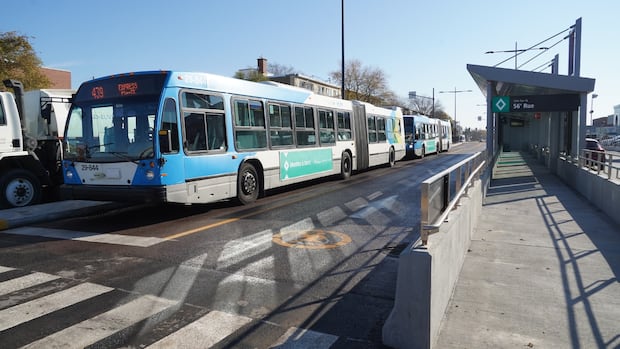
After REM and tramway plans, could Montreal’s east end only get a rapid bus network?
With the cost of infrastructure projects continuing to rise and the precarious financial situation of Montreal’s transit authority, it may be residents and businesses in the city’s east end who lose out, with transit project plans once again being reconsidered.
Jean Jacques said the youth council wrote to the transportation minister but it was to no avail.
She hasn’t gotten any concrete answers from the city’s public transit authorities either, she said.
“We’ve had the meetings where they propose projects and then, last minute, the project gets not enough funding or for some other reason the project gets voted out,” she said.
In 2020, residents were told they would be getting access to an extension of the city’s light-rail network in a project known as the REM de l’Est.
But that project was later nixed and replaced with plans for a tramway.
Those plans were then taken over by the province’s transportation agency, Mobilité Infra Québec, which then announced it would be studying whether it should be replaced with a rapid bus network instead.
For its part, the youth council is calling on all levels of government to sit down with public transit authorities to come up with and commit to a solution.
In the meantime, it also wants to see temporary measures in place to ease travel between the east end and other parts of the city, such as better access to the shared Bixi bicycle network or a shuttle service.
Quebec’s transport ministry and Transport Minister Jonatan Julien declined a request for comment.
In a statement, the Société de transport de Montréal (STM) says it already improved access to express buses in the area in recent years.
“In the short or medium-term, we will analyze certain transport corridors in the area to improve the performance of these lines,” the STM says in a statement. “We are also analyzing, with the [Autorité régionale de transport métropolitain], the creation of metropolitan corridors, [some] of which are in the east.”