
Researchers find nanoplastics from food packaging may boost Salmonella virulence and biofilm formation, raising emerging questions for food safety.
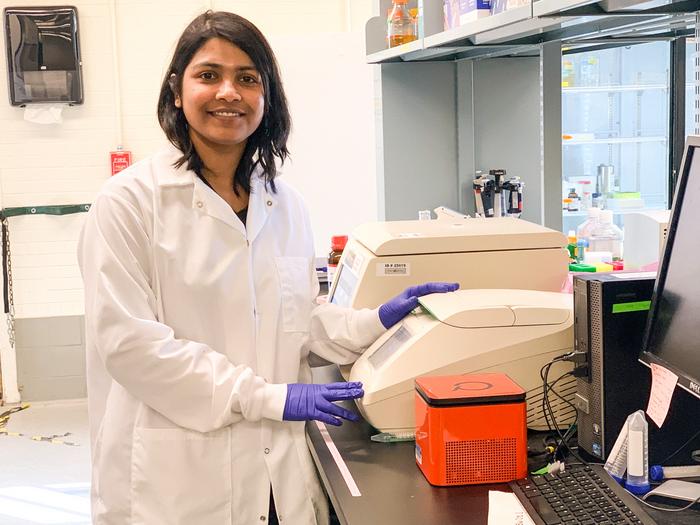
Jayita De, graduate student in Food Science and Human Nutrition at the University of Illinois Urbana-Champaign, is lead author on the study. Credit: College of ACES/Marianne Stein
Nanoplastics shed from plastic food packaging could impact the behaviour of Salmonella enterica, potentially affecting food safety and antimicrobial resistance, according to new research from the University of Illinois Urbana-Champaign.
The study examined how nanoplastics – microscopic fragments formed as larger plastics degrade – interact with Salmonella, a leading cause of foodborne illness frequently associated with meat, poultry and ready-to-eat products. Researchers focused specifically on polystyrene, a plastic widely used in food packaging and disposable utensils.
The research was led by Pratik Banerjee, associate professor in the Department of Food Science and Human Nutrition. His team began investigating the issue after routine laboratory testing of retail ground turkey samples frequently identified the presence of Salmonella. While properly cooking the meat removes the risk, the product is commonly packaged in plastic, prompting researchers to explore how the pathogen behaves when exposed to plastic polymers.
The team analysed how exposure to polystyrene nanoplastics affected the physiology and gene expression of Salmonella enterica. Their findings suggest the particles can alter bacterial behaviour in ways that may influence virulence and survival.
Lead author Jayita De, a graduate student in Banerjee’s lab, said:
We examined the physiology of Salmonella in response to nanoplastics, and we found an increased expression of virulence-related genes. The bacteria also formed thicker biofilms, which further indicates they are becoming more virulent.”
Biofilms – protective layers formed by clusters of microorganisms – can increase bacterial survival under stress. In food processing environments, biofilms are a persistent hygiene challenge, helping pathogens endure cleaning regimes and environmental pressures.
Bacteria switch between ‘offensive’ and ‘defensive’ modes
Researchers also observed that Salmonella’s response to nanoplastics changed over time.
De explained:
When the bacteria first encounter nanoplastic particles, they go into offensive mode and become more virulent. But after a while, they start losing their resources and energy, so they switch to defensive mode, which allows them to persist in the environment for a longer time. If the concentration of nanoplastics rises, they can again switch to an offensive mode. It’s a trade-off between offense and defense.”
Beyond virulence, the team is also investigating whether nanoplastics could influence antimicrobial resistance in foodborne pathogens. Banerjee explained that physiological stressors can trigger resistance mechanisms in bacteria, even if those stressors are not antimicrobial agents themselves. Early findings from ongoing work indicate that polystyrene nanoplastics may increase the expression of antimicrobial-resistant genes in Salmonella.
Despite the findings, the researchers caution that it is too early to draw firm conclusions about the real-world implications for the food industry.
Banerjee added:
However, we don’t want to sound the alarm and advocate that people stop using plastics. Plastic packaging provides a lot of benefits, such as reducing food spoilage and waste while keeping expenses low. We don’t know yet whether this is something we should be worried about.”
The researchers say their work is among the first to examine interactions between nanoplastics and foodborne pathogens from a food safety perspective. They hope further global research will help determine the potential risks, tolerances and implications for future food safety policy.