
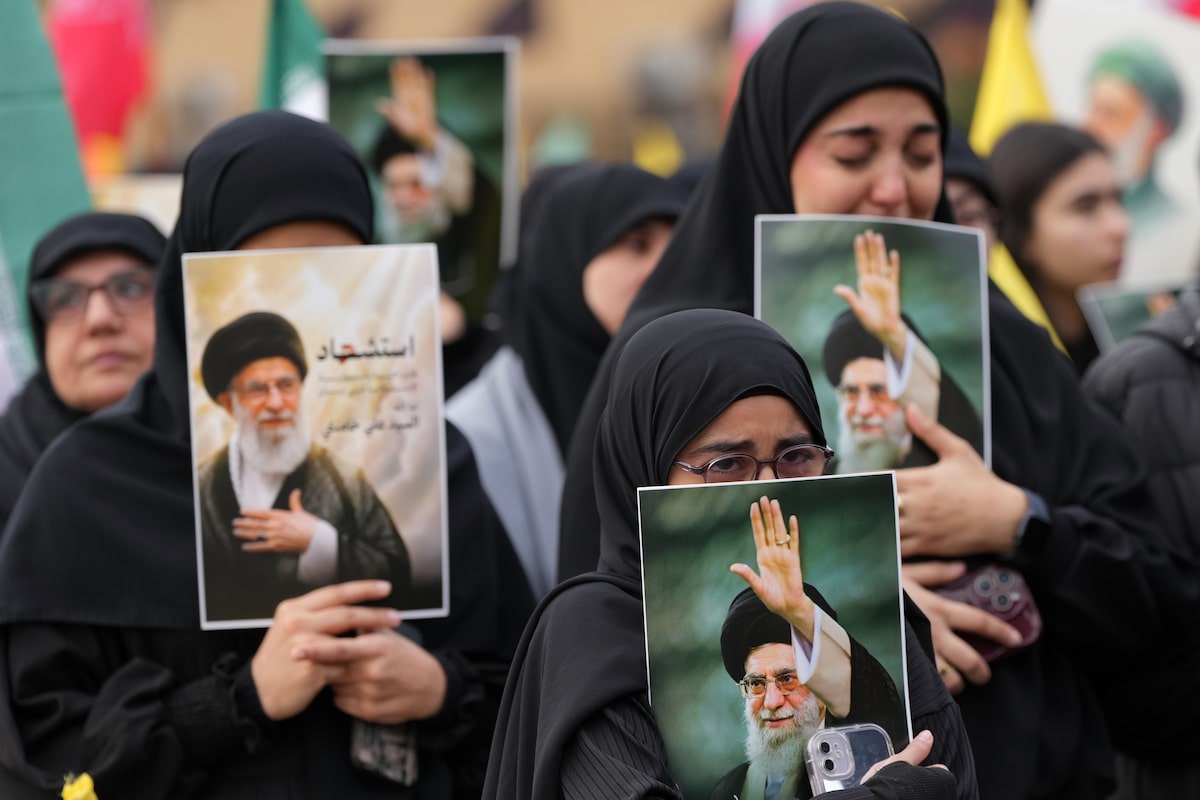
Women cry as they mourn the death of Iranian Supreme Leader Ayatollah Ali Khamenei in Beirut, Lebanon, on Sunday.Hassan Ammar/The Associated Press
There were calls for revenge on Sunday from across the Shia Muslim world after the assassination of Ayatollah Ali Khamenei, a cleric who long seemed to preside not just over Iran but half of the Middle East.
Beirut was tense Sunday evening, with the military deployed outside the country’s lone airport and at major intersections in the Lebanese capital, even as many analysts suggested that Hezbollah – once the most formidable weapon in Iran’s regionwide arsenal of proxy armies – was too weakened by a 2024 conflict with Israel to retaliate.
Ayatollah Khamenei was killed Saturday in a missile strike, part of the opening salvo in a war the United States and Israel have launched against Iran.
Early Monday morning there were reports of rockets fired from Lebanon into southern Israel, followed an hour later by at least three airstrikes on the Hezbollah-dominated southern suburbs of the city. Warplanes, presumably Israeli, could be heard in the skies afterwards.
In a statement, the Israeli military said that “in response to Hezbollah’s projectile fire toward the State of Israel, the IDF is currently striking Hezbollah targets.” It was unclear whether the tit-for-tat exchange was isolated, or the start of something wider.
For much of the past two decades, the face of Iran’s stern-looking, bespectacled Supreme Leader had stared down from billboards not just in Tehran and other Iranian cities but in Beirut and across southern Lebanon, street corners in Damascus and Baghdad and as far away as the Yemeni capital, Sanaa.
The ayatollah’s death will be mourned by some Iranians, and officially marked by Iranian-backed militias across the region. But it will also be celebrated by at least as many Iranians who were repressed by his regime, as well as by Lebanese, Syrians and other Arabs who saw their countries broken and turned into fronts in the Islamic Republic’s confrontation with the U.S. and Israel.
That confrontation was decisively lost long before the missile slammed into the ayatollah’s official residence in Tehran, killing the world’s most powerful and influential Shia cleric. Iran’s “axis of resistance” had been crumbling since shortly after its ally Hamas launched its Oct. 7, 2023, invasion of southern Israel, triggering a furious and continuing response.
Anger flared across the Shia world Sunday, from Karachi – where Pakistani police used tear gas against protesters who breached the outer wall of the U.S. consulate – to Beirut, where thousands took to the streets in the predominantly Shia southern suburbs of the capital.
Naim Qassem, the leader of the Iranian-backed Hezbollah militia, saluted Ayatollah Khamenei as a “divine leader and heavenly guide.”
“We will do our duty in confronting aggression,” Mr. Qassem said in a statement Sunday. “No matter how great the sacrifices, we will not abandon the field of honour and resistance.”
U.S. President Donald Trump and Israeli Prime Minister Benjamin Netanyahu, meanwhile, called on Iranians to rise up and bring an end to the Islamic Republic that was established in a 1979 revolution.
Eyewitness video released on Feb. 28 showed crowds in the Iranian town of Galleh Dar toppling a monument dedicated to the Islamic Republic’s founder, Ayatollah Ruhollah Khomeini.
Reuters
Before the Oct. 7 attacks, Ayatollah Khamenei was the de facto leader of an alliance that included both Hamas and Hezbollah, as well as a network of Shia militias in Iraq, the Houthis of Yemen and Bashar al-Assad’s regime in Syria, which was very much a junior partner to Tehran.
Two and a half years later, Hamas has been devastated by the Israeli assault on Gaza, and Hezbollah is a shell of its former self after a two-month war with Israel in 2024 that saw the group’s long-time leader, Hassan Nasrallah, assassinated in an air strike on his bunker in southern Beirut.
The Assad regime fell shortly afterward, and the Houthis have been weakened by Israeli, U.S. and British air strikes.
Now, Ayatollah Khamenei has followed the leaders of Hamas and Hezbollah to their graves, leaving open the question of who and what remains to carry on Iran’s decades-long struggle against U.S.-Israeli-Saudi dominance of the Middle East.
Iran responded to the U.S. and Israeli attacks by launching missiles and drones at Israel throughout Saturday and Sunday, while also targeting U.S. regional allies Qatar, the United Arab Emirates, Bahrain, Kuwait and Jordan. Even Oman, a country that has remained neutral and which brokered last-minute U.S.-Iranian negotiations in an effort to avert the war, said drones had struck one of its port facilities.
Israel said it launched another wave of strikes on Iran on Sunday as Iranians grappled with uncertainty after the killing of their supreme leader in U.S. and Israeli attacks that threaten to destabilize the wider Middle East. Ciara Lee reports.
Reuters
Iranian Foreign Affairs Minister Abbas Araghchi suggested in an interview with the Qatari-based Al-Jazeera TV network that the elected government – always less powerful than the country’s religious leadership – now had little influence over the actions of the military.
“What happened in Oman was not our choice. We have already told our armed forces to be careful about the targets that they choose,” Mr. Araghchi said Sunday. “Our military units are now, in fact, independent and somewhat isolated, and they are acting based on general instructions given to them in advance.”
The question hanging over Lebanon – as well as Yemen and Iraq – is whether Iranian proxies such as Hezbollah will join in the attacks.
“Hezbollah’s capabilities were eclipsed after the last blow,” said Joseph Bayeh, an assistant professor of international affairs and public policy at Lusail University in Qatar. He predicted that Hezbollah would refrain from starting another war it couldn’t win.
However, Amal Saad, a Hezbollah expert who lectures on politics at Cardiff University, said the “brazenness” of the Khamenei assassination would force Hezbollah’s leadership to consider if war was coming to them whether they chose it or not.
“I do think that Israel might well maintain its new post-Oct. 7 strategy of eliminating threats even if they aren’t fully fledged,” she said. “So even if Hezbollah has been subdued, the fear of it rearming and reconfiguring will likely mean Israel will try to finish it off.”
Opinion: Two wrongs don’t make a right in the Iran war
Much of what happens next will be determined by whoever emerges as Ayatollah Khamenei’s successor.
A three-member panel, including President Masoud Pezeshkian, was formed in Tehran Sunday to run the country until the 88-member Guardian Council selects a new supreme leader.
Leading candidates are believed to include Alireza Arafi, a member of the Guardian Council who heads the Basij, a paramilitary force that is part of the elite Islamic Revolutionary Guard Corps, as well as Ali Larijani, the head of the regime’s Supreme National Security Council. Other presumed contenders include Ayatollah Khamenei’s son Mojtaba, as well as Hassan Khomeini, the grandson of Ayatollah Ruhollah Khomeini, the founder of the Islamic Republic.
Abas Aslani, a Tehran-based senior fellow with the Middle East Centre for Strategic Studies, said it was difficult to predict who would emerge as the country’s new supreme leader. But he forecast that the Islamic Republic – which has already weathered a series of anti-regime protests earlier this year by unleashing a crackdown that left thousands of people dead – would survive and continue its policy of confronting the U.S. and Israel.
“A surrender or change from the Iranian side seems unlikely,” Mr. Aslani said, predicting instead that there would be “further escalation” of the conflict across the region.
The death of Ayatollah Khamenei “is a big loss for Iran and the axis, and this creates a vacuum,” Mr. Aslani wrote in an exchange of WhatsApp messages. “But the infrastructure that Iran has built under his leadership is capable of recovering and adapting.”
Prof. Bayeh agreed that the U.S. and Israeli air strikes were unlikely to bring about regime change on their own. He compared the situation to 2003, when the U.S. and its allies invaded Iraq to depose dictator Saddam Hussein without a plan in place for what came next.
While Mr. Hussein was removed from power, and later executed, the country eventually descended into a prolonged civil war that killed hundreds of thousands of people and ironically helped make Iran the region’s dominant power.
“I doubt we will see regime change in Iran,” Prof. Bayeh said. “But if it collapses, the aftermath will be similar to the Iraq fiasco.”