

Home prices may have cooled across Canada in 2025, but many buyers who waited for better affordability did not end up seeing much benefit.
Instead, rising food costs added pressure to already stretched budgets, erasing much of the relief that lower home prices were expected to bring. The effect was felt especially in Edmonton, according to a new report from Zoocasa.
The real estate platform compared data from Canada’s 2026 Food Price Report with housing affordability across major Canadian cities to see how higher grocery bills affected buyers’ budgets.
Zoocasa’s analysis is based on the 50/30/20 budgeting rule, which suggests that 50 per cent of income should cover necessities like food and housing, 30 per cent for wants, and 20 per cent should be set aside for savings.
Between January 2025 and January 2026, monthly food costs for a family of four in Canada rose by $128, or $1,536 per year.
In Edmonton, the average monthly mortgage payments dropped by about $62 year-over-year as home prices ticked down. On paper, that should have improved affordability. But once you factor in the extra food costs, the typical household was actually left with a $66 per month shortfall.
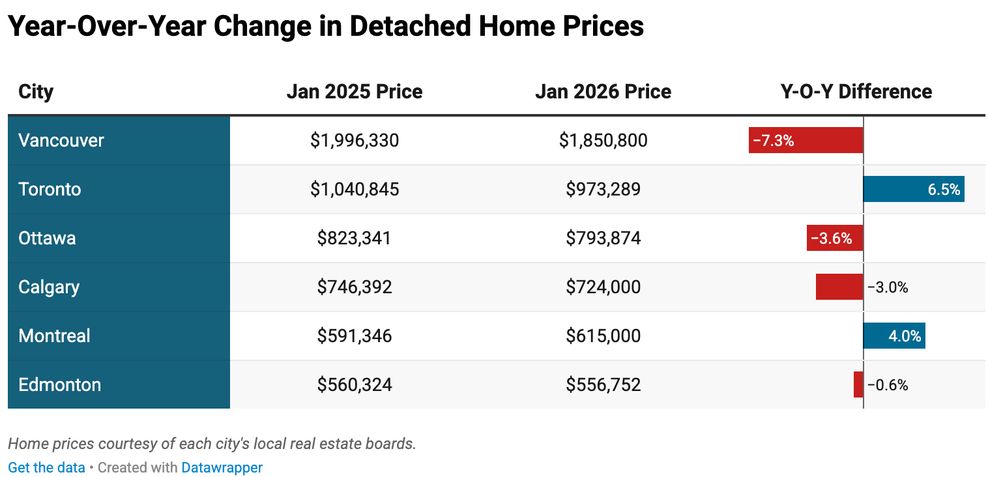
The result is that affordability in Edmonton slightly worsened despite lower home prices. The city’s median after-tax household income stands at $88,500. Under the 50/30/20 budget model, a family would need $89,592 to comfortably purchase a detached home priced at $556,752 in 2026, leaving a gap of $1,092.
While that shortfall is small in comparison to other Canadian cities, it’s a shift from the previous year, when more households were within reach.
Zoocasa
But despite the erosion, Zoocasa says Edmonton remains the most viable market for a median-income family for three main reasons.
A modest raise or a larger down payment can bridge the gap between what households earn and what they need in Edmonton. In other major Canadian cities, buyers would need anywhere from $17,000 to $142,000 more in annual income to afford a home.
Purchasing power also plays a role. Edmonton households report a median after-tax income of $88,500, among the highest in the country, while detached home prices average $556,752, the lowest of the major markets analyzed.
Even though food inflation wiped out the benefit of the city’s 0.6 per cent price decline, Edmonton remains the only major city where the 50/30/20 budgeting guideline is within reach for the average household.
Looking ahead, however, the pressure is unlikely to ease. Food prices are projected to rise by four to six per cent annually through 2027. By 2031, a family of four could be spending about $1,780 per month on groceries, adding close to $3,800 more per year to household budgets.
You can find the full report on Zoocasa’s website.