
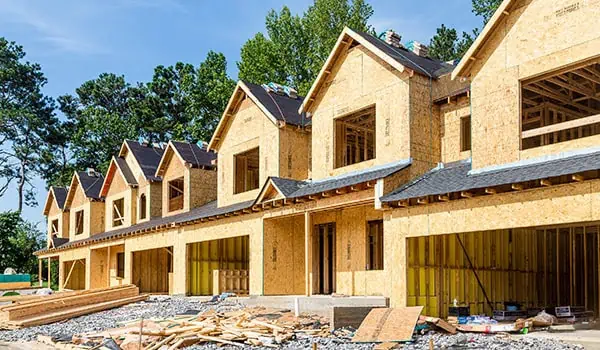
Brampton needs more than 46,000 new homes built over the next five years while over 8,000 households are waiting for affordable housing, according to a new report.
The city’s latest Housing Needs Assessment presented to a committee of council shows nearly 13 per cent of Brampton households are in “core housing need,” spending 30 per cent or more of before-tax income to pay rent.
The HSN found 22,925 (around 12.9 per cent) of Brampton homes are in “core housing need,” meaning the home falls below at least one threshold for housing adequacy, affordability or suitability. That’s down from 2016, when 27,195 (or around 16.2 per cent) of households in Brampton were
considered to be in core housing need, according to Statistics Canada.
Homes led by a single mother and a senior over 85 years old made up the most residents in core housing need, at 24.1 per cent and 28.4 per cent respectively.
“While these changes can be considered net positives over the last five years, when compared to Ontario and Canada, Brampton is still experiencing relatively higher rates of core housing need, especially for renter households,” the report reads.
Data from 2023 also shows some 8,699 Brampton households were on Peel Region’s centralized wait list for subsidized housing – a list that had over 32,000 households waiting up to 20 years to find affordable housing in 2024.
By 2031, Brampton will have demand for approximately 46,700 additional housing units, with a specific need for more apartments, higher-density housing units, and family-sized units to support larger households, according to the report.
Renters make up almost half of Brampton homes
Renters make up 22 per cent of Brampton’s households, with 26.6 per cent of those renters in core housing need. And while Mississauga has a larger share of renters at 29.5 per cent, only 9.6 of Mississauga renters are in core housing need.
The median renter income is $65,500, compared to $120,000 for homeowners – a gap of nearly 40 per cent.
Renter households increased by 46.7 per cent between 2011 and 2021 – more than double the rate of owner households at 16.8 per cent – while Mississauga and Toronto renter households increased 22.9 per cent and 17.2 per cent, respectively.
One-parent families increased by 112 per cent between 2001 to 2021, a number that is “significantly higher” than Mississauga at 42.4 per cent and 16.6 per cent in Toronto.
Some 81 per cent of one-parent families in Brampton are led by women who typically report lower incomes, and 27.4 per cent of Brampton’s one-person households live below the low-income measure, up from 25.2 per cent in 2016.
When will Brampton hit 1 million residents?
The city is predicting it will take until 2051 for Brampton to hit a population of 1 million, but online data shows the city could hit that number much more quickly. Website World Population Review says Brampton has an estimated population 833,365 and an annual growth of around 2.58 per cent (or 29,181 residents), while the last Canadian Census in 2021 showed a population of 656,480.
In 2024, Mayor Patrick Brown indicated Brampton is growing at a rate four times faster than Canada, and five times that of Ontario. He said the city is seeing “explosive growth” compared to similar municipalities.
Statistics Canada says Brampton had a total estimated population of 791,486 – a spike of 17 per cent or 135,006 people from the 2021 Census.
If the 2.58 per cent growth rate continues to hold, Brampton will hit 1 million residents in less than six years.
The city’s Housing Brampton Strategy and Action Plan was approved by city council in 2021, and identified “Four Big Moves” to try and speed up housing development – purpose-built rentals, use of public land, attainable ownership, and monitoring.
The city says it has made “significant progress” through the housing plan, with 40 of 52 Housing Brampton projects completed, including an incentive framework to include purpose-built rental housing.
The province’s More Homes Built Faster Act wants to see municipalities across Ontario add 1.5 million homes across the province within 10 years, with Brampton’s target set at 113,000 new units.
Municipalities that hit 80 per cent of their annual target number receive additional funding under Bill 23 – a target Brampton missed last year. Brampton was expected to hit only 60 per cent of its target in 2025.
INsauga’s Editorial Standards and Policies
Last 30 Days: 48,403 Votes
All Time: 1,245,415 Votes
3609 VOTES
Have you had to cut back on buying certain groceries to save money?
WIN A $100 GIFT CARD
Subscribe to INsauga’s daily email newsletter for a chance to win a $100 Amazon gift card.