
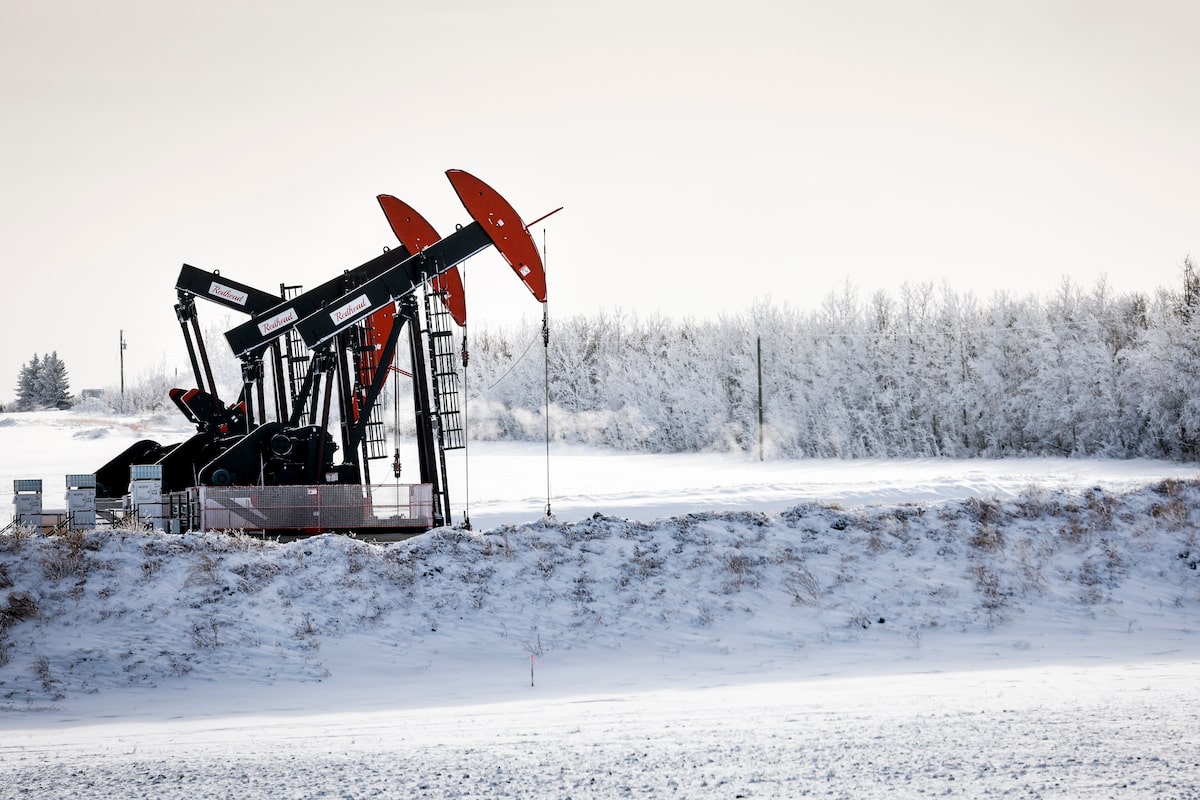
Alberta oil just got a whole lot more attractive for leaders in China, India, Japan, South Korea and every other country that fuels its economy with crude that must travel through the Strait of Hormuz.
The latest conflict between the U.S., Israel and Iran has effectively closed a sea lane that carries roughly a fifth of the world’s oil and natural gas.
For Asian policymakers paid to think in terms of generations, rather than the next election, the prospect of increased instability in the Middle East makes the case for boosting imports from Canada’s stable, long-life oil sands.
For politicians like Alberta Premier Danielle Smith, heightened sensitivity to the vulnerability of energy supplies can help turn the political push for a second pipeline to the B.C. coast into a business pitch. The federal government can expect Asian refiners to be motivated bidders for stakes in the existing Trans Mountain link.
China runs on oil from the Persian Gulf. The country imports roughly 11 million barrels per day and more than half those barrels transit the Strait of Hormuz. Its other major supplier is Russia.
What to know about the Strait of Hormuz
Canadian oil exports to China account for just 200,000 barrels per day. Those relatively small shipments are up significantly since the Trans Mountain expansion opened for business two years ago.
India, South Korea and Japan are even more dependent on Middle Eastern suppliers, as those countries are in various stages of weaning themselves from Russian oil.
Predicting where the U.S. campaign for regime change in Iran will end up is a mug’s game.
There are scenarios that see the Iranian people get the fair and just government they deserve, which would move geopolitical concerns around seaways to the backburner. There are also scenarios featuring hardliners from the Islamic Revolutionary Guard Corps taking control of the country and keeping the strait essentially closed as a negotiating tool with the U.S.
No matter how the Iranian conflict unfolds, Asian policymakers got a brutal reminder of their energy vulnerability early Monday when the price of oil soared to US$71 a barrel.
Eric Reguly: U.S., Iran could use oil as a weapon in the war. They may not
The Alberta government, and potential operators like Enbridge Inc. or South Bow Corp., don’t need direct investments to justify building another pipeline. Long-term contracts with Asian refiners to buy the oil would be a reason to break ground on the project.
The same sort of contracts with Trans Mountain would mean front-of-the-line access to bitumen, while increasing the value of the pipeline when the federal government decides to sell an asset that cost taxpayers $34-billion.
Asian energy companies have long been investors in both Canadian oil sands and natural gas.
In 2013, state-backed China National Offshore Oil Corp. made what in hindsight was a poorly timed $15-billion acquisition of Calgary-based Nexen. The purchase made CNOOC a major oil-sands player, as owner of the Long Lake facility that pumps 72,000 barrels per day. Korea Gas Corp. is a significant investor in the LNG Canada export terminal in Kitimat, B.C.
The same logic that prompted these bets – diversifying suppliers to include stable, long-life Canadian producers – may now inspire doubling down.
Investors are shrugging off oil-shock risk too easily
A sustained bout of higher oil prices would hammer consumers who are already struggling with affordability. However, the Canadian and Alberta economies stand to benefit if crude stays at these levels, or the gap narrows between world prices and what Alberta producers receive.
Every sustained $10-per-barrel increase in oil prices will lift Canadian GDP by up to 0.5 per cent in 2026, according to a report on Monday from Bank of Nova Scotia economist Derek Holt, “while doing relatively little to U.S. growth given its smaller net export status.”
The leverage is even higher for Ms. Smith’s government, which just announced that it would run a $9.4-billion deficit this year. Every US$1-per-barrel increase in the price of oil, or an equivalent tightening in spreads, translates into at least $680-million in additional provincial royalty revenues. Those are the fiscal silver linings in the very dark clouds over Iran.
Conflict in Iran is one of those crises that Canadian politicians can’t let go to waste. Deep-pocketed Asian energy companies are revisiting their reliance on supplies from the Persian Gulf.
Investors around the world are piling into the HALO trade – a Goldman Sachs-coined acronym for investing in companies with “heavy assets, low obsolescence.”
Alberta’s oil sands and natural gas and the infrastructure that gets these fossil fuels to customers are the definition of HALO investments.