
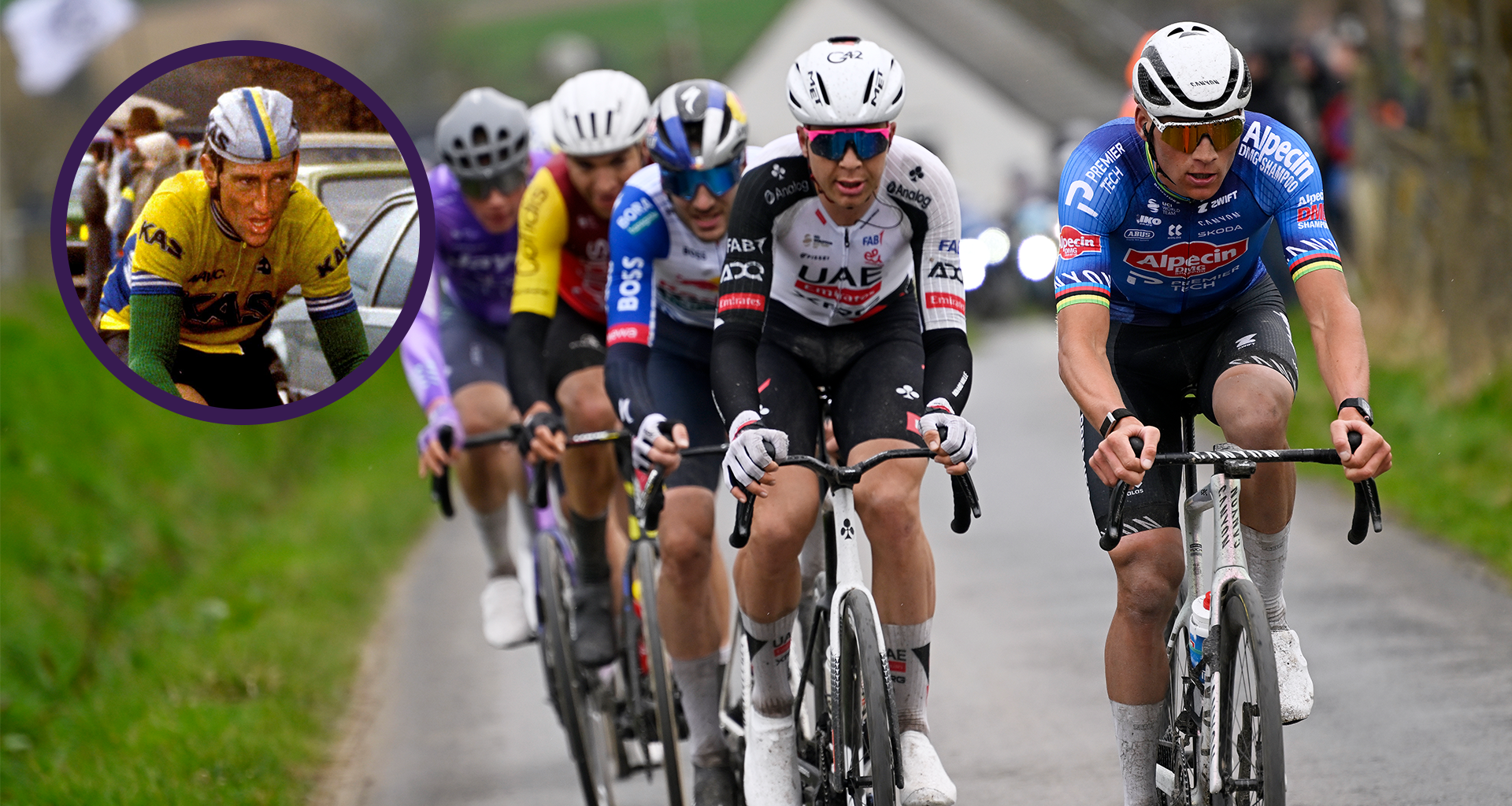
I was looking forward to Omloop Het Nieuwsblad until Mathieu van der Poel announced he was riding. It’s always an interesting one, the first of the Classics, with a lot of question marks, and I was looking forward to a good race, an exciting race, and probably a race with a bit more suspense than the one we got. But unfortunately, when he announced he was riding on Thursday, I could not help but feel – like many of the riders no doubt – a little disappointed.
As it turned out, he made it look so, so easy. But don’t get me wrong, Van der Poel is still impressive to watch. He is phenomenal, not only physically but also technically. He’s just able to read the race so well, and his bike handling is excellent.
He showed that on the Molenberg, when the Tudor rider [Rick Pluimers] crashed in front of him, which was a crucial moment. What struck me was that he seemed so cool when it happened. A lot of riders would have reacted with a sudden movement. He just moved calmly, got his foot out, nipped around, and got moving again. That is just class bike handling. When you’re in a moment like that, and you’re fighting on the climb, and the adrenaline is flowing, to be able to have that cool head is a huge thing.
You may like
That said, one of the big question marks was whether his rivals could have done more. It was interesting to see the scenes beyond the finish line with Van der Poel’s two breakaway companions. Florian Vermeersch and Van der Poel give each other a big hug, but Tim van Dijke didn’t get anything – he was basically ignored after the finish line.
‘His market value would be a good bit higher’
Vemeersch, on the other hand, didn’t skip a turn. I was watching it, wondering, ‘Why is he riding that strongly with him?’ He was too generous, in my eyes.
There has been all this talk ahead of the Classics of the only way to put pressure on Van der Poel and Pogačar being to refuse to collaborate with them at the front – Tiesj Benoot said as much. But on Saturday, it was the same story.
When you’re with Van der Poel, and you’re going into the final 25km, and the Muur is coming up, you say, ‘I better conserve energy here and see what I can do on the Muur.’ Yes, it’s a Classic, it’s Belgium, these guys are so up for it, but that’s when you need a good Directeur Sportif. They can see everything that’s happening, and they can give you that word in your ear to say ‘okay, here’s the situation, just take it easy, if you’re doing turns just do a very short turn, leave Mathieu to do the bulk of the work, maybe skip a turn here and there, and see if you can get over the Muur with him’.
If you do manage to get over the Muur with Van der Poel, you go into the final with him, and then you never know what might happen. You can play your cards, maybe put the pressure on him to keep the gap, and then you just never know what you can do in a sprint. If you look at Van Dijke, he was struggling, but the way he survived with Vermeersch on the Muur showed how well he played his own card. If he had been contributing beforehand, he may well not have been able to get up the Muur as well as he did – and he goes on to finish second.
You may like
I don’t know what Vermeersch and his directors were thinking, really. I was asking myself if it was because of the situation with the UCI points, but this is UAE Team Emirates-XRG, and the points cycle has only just begun. I’ve heard it argued that Vermeersch is out of contract at the end of the year, so was happy not to gamble with a podium result. Well, what I say to that is, imagine if he had played it a bit more tactically and just managed to hold onto Van der Poel and get into the final.
We don’t remember the guys who did a lot of riding up until the crucial point of the race – that will be forgotten quickly. But if you get into a final with Mathieu van der Poel, and you put him under pressure, and he has to ride, and it’s suspense right to the very end… then we’re all talking about how Florian Vermeersch took it to Mathieu van der Poel in Nieuwsblad, and I’d say his market value would be a good bit higher than it is right now.

Niewiadoma-Phinney didn’t have many options as she headed towards a two-up sprint with Vollering, who ultimately came out on top (Image credit: Tim de Waele/Getty Images)
I was left with similar questions after the finish of the women’s race.
Kasia Niewiadoma-Phinney kept on riding full-on, when it was always going to be difficult to see her beating Demi Vollering in a sprint. After the Muur and the Bosberg, the workload was pretty much 50-50, from what I could see.
There’s not a lot Niewiadoma can do in that situation, but she could have started to play that game a little bit. I was expecting her to stop contributing quite so much and to put the pressure on Vollering a bit more, but no, she just continued all the way.
Then, when she got into that final kilometre, she could have just sat on the wheel, but Vollering flicked her elbow, and Niewiadoma simply came through, keeping the pace high.
There was not a lot she could do, but I do think she should have played it a bit more tactically in the final number of kilometres, and certainly in the final kilometre.
Maybe I’m guilty of the ‘back in my day’ mindset, but to me, sometimes that’s the only chance you have at winning, so why not take it?
Crashes
One theme of the Opening Weekend was riders on the deck. It didn’t used to be quite so intense at this point in the season, but that’s the way racing has gone these days. My goodness, it was just crazy stuff.
Going back to the one that Van der Poel was able to avoid on the Molenberg, the way the rider charged in that corner – he was on the wrong side of the crown, going around the slight bend, and he was going full gas. The bike is just going to go from under you, and that’s what happened. Many riders were caught behind, and for many of them, it meant they’d never get to the front of the race. I’m sure if you’re a rider up there in the front end of the race, feeling good, and you get caught up behind, you’d be pretty annoyed about that.
We saw so many other crashes across the weekend, and it was uncomfortable to watch. It’s just so dangerous now, and it’s getting worse and worse, with the speed of the racing and the aggressive way they’re racing. Ok, there’s always the risk of crashes, and they do happen. But everybody seems to be fighting for every centimetre of road, and nobody is backing off at all. So you get all these crashes and all these broken bones. When you look at the amount of work these guys put in from December, and you get a bad one and your Classics season is over, it must be horrendous.
The UCI have to start doing something. They have introduced some equipment rules and have some things they want to do, including the idea of gear restrictions, but the issue has to be looked at immediately, because the way things are going, the Spring might just be a big crash-fest.