
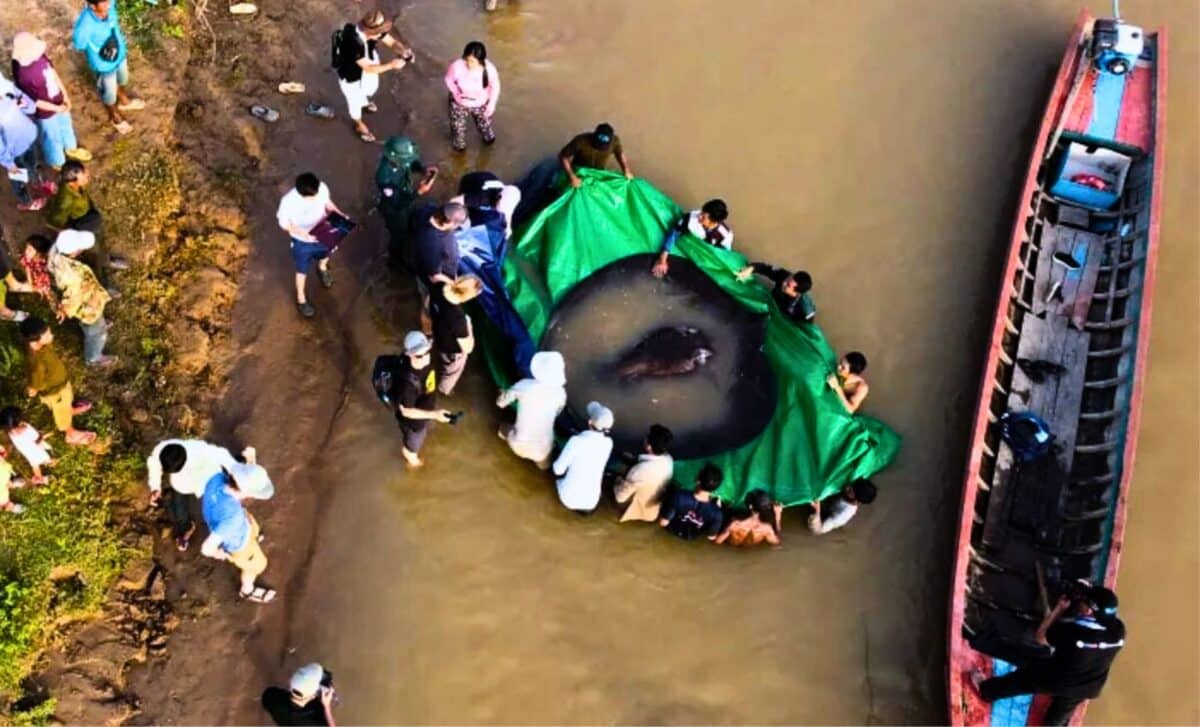
Along a wide, brown stretch of the Mekong River, fishing boats move slowly against the current, their engines low and steady. Nets drop into water that can plunge dozens of meters deep, disappearing into silt and shadow. Most days bring modest catches that feed families and local markets. But every so often, something pulls back from below with a force that feels almost prehistoric.
In June 2022, that pull turned into a scene few people present will forget. Fishers near Koh Preah island in northern Cambodia realized that what they had hooked was far heavier than anything they had handled before. The animal did not thrash like a typical river fish. It pressed downward, anchoring itself to the riverbed with sheer mass.
When the team finally brought it to the surface, they were staring at a broad, mud-colored disk wider than a doorway. Its long tail trailed behind like a thick cable. It took more than a dozen people working together to secure it onto a reinforced tarp along the riverbank.
Only after the weighing equipment was set up did the scale of the moment become clear. The massive ray tipped the scales at 300 kilograms, stretching 3.98 meters from snout to tail. Scientists soon confirmed it was the largest freshwater fish ever officially recorded.
Guinness Confirms the 300 Kilogram Record
The animal was identified as a giant freshwater stingray, scientifically known as Urogymnus polylepis. Researchers connected to the Wonders of the Mekong project, supported by the University of Nevada, Reno, were called in to examine the catch. They carefully measured the fish, documented its dimensions, and verified the final weight using certified scales.
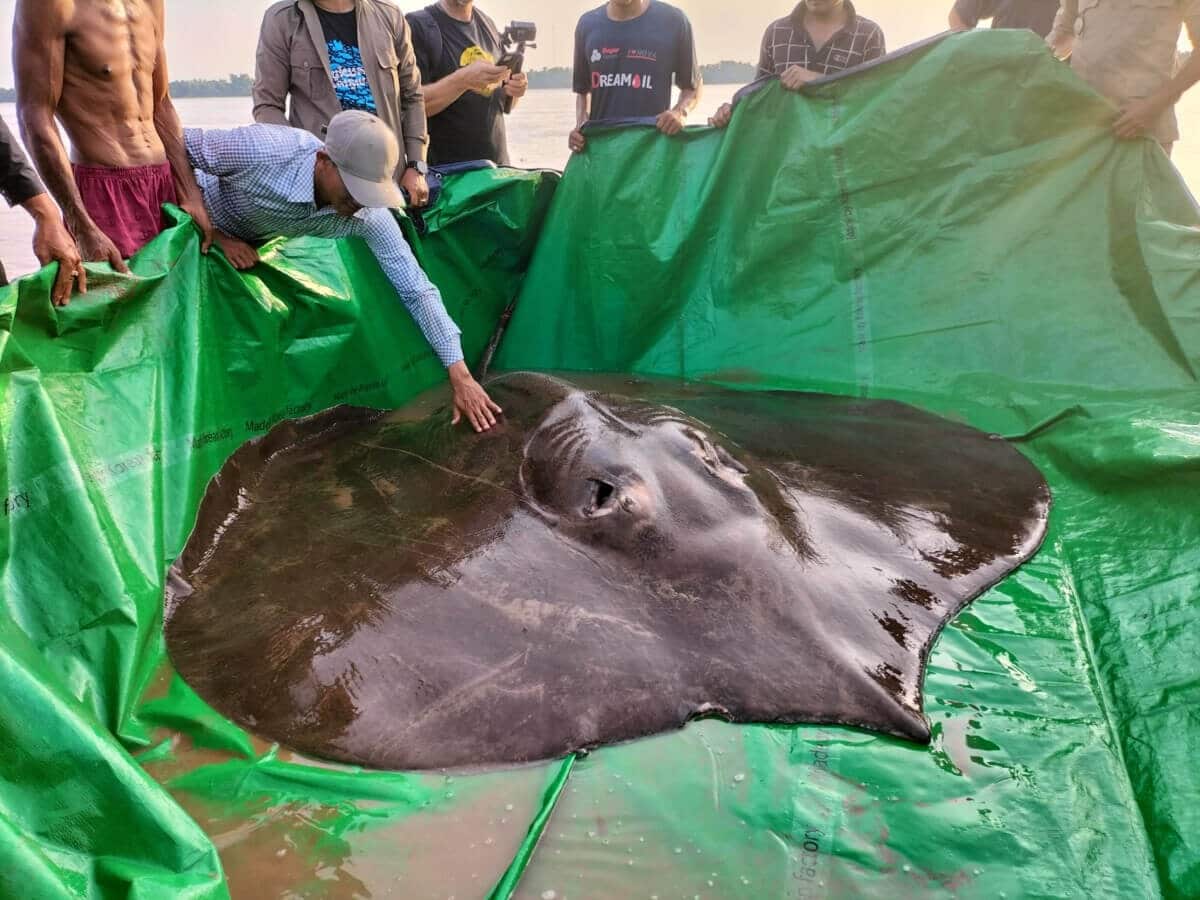 The enormous freshwater stingray discovered near the village of Koh Preah, an island in the Mekong River, Cambodia. Credit: Jack Eschenroeder
Shortly afterward, Guinness World Records reviewed the documentation and recognized the specimen as the largest freshwater fish ever recorded. The new mark surpassed the previous record of 293 kilograms, held by a Mekong giant catfish caught in Thailand in 2005. That earlier fish had stood as a benchmark for nearly two decades.
The confirmation placed the Mekong River back at the center of global attention for extreme freshwater biodiversity. Unlike ocean giants such as whale sharks, freshwater fish rarely reach such enormous sizes due to limited habitat space. That makes a 300 kilogram river fish especially remarkable in scientific terms.
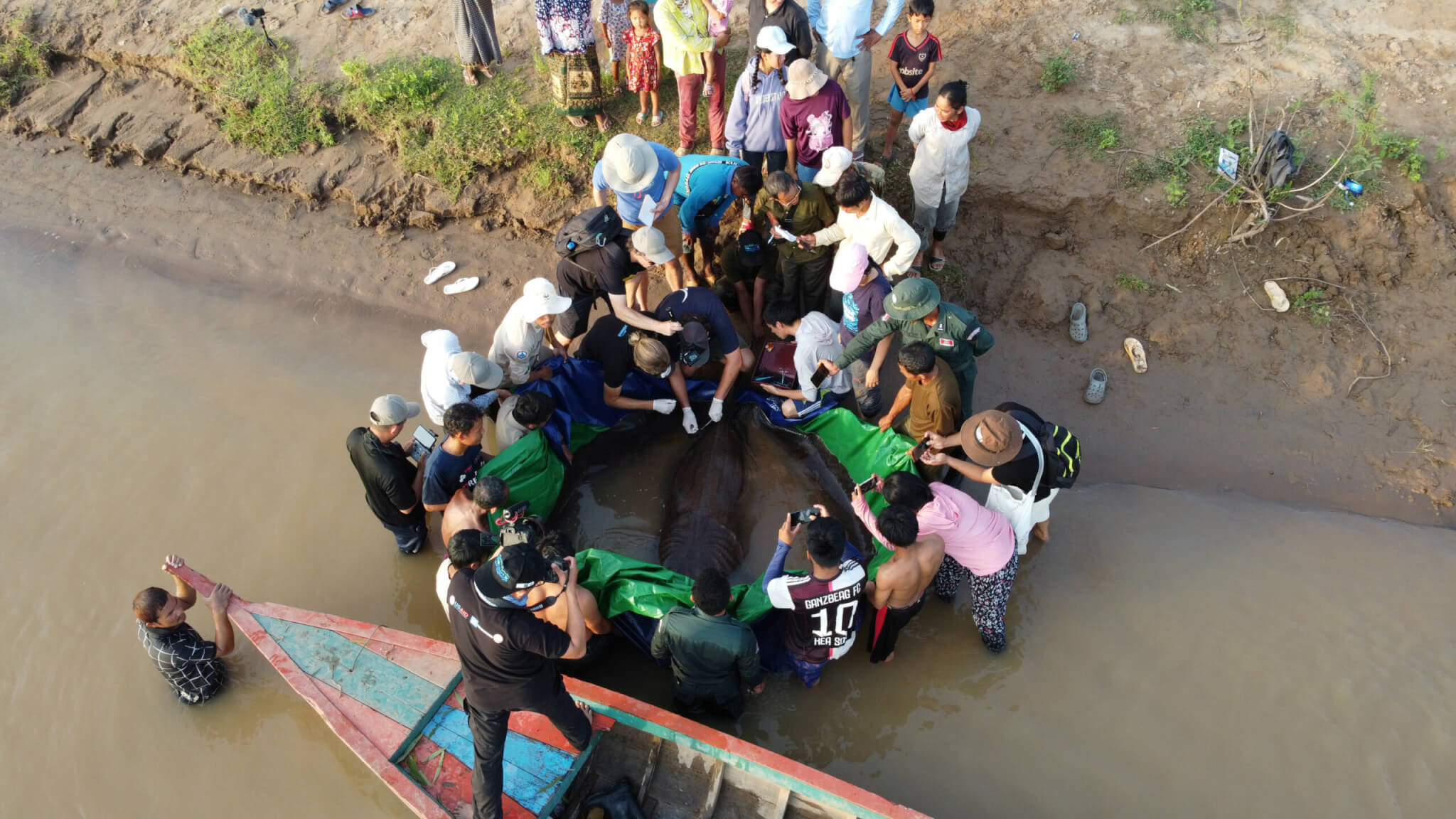 Guinness World Records confirmed the stingray as the world’s largest freshwater fish to ever be officially recorded. Credit: Jack Eschenroeder / Wonders Of The Mekong
After the measurements were complete, the team fitted the stingray with an acoustic tracking tag. It was then guided back into the river and released alive. The entire process was designed to minimize stress and allow researchers to monitor its movements in the months ahead.
A Rare and Elusive River Giant
The giant freshwater stingray is one of the least understood large fish species in Southeast Asia. It spends most of its life pressed against muddy river bottoms, often in deep channels that are difficult for scientists to survey. Its flattened body allows it to blend into sediment while hunting small fish and invertebrates hidden below the surface.
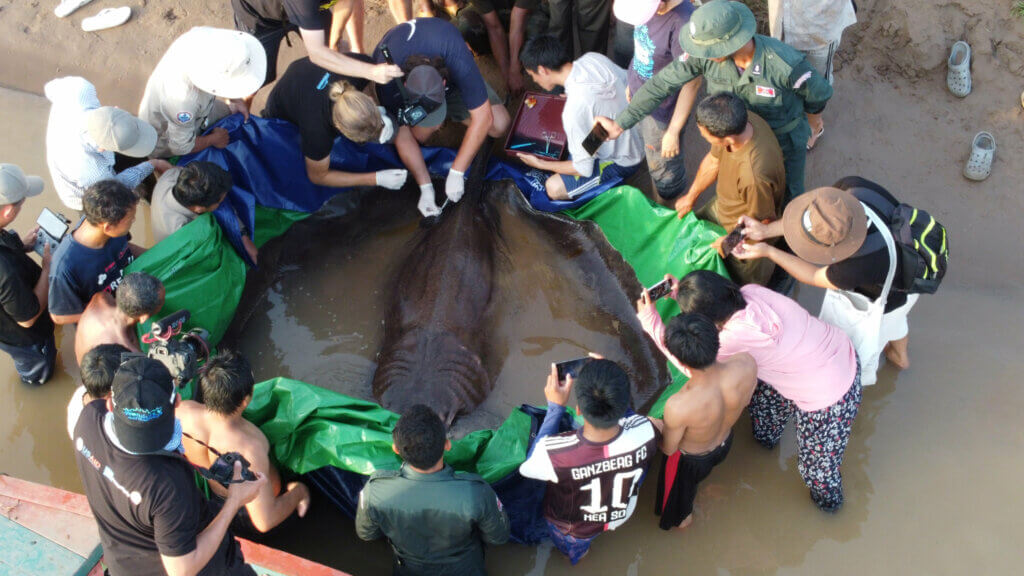 Researcher Jack Eschenroeder, described the discovery as “surreal.” Credit: Jack Eschenroeder/Wonders Of Mekong
Although the species can grow to enormous dimensions, confirmed encounters with individuals of this size are rare. The International Union for Conservation of Nature lists Urogymnus polylepis as endangered due to overfishing and habitat disruption. Large dams, sand mining, and heavy fishing pressure have altered significant portions of the lower Mekong basin.
The Mekong itself runs about 4,350 kilometers from the Tibetan Plateau through China, Myanmar, Laos, Thailand, Cambodia, and Vietnam. It supports one of the world’s largest inland fisheries, providing food and income to millions of people. That same productivity also means intense human activity along much of its length.
Researchers believe the record-breaking stingray may have been decades old. Freshwater rays grow slowly, adding mass over many years if conditions remain stable. Individuals that survive long enough can reach extraordinary sizes, but few are ever documented and measured with scientific precision.
Why the Mekong Still Produces Giants
Biologists say the Mekong River has unique ecological features that allow certain fish species to reach extreme sizes. Seasonal flooding expands feeding grounds, while deep pools provide refuge during dry months. Nutrient-rich sediment carried from upstream regions supports dense food webs throughout the basin.
The previous record holder, the Mekong giant catfish, also depended on these conditions before its population declined sharply. That species is now critically endangered, largely due to dam construction and overfishing. The stingray’s survival to such a massive size suggests that some stretches of the river still maintain suitable habitat for large, long-lived fish.
Data from the tracking tag attached to the ray will help researchers map its movements and preferred habitats. Scientists hope the information will clarify whether these giants migrate long distances or remain in specific deep-water refuges. Such data remains limited because so few individuals have been tagged.