
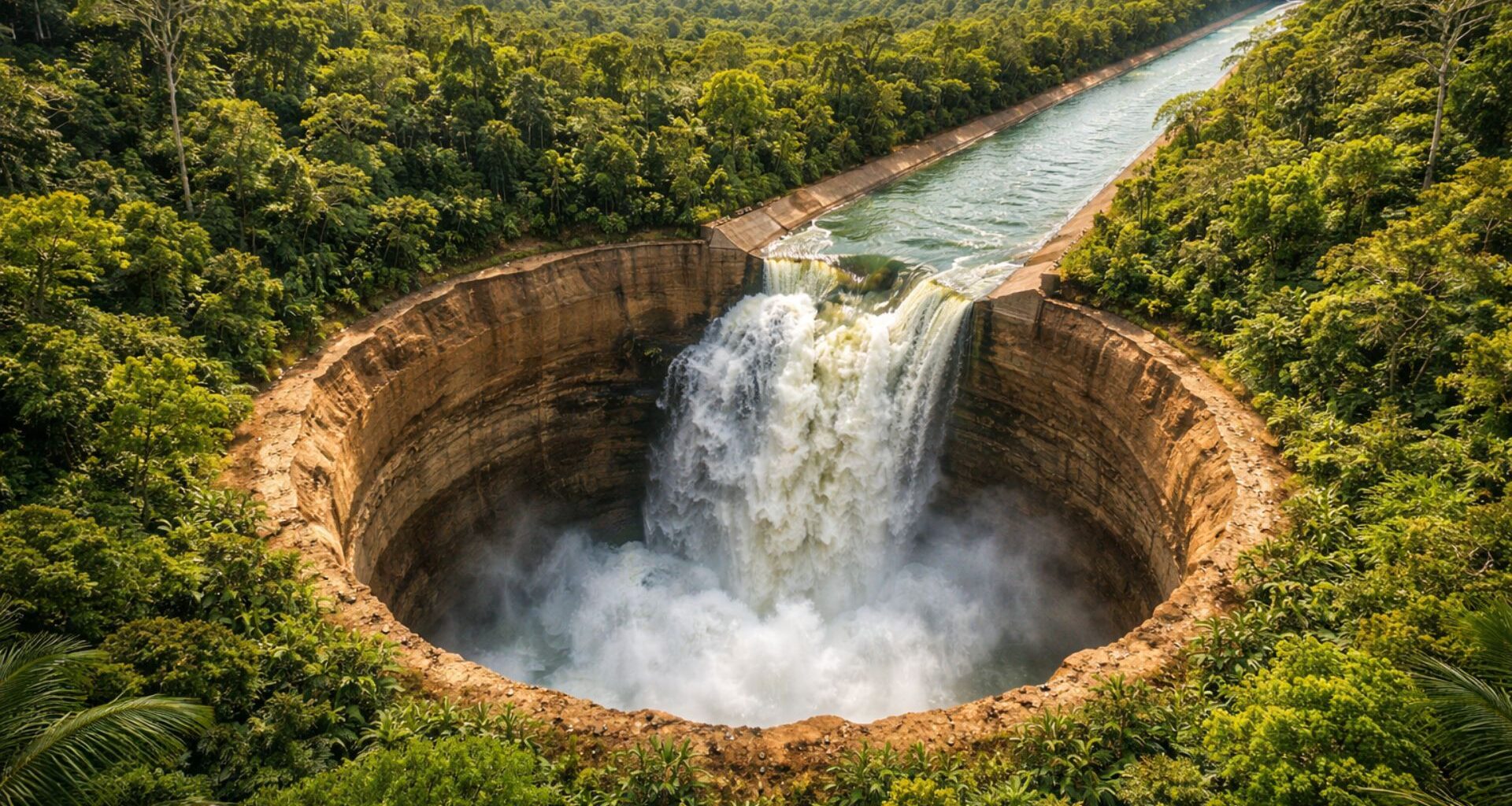
The underground reservoir beneath the Amazon holds an estimated volume of over 162 km³ of fresh water, surpassing the Guarani Aquifer in total capacity. Studies indicate strategic potential for regional water supply, but warn of technical and environmental limitations, as well as management challenges.
The Amazon region contains, underground, a set of aquifers grouped by researchers such as Greater Amazon Aquifer System (SAGA), with estimates reaching 162.520 km³ of fresh watervolume greater than that of Guarani Aquifer, frequently cited with 37.000 km³.
Although the number is enormous, experts treat this type of comparison as purely theoretical, because underground reserves do not automatically convert into water available for safe withdrawal, nor can they be exploited indiscriminately without local impacts.
The Great Amazon Aquifer System and Alter do Chão
SAGA is described in the technical literature as a system that brings together geological units with the capacity to store groundwater under the basins of the Acre, Solimões, Amazonas and Marajó rivers, forming a hydrogeological mosaic associated with the Amazon Hydrogeological Province.
Recommended for you
Fairs and events
A major event for the oil, gas, and energy sector will take place in Brazil: Macaé Energy will bring together Petrobras, Equinor, Prio, and other suppliers and executives from the energy sector for business, networking, and job opportunities.
The technical agenda and trade fair in the city of Macaé should boost discussions about investments, energy transition, and the development of the oil, gas, and energy supply chain in the national context. The city…
Within this set, the Alter do Chão Aquifer It gained prominence for concentrating studies and for appearing with very high volume estimates in dissemination materials, frequently cited in the context of 86,4 thousand km³ and with an approximate area of 437,5 thousand km².
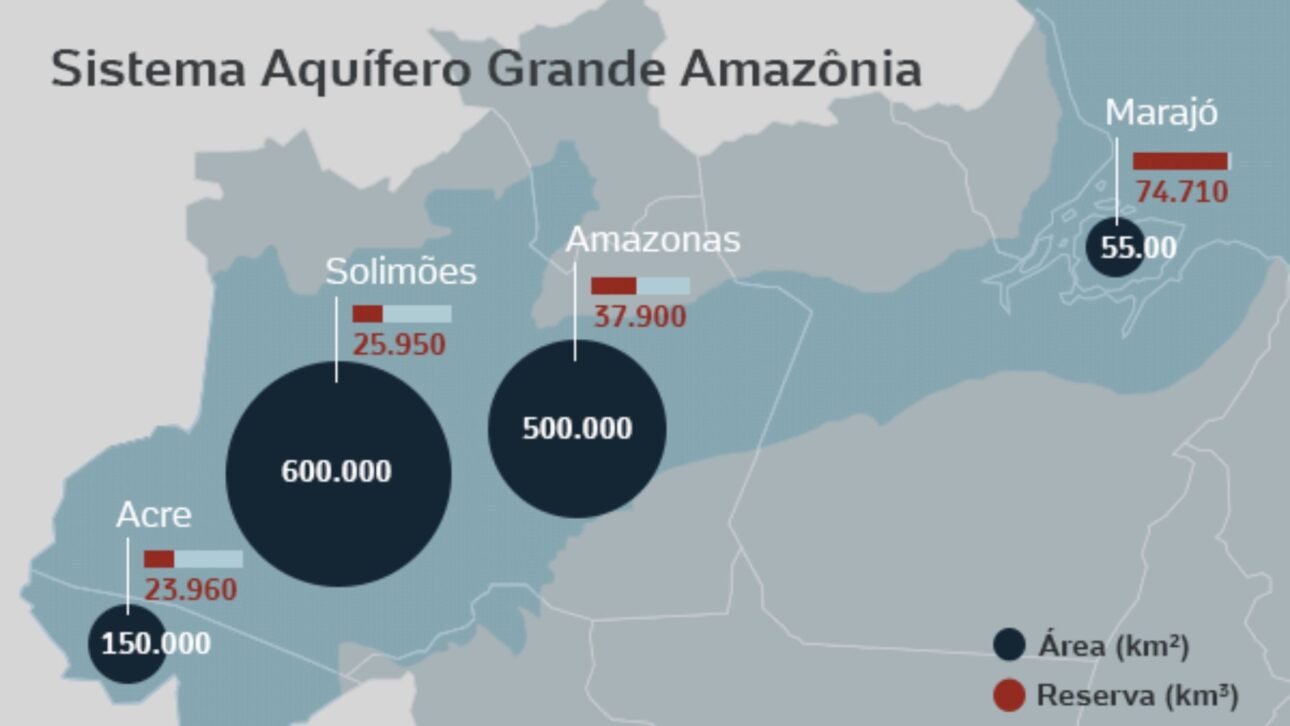 The Great Amazon Aquifer System holds 162 km³ of fresh water beneath the Amazon and surpasses the Guarani Aquifer in estimated volume.
The same discussion, however, is often accompanied by methodological warnings, because volumes depend on parameters such as porosity, saturated thickness, and considered extent, which causes different studies to produce results that are not always comparable.
Depth and the use of the expression “underground ocean”
The expression “underground ocean” functions as a metaphor to communicate scale, but it doesn’t describe a void filled with water; it refers to water stored in the pores and fractures of the earth. rocks, in layers with some sections being more productive and others less permeable.
When it comes to depth, the data also varies by region: there are didactic descriptions that place shallower, open areas and confined sectors at hundreds of meters, which helps to explain why the uptake is uneven and depends on local conditions.
The reference to 3.000 meters beneath the Amazon It frequently appears in recent content, but it is not the most common way to characterize Alter do Chão, and it is often mixed with discussions about deep underground flows investigated from oil wells.
Comparison with the Guarani Aquifer
O Guarani Aquifer It remains one of the largest transboundary reserves in the world and extends across Brazil, Argentina, Paraguay, and Uruguay, with widely publicized cumulative volume estimates from Brazilian public agencies in the range of 37.000 km³.
In technical work, the debate about magnitudes usually includes not only total volume, but also notions of recharge and exploitable portion, since not all stored water can be safely withdrawn and replenished commensurately over time.
In this type of analysis, comparisons such as “four times larger” depend on which numbers are taken into account, and may vary depending on whether the source uses estimates for the entire SAGA, for Alter do Chão in isolation, or for different sections of Guarani.
Could it power the world for centuries?
The idea that the water The idea that the Amazon’s underground reserves could supply the planet for centuries often arises from a simple division between estimated volume and global consumption, but this reasoning fails to consider technical limitations, costs, logistics, and, most importantly, the environmental effects of intensive extraction.
Furthermore, the very concept of “reserve” can be interpreted in different ways, because a portion of what is stored may be slowly renewed, and withdrawing more than is recharged tends to lower levels, reduce flow rates, and increase the risk of degradation.
On the other hand, the regional use of groundwater is already significant in Amazonian cities, and technical studies indicate that, in Manaus, a significant portion of the public water supply relies on water intakes associated with Alter do Chão.
Preservation and governance challenges
Even when water is considered to be of good quality in many places, reports and studies point to vulnerabilities associated with urbanization, lack of sewage collection and treatment, and the presence of potential sources of contamination in urban and peri-urban areas.
Another recurring problem is the limitation of continuous monitoring, since observation networks need long data series to identify trends, and technical bodies describe efforts to deploy and expand monitoring in strategic aquifers.
Since SAGA relates to a vast and, in parts, transboundary area, governance also presents a practical challenge, because actions for protection, well control, and usage rules require coordination between federative entities and, when applicable, international dialogue.
Instead of promises of water exports or “infinite” availability, the discussion that best aligns with what science and public management can support today revolves around sanitation, protection of recharge areas, licensing, oversight, and data transparency.
With moderate extraction and planning, aquifers can function as a strategic reserve to weather droughts, support urban expansion, and reduce pressure on surface water sources, but this depends on clear rules and an increasingly refined hydrogeological picture.