
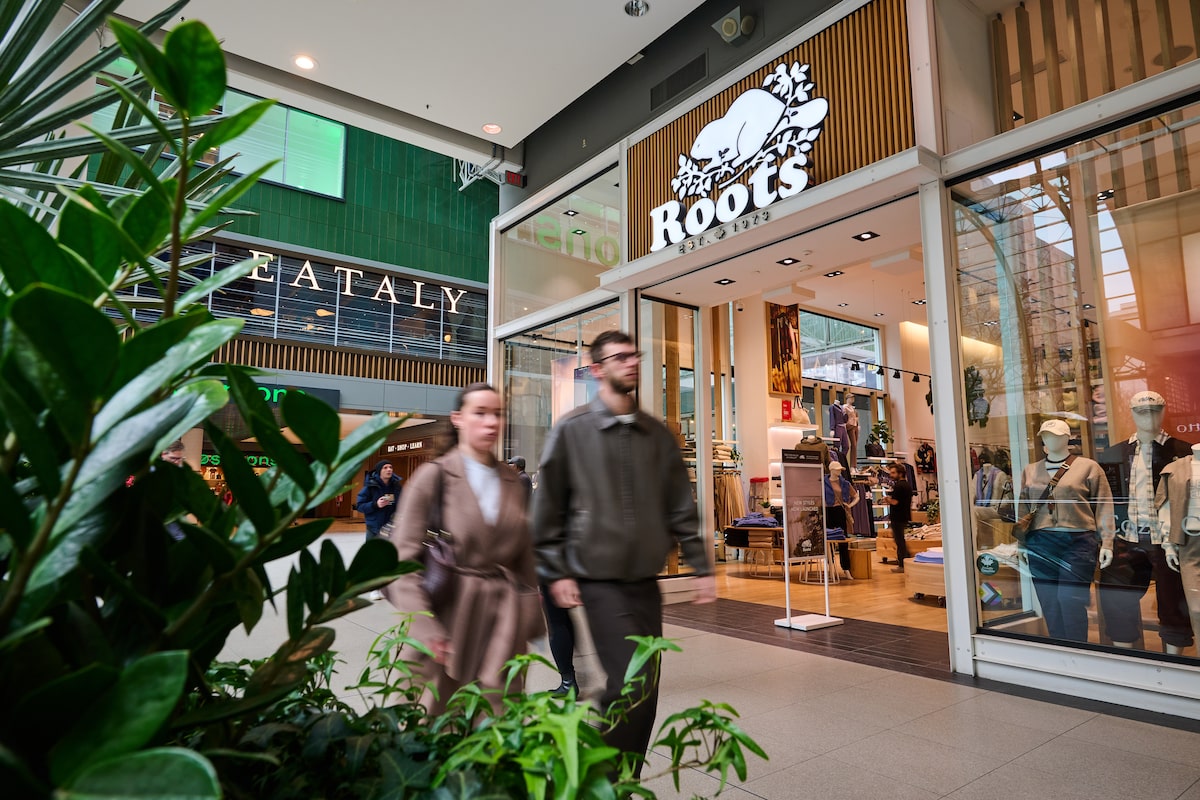
Shoppers pass a Roots store in Toronto’s Eaton Centre on Tuesday.Sammy Kogan/The Globe and Mail
Retailer Roots Corp. ROOT-T could be up for sale as the iconic Canadian clothing and accessories brand launches a strategic review of the company.
Toronto-based Roots, which has cultivated an image deeply tied to Canadiana over its 53-year history, announced on Tuesday that its board will be looking at a range of options for the company that could include a sale or other measures.
Roots has roughly 100 stores in Canada, two locations in the United States, and another 100 partner-operated stores in Asia. The company, known for selling loungewear such as sweatpants and “cabin socks,” as well as leather goods, has been majority-owned by private equity firm Searchlight Capital Partners since December of 2015. It completed an initial public offering on the Toronto Stock Exchange in October, 2017.
Founders Michael Budman and Don Green, who met at an Ontario summer camp and launched Roots in 1973, continue to own roughly 13 per cent of the shares.
Searchlight took a majority stake with the intention of accelerating the company’s expansion and building its international presence, but growth has been significantly slower than expected.
Roots CEO says shoppers remain price-sensitive as retailer records lower profit, sales up 7%
In a prospectus filed just before the IPO, Roots estimated that its annual sales would grow to a range of $410-million to $450-million by 2019, but walked back that guidance the following year. In the fiscal year ended Feb. 1, 2025, total revenue was $262.7-million.
The retailer’s “financial track record has not achieved expectations outlined during its IPO,” TD Cowen analyst Brian Morrison wrote in a research note published on Tuesday morning. He added that Roots has consistently generated had strong free cash flow, but has a “limited growth profile,” and estimated that in a sale scenario, it would fetch a price at the “low end” of its peer group in the retail industry.
In an e-mail, Roots chief executive officer Meghan Roach declined to comment on why the board had decided to launch the strategic review at this time.
“As this is a board-led process, I cannot comment on the intentions of any investors,” wrote Ms. Roach, who joined the company from Searchlight Capital in 2020.
Roots’ share price, which has hovered around $3 per share so far this year, jumped 13 per cent in trading on Tuesday following the announcement to close at $3.40.
The company’s sales performance has been improving: Roots’ comparable sales grew by 11.5 per cent in the first three quarters of its fiscal year.
But in recent years, profitability has declined. Excluding a one-time impairment charge – which caused Roots to report a net loss in the fiscal year ended Feb. 1, 2025 – net income would have been $3.3-million. That was an improvement from the prior year, but just half the income the company reported two years earlier, and down significantly from the postpandemic recovery years.
Under Ms. Roach’s leadership, Roots has been cleaning up its operations – including cutting back on the number of items sold at a discount, improving its mix of merchandise, and reducing the cost of producing its products. Roots has also been spending more on advertising, to try to revive the brand in customers’ minds.
“Younger people are going retro, and they haven’t found Roots yet,” said retail industry consultant David Ian Gray. “Maybe there is an opportunity to reconnect with a younger audience. But that’s going to take more digital savvy than they have now.”
For some demographics of Canadian shoppers, on the other hand, Roots has enviable, almost universal brand awareness – but that can be both a blessing and a curse, said Randy Harris, president of market research firm Trendex North America.
“When you have awareness like that, people say, ‘I don’t need to look at that; I know what they’re about,’” he said.
Roots has also been eyeing U.S. expansion – an effort the company abandoned in 2020 – but succeeding in that market takes significant investment, Mr. Gray said.
“If you look at what Aritzia has been doing, that’s not an overnight success,” he said. “They’ve been investing persistently there, and putting serious money into it.”