
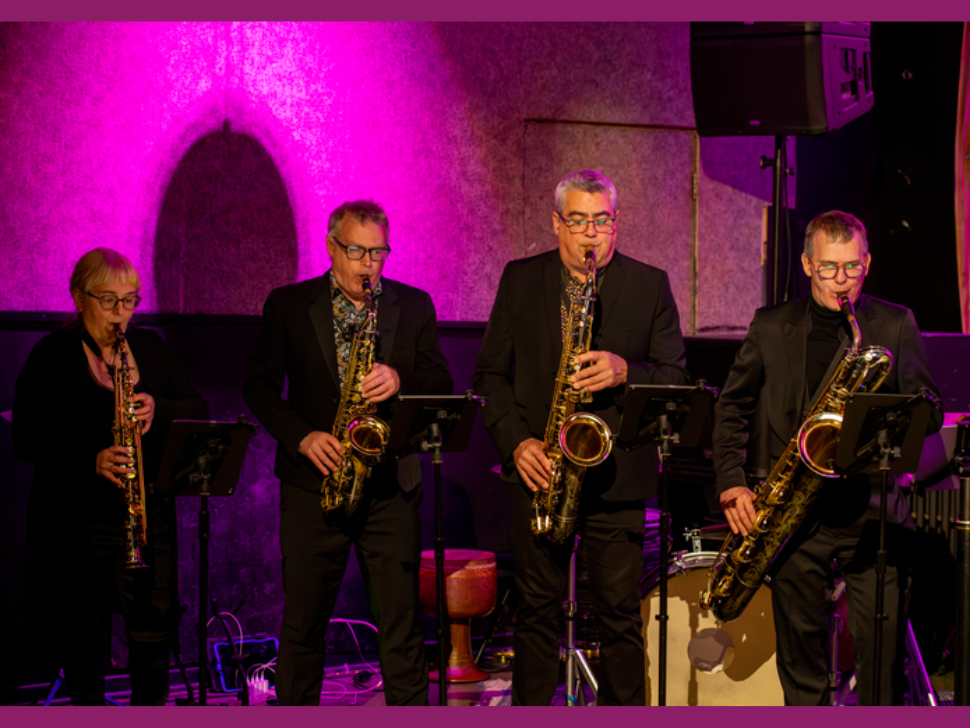
Coming up this Thursday, March 5th at 7:30 p.m. at the Muriel Richardson Auditorium, at the WAG-Qaumajuq, Winnipeg’s GroundSwell presents the third concert of its 2025–26 season. Titled Vestigial Structures, the program features the acclaimed Quasar Saxophone Quartet from Montreal in a concert that promises to be as immersive as it is innovative.
The ensemble will perform works by University of Manitoba composition professors Örjan Sandred and Gordon Fitzell, alongside music by Bekah Simms, Egidija Medekšaitė, and a new composition by Groundswell’s National Emerging Composer Competition winner Tokuto Fukuda.
Celebrating more than 30 years of artistic innovation, Montreal’s award-winning Quasar Saxophone Quartet has commissioned and premiered over 200 works and recorded seven albums. Their repertoire spans acoustic and electroacoustic music, multimedia projects, improvisation, orchestral collaborations, and works that bridge classical and jazz traditions. Known for their close collaborations with composers, Quasar continues to push creative boundaries and champion experimentation in contemporary music.
“This is a concert that is meant to be heard and fully experienced,” host Chris Wolf noted in conversation with curator Gordon Fitzell and quartet members Marie-Chantal Leclair and Jean-Marc Bouchard.
Three Decades of Collaboration and Innovation
Fitzell, who curated the program, has known the ensemble for most of his professional life.
“They have been a mainstay and a bright light on the new music performance scene for as long as I can remember,” he said. “And really spectacular.”
One of the most remarkable aspects of the quartet is its longevity and cohesion. “You’ve been together for over 30 years with no personnel change,” Fitzell observed, noting how that stability has refined the group’s collaborative approach.
Quasar’s work extends far beyond the traditional concert model. “There’s surround sound, there’s video, there’s close interaction between them, there’s interactive music where the computer is reacting to the music that they are creating acoustically,” Fitzell explained. He also emphasized the importance of their technical collaborator: “They travel with a very talented technician, Vincent, who is really like a fifth member of the group in a sense.”
For Marie-Chantal Leclair, working across generations of composers is central to the ensemble’s artistic mission. “What I really like is to mix generations,” she said. “So not to do necessarily a separate project for young composers but really to mix them with more experienced composers.”
She added that the exchange benefits everyone involved: “It’s inspiring both ways, both for the more experienced and for the newcomers on the scene.” Staying connected to emerging voices also ensures relevance. “If you want to stay pertinent, relevant as an ensemble, you need to stay in touch with, you know, the new generation.”
Working With Composers From the Very First Idea
One recurring theme throughout the conversation was collaboration at the earliest stages of creation.
“We start working with the composer at the very first stage, ideally before they start writing the piece,” Jean-Marc Bouchard explained. “So we know what the idea is there, and they would propose to us some way of getting their ideas.”
If something proves impractical, the dialogue continues. “If it works, it works. If not, we are there to help find solution, or they have to manage to adapt their idea.”
That hands-on approach extends to educational outreach. During their Winnipeg visit, Quasar is working with students from the University of Manitoba’s composition department.
“For us, of course, the main concert is something, you know, maybe the first focus,” Leclair said. “But when you visit a new city, it’s interesting to be more in relation, not just with people that are going to be there in for an hour or two in the concert hall, but to get to interact.”
Sharing experience is part of their mandate. “We think it’s our mandate, mission to share it with the new generation, not to keep it for ourselves,” she said. “I humbly think it’s valuable and I think it would be a shame not to share it with them.”
Fitzell sees the impact firsthand. “That’s one of the things that I think that immediately hits a young composer is how human and physical the experience is, which is very different than pressing play.”
A Video Game, Liminal Spaces, and Immersive Sound
One of the highlights of the concert is Tokuto Fukuda’s Super Colliders II, described as being inspired by video games.
“I would go a little bit further and say that it is a video game,” Bouchard said. “Literally, but we don’t have like a regular interface, controller. The saxophone as such is a controller through a microphone.”
The quartet controls the on-screen action in real time. “If we play louder, they go faster. [the balls on the screen] If we play softer… if we play higher, they go up,” Leclair explained. “Everything that is happening… is through the sound of the saxophones.”
Gordon Fitzell’s own work on the program, Liminal Spaces, a Study in Five Acts, explores transitional environments. “It generally refers to some kind of transitional space that’s on the border between being or becoming something else,” he explained.
The piece incorporates tightly synchronized video and found objects such as “walkie-talkies” and “rotary dial telephone,” evoking nostalgia. “In addition to four saxes, we also have four speakers, so we have quadrophonic sound as well,” Fitzell said. “So it’ll be, as we’ve said, immersive as an experience.”
Leclair described the collaboration process as extensive and rewarding. “We had two extensive sessions of workshops,” she said. “After every session, Gordon would go back to his work and refine things.”
Electronics, Extended Techniques, and Expanding the Sound Palette
The program also includes Örjan Sandred‘s Engrammes, a work that deeply integrates electronics.
“In this piece, the computer is really listening to the performer and reacting exactly to what we’re doing,” Leclair explained. “Here, really, it’s the computer who’s listening to us.”
Bouchard emphasized the seamless integration: “Perfect integration of electronics and acoustic sounds. Because we have the feeling of just playing in between us, but there are things that appears behind us.”
Bekah Simms’ Bug pushes the quartet’s sonic boundaries even further. Discussing playing baritone saxophone without a mouthpiece, Bouchard said, “It’s using the sax like a trumpet, finally.” He described it as “part of my tricks and my tools.”
Leclair framed these techniques as colouristic expansion: “It’s just like making our sound palette larger, you know, like adding colors.”
From blowing air through the instrument to percussive key sounds, the ensemble blurs the line between acoustic and electronic textures. “At times, it’s hard to tell what’s electronics and how can you make that sound on a saxophone when you realize it is this saxophone,” Fitzell observed.
A Collaborative Spotlight: Cities and the Next Generation of Creators
One of the most inspiring elements of Vestigial Structures is the inclusion of Cities, a new work created and performed by students from Collège Pierre-Elliott-Trudeau. Rather than simply interpreting an established score, the students themselves composed the piece, each contributing movements or sections built around the shared theme of urban life. The result is a true collective creation, a musical portrait shaped by young voices exploring their own ideas about rhythm, space, energy, and atmosphere.
The project is led by band director Brady Gill, a respected Winnipeg educator and musician, whose guidance has helped shepherd the students through both the creative and rehearsal processes. Supporting the students on the compositional side is collaborative mentor composer Kenley Kristofferson, who worked closely with them to refine their ideas, structure their material, and prepare the score for performance.
What makes Cities especially remarkable is that the students will not only perform their own music, they will do so alongside the Quasar Saxophone Quartet, with the quartet serving as featured soloists. It is an extraordinary opportunity for young composers and performers to share the stage with an internationally acclaimed ensemble, hearing their ideas come to life in collaboration with artists of this caliber.
In Cities, that philosophy becomes tangible: a professional concert stage becomes a platform for student imagination, guided mentorship, and meaningful collaboration; a living example of how GroundSwell fosters the next generation of composers and performers.
When asked what they are most looking forward to, Fitzell admitted, “There’s so many things,” before singling out the high school piece as perhaps “at the top of my list.”
Leclair agreed. “For us, it’s going to be a new experience,” she said. “I’m very curious actually to be part of this adventure.”
Bouchard summed it up simply: “To me, there is one adventure, and it’s the entire concert.”
Vestigial Structures takes place Thursday, March 5 at 7:30 p.m. at the Muriel Richardson Auditorium. Admission is pay what you can. For audiences seeking an evening where sound, technology, collaboration, and imagination converge, this promises to be a true feast for the senses.