

Warning: This article contains discussion of mental health conditions, child abuse and suicidal thoughts which some readers may find distressing.
A woman wrongly believed that she was a paedophile before a diagnosis revealed that she was suffering with a debilitating condition.
Molly Lambert, 22, began to experience violent and sexual intrusive thoughts when she was a teenager.
The thoughts became so intense that Molly was terrified that she was a danger to other people, and became wrongly convinced that she was a paedophile.
She remembers her fears began when she was 15 years old, and at the airport with her family.
“I saw a little girl wearing a crop top and short skirt and thought, ‘That’s weird for a child to wear that,’” she shared.
“And then I panicked – ‘why would I even notice that? Why would I think about that? She’s a child.’”
The conviction she was a pedophile returned when she was revising for exams.
She said: “I was 15 and I remember thinking, ‘Oh my gosh, I’m a paedophile – I thought, I’m never going to forget this thought. My life is over’.”
 Molly is now better able to manage her condition (SWNS)
Six months after her first intrusive thought about pedophilia, Molly started a job at a swimming pool cafe.
She said: “I remember thinking, there are kids here and I honestly thought to myself that I would have to kill myself on my way home.
“That’s how convinced I was that I was dangerous.”
Misunderstandings about intrusive thoughts have circulated widely on the internet in recent years, but the reality is that intrusive thoughts can be extremely distressing and debilitating to people who experience them.
While one person might imagine an ‘intrusive thought’ as something like swearing at a co-worker, for some people they can be extremely dark.
Molly, from Manchester in the UK, found out that she was actually suffering from a specific kind of mental health condition.
This is paedophile obsessive compulsive disorder, or P-OCD, where someone experiences unwanted intrusive thoughts about the sexual abuse of children.
P-OCD is not paedophilia, and left Molly distraught.
“I thought OCD was cleaning and tidying, that wasn’t me at all,” she said. “The more controlling forms of OCD like mine are the ones we don’t talk about.”
‘I was scared of going to bed’
It’s entirely normal to experience intrusive thoughts, and people without OCD are mostly able to recognise them as such and brush them off.
But someone who has OCD might experience them more intensely and find them impossible to ignore, leading them to believe that the intrusive thoughts are true.
“I genuinely thought I was a paedophile,” Molly said. “No matter what you’re worrying about, it’s the same brain process each time, but when it’s that deep, and such a horrid thought, the shame is unbearable.”
Over time, this can have a devastating impact on someone.
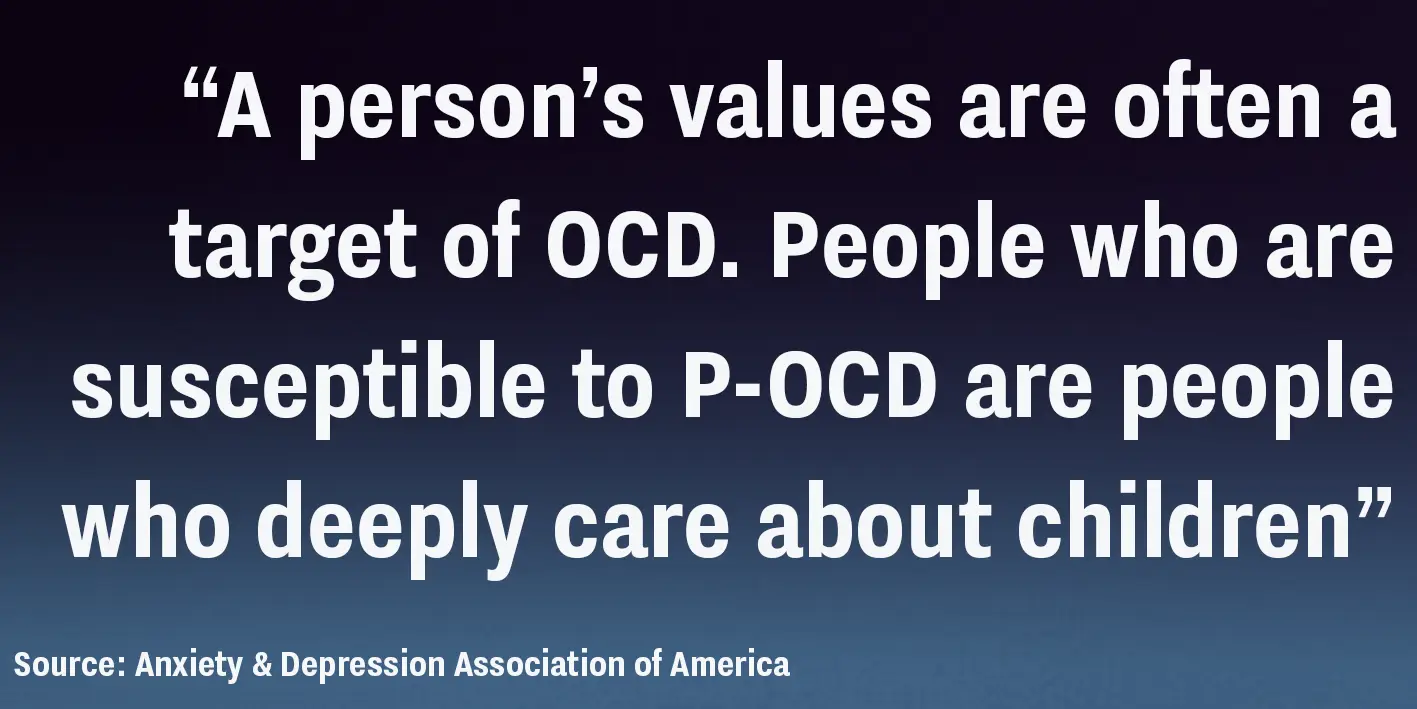 P-OCD is not the same as pedophilia (UNILAD)
“It was fight or flight constantly,” said Molly. “Every thought was dark, I wasn’t eating properly, I wasn’t sleeping, I was so scared of being alone and going to bed.”
Molly now realizes that she has had traits of the condition for a long time, but it wasn’t until she saw someone talking about P-OCD on TikTok that she was able to make the connection.
“I always had OCD traits,” she said. “I had graphic images about death, I was scared of everything.
“I’d obsess over things like Madeleine McCann and worry I would get kidnapped.
“I even have a phobia of dogs and I’d think – ‘what if I fancy my dog?’ I knew I didn’t feel anything, but what if I was unsafe to everyone?”
Molly is now starting to manage her condition after starting therapy, and wants to help other people who are living with it.
 Molly now hopes that she can help others living with the condition (SWNS)
“Getting all of that outside of me was the biggest part of my journey,” she said. “It felt like I was in a war with myself, but now I knew what I was fighting.”
Molly is finding that she can better moderate her thoughts.
“My brain can still say, ‘You’re a paedophile,’ but now I can tell myself that’s not true,” she said.
“OCD won’t let you move on from intrusive thoughts. Everyone has them, but OCD makes them stick.”
If you or someone you know is struggling or in crisis, help is available through Mental Health America. Call or text 988 to reach a 24-hour crisis center or you can webchat at 988lifeline.org. You can also reach the Crisis Text Line by texting MHA to 741741.