
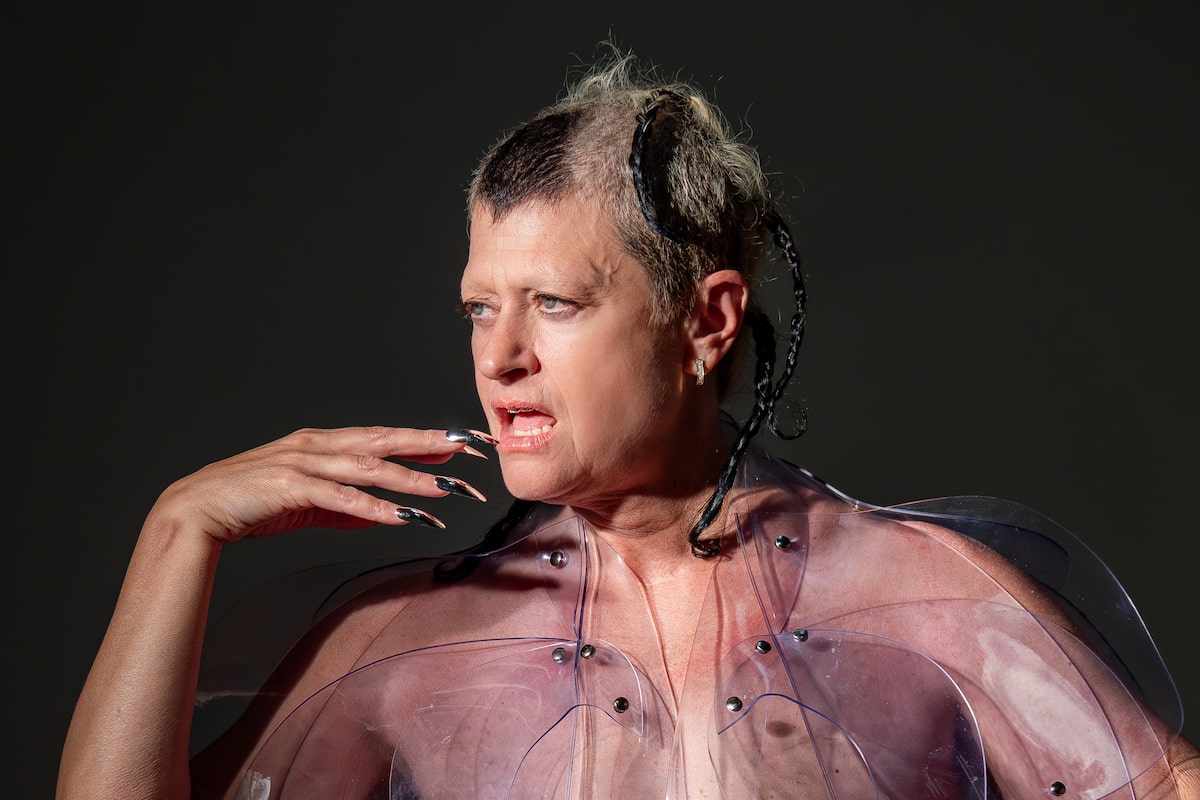
Peaches, the stage name of Merrill Nisker, released her seventh studio album last month and kicked off a North American tour.The Squirt Deluxe/Supplied
On a remix of Cain Culto’s 2025 viral hit KFC Santeria, the Canadian cult heroine Peaches boasts her delicious anatomy is “so Michelin,” finding yet another way to describe her physique three decades into a career spent making art about the politics and pleasures of the human body. Then she snaps, “Where’s my discount? I’m a senior citizen.”
It’s true: This November, Peaches turns 60. But age has only made the artist, born Merrill Nisker, more energized. In February, she released her seventh studio album, the sexy and defiant No Lube So Rude, and kicked off a North American tour. It’s her first album in a decade, but she’s been keeping busy.
Fifty years of Rush’s 2112: The sound of a band that refused to bend
Since 2015’s Rub, Peaches acted in a stage production of Bertolt Brecht’s ballet The Seven Deadly Sins, released an art book and opened her first major solo art exhibit, Whose Jizz Is This?, in Germany. She also launched a 20th anniversary tour celebrating her breakthrough album, 2000’s The Teaches of Peaches – the record that made her a star and led to her songs soundtracking everything from The Simpsons to Mean Girls and to collaborations with the likes of Iggy Pop and Christina Aguilera.
Her new record serves as an antidote to this cultural moment and a response to the rollback of rights for women and queer people. On one track, for instance, Peaches calls out the overturning of Roe v. Wade, the U.S. Supreme Court decision protecting abortion rights, and curses the name of one of the judges who helped kill it, Brett Kavanaugh.
Peaches grew up in North York in the 1970s.ANDREW WHITE/The New York Times
Speaking from New York two days before the release of No Lube, Peaches explains the genesis of the record was her desire to respond to injustice. “This is a really insane time in the world right now and it’s so intense and it’s not a time to be silent,” she says. “I know we have been through a lot in the past few years and we’re feeling pretty crazy right now but there needs to be joy in the revolution. I want to give you that moment.”
On the album’s hypnotic, confrontational single, Not In Your Mouth, None Of Your Business, Peaches screams, “I cannot be squashed or minimized. You will never take away our pride.” She calls the song both a protest and a mantra, designed for a listener to sing along to in a moment of fear. In that way, the song is representative of what Peaches, who is bisexual, has been doing for more than 30 years: providing rallying cries and flashes of hope for queer people.
Peaches grew up in North York in the 1970s, back when the Toronto suburb was a new development. By chance, she lived around the corner from another future rock star, Rush’s Geddy Lee. She played hide-and-seek with Lee’s brother and caught glimpses of Rush practising in the garage. Then she got her own taste of the limelight singing at bat and bar mitzvahs and family weddings.
Then came her folk band, Mermaid Cafe. The first iteration of the group was just Peaches and her girlfriend. They toured Jewish summer camps and sang about gay love in the Jewish community. “We were harmonizing, basically, about breaking up with each other,” she laughs.
Next she joined a jam band and borrowed the name “Peaches” from a line in a Nina Simone song. In her 20s, she lived with a pre-fame Feist above a feminist sex shop in Toronto called Come As You Are. By then, she’d started work on The Teaches of Peaches, which was later released by an influential indie label, Kitty-Yo, based in Berlin, where Peaches soon moved.
The Teaches of Peaches broke unusually far into mainstream culture for a brash indie record celebrating sex from a feminist perspective. It also provided a blueprint for the next generation of performers who wanted to embrace their sexuality without compromising their morals. The Canadian singer Kiesza, for example, was so inspired by Peaches that she invited her to collaborate on a sex positive track, So Erotic, last year.
“As a woman in the industry, going up against this male-dominated industry where your body is objectified all the time and people are telling you what you can and can’t do, Peaches is the best example of a woman who defies everything,” Kiesza says in an interview.
“She shows being sexy is within your own power,” the singer, born Kiesa Rae Ellestad, continues. “And it has nothing to do with age.”
Peaches is certainly revelling in her sexuality, as she celebrates her body lyrically on record and also in its visual accompaniments, including an explicit, adult-oriented version of the music video for the album’s title track. She is embracing, in her own words, “postmenopausal desire.”
In her art, she gives off the impression of fearlessness. When the pop world came calling, she only got weirder in the face of success. She wore a beard on the cover of her 2003 album Fatherf-cker and released an album called Impeach My Bush during former U.S. president George W. Bush’s second term in office. At every turn, she spun new political hellscapes into bawdy jokes and queer and feminist anthems.
The reason Peaches has returned, both to music and to the stage, is political.The Canadian Press
At one point in our conversation, however, while speaking about her Jewish upbringing and her relationship to the Jewish community today, she pauses and admits what she is about to say is scary for her. “I’m from a Jewish community and I’m sure a lot of, you know, parents, friends, kids I grew up with, they are going to really be angry at me right now,” she says carefully.
“But that’s too bad. Because I stand for humanity. And it’s beyond me there’s no understanding of the genocide in Palestine.”
In the face of the injustices she sees in the world, Peaches has the same response as ever: speaking out and slamming beats. In February, on the same day No Lube So Rude came out, Peaches stood on stage under the shadows of palm trees in Miami for a sound check. The locale was symbolic: The American Civil Liberties Union is currently tracking 12 anti-LGBTQ bills in Florida. The state is a hotbed of conservatism, but Miami is also home to a vibrant queer culture. That’s why Peaches brought her “queer cavalcade” to town.
That night’s show was full of absurdities and queer joy. Peaches appeared on stage wearing one bodysuit that criticized the U.S.’s Immigration and Customs Enforcement, then another with the phrase “Trans Rights Now.” And she doused the crowd in celebratory champagne.
The reason Peaches has returned, both to music and to the stage, is political. She says she knows her skills are in the form of entertainment and she wants to use them to aid in political resistance.
“I know we have been through a lot in the past few years and we’re feeling pretty crazy right now, but there needs to be joy in the revolution. I want to give you that moment.”