
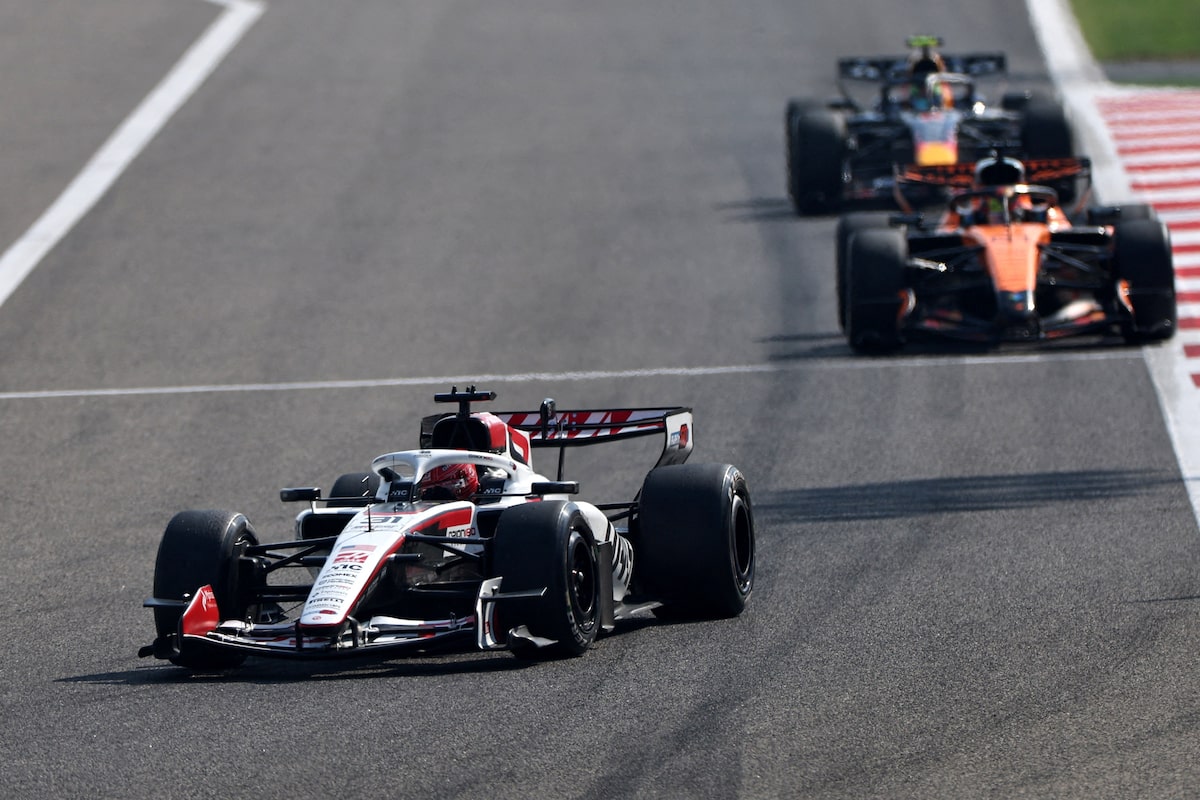
Haas’ Esteban Ocon, McLaren’s Oscar Piastri and Red Bull’s Isack Hadjar during pre-season testing FILE PHOTO: Formula One F1 – Pre-Season Testing at the Bahrain International Circuit, Sakhir, Bahrain last month.Hamad I Mohammed/Reuters
A Formula 1 rules revolution is making cars lighter and smaller for 2026, with more electrical power.
After the biggest changes in years, F1 teams are dealing with a whole new driving style and trying to find innovations that are within the letter of the rules.
Ahead of the season-opening Australian Grand Prix, here’s a guide to key concepts which could decide who wins, how they do it, and whether it’s fun to watch.
Compression ratio
The first real controversy of F1’s new era. The engine rules set out a compression ratio of 16:1, a measurement of how tightly the pistons squeeze the mixture of fuel and air before it ignites. In theory, a higher ratio means more power.
The regulations include a test to stop teams exceeding 16:1, but the checks happen at “ambient temperature.”
Some rival teams have suggested Mercedes found a way for components to behave differently when they heat up during use, beating the test. Mercedes says its engine is fully legal.
After the preseason outcry, updated rules require testing at operating temperature, but only from June 1. The first race under the new checks is the Monaco Grand Prix on June 7, scheduled to be the eighth race of the year.
Overtake mode
The old DRS overtaking aid is gone after 15 years and, while new “active aerodynamics” do a similar job, they can be used at any time. Ferrari has the most eye-catching solution so far with a wing which turns upside down on straights for extra speed.
Electrical power is the way to overtake in 2026. Using “overtake mode” unlocks the full power of the battery hybrid system for a short time, generally when a car is within a single second of the car in front.
The system could be fine-tuned during 2026 if it doesn’t make enough of an impact. Some drivers complained in testing that overtake mode tends to drain the battery too much, making it inefficient in a lot of situations, or impossible to defend the place afterward.
Lift and coast
Slow and steady wins the race? Not in F1. Still, lifting off the gas is one way to get more energy later on.
Lifting and coasting on straights is one way to “harvest” energy for the car’s battery beyond what the car generates under braking.
If races in 2026 are too focused on saving energy, the FIA could potentially intervene under a commitment to “competitive balance and sustainability” newly written into the 2026 regulations.
The FIA has said fans appreciate strategy but driving shouldn’t be “like a chess game, where it’s just a matter of energy management and energy deployment,” as Nikolas Tombazis, director for single-seater racing series at the FIA, told The Associated Press last year.
Sandbagging
The art of seeming slower than you really are. One reason testing times are an unreliable guide is that teams typically want to avoid the extra scrutiny that comes with being fastest. F1 has a history of rivals demanding rules investigations into any dominant technology.
The last time engine rules changed this much, Mercedes designed a near-unbeatable turbo hybrid but rarely used its full power.
The tactic worked. Mercedes won the constructors’ championship, its first of eight in a row.
Dirty air
The turbulence created in a car’s wake is the eternal bugbear of F1 fans and rule makers.
For drivers, dirty air means less grip through the corners, making it hard to get close to a car in front. For fans, it turns races into dull processions.
Every time the FIA revamps the rules, it tries to ban aerodynamic parts which churn up the air too much. This year, it targeted “outwash” front wings pushing air out to the side.
Every time the FIA takes action, engineers find ways around the rules. How quickly that happens could decide how watchable F1 is in 2026.