
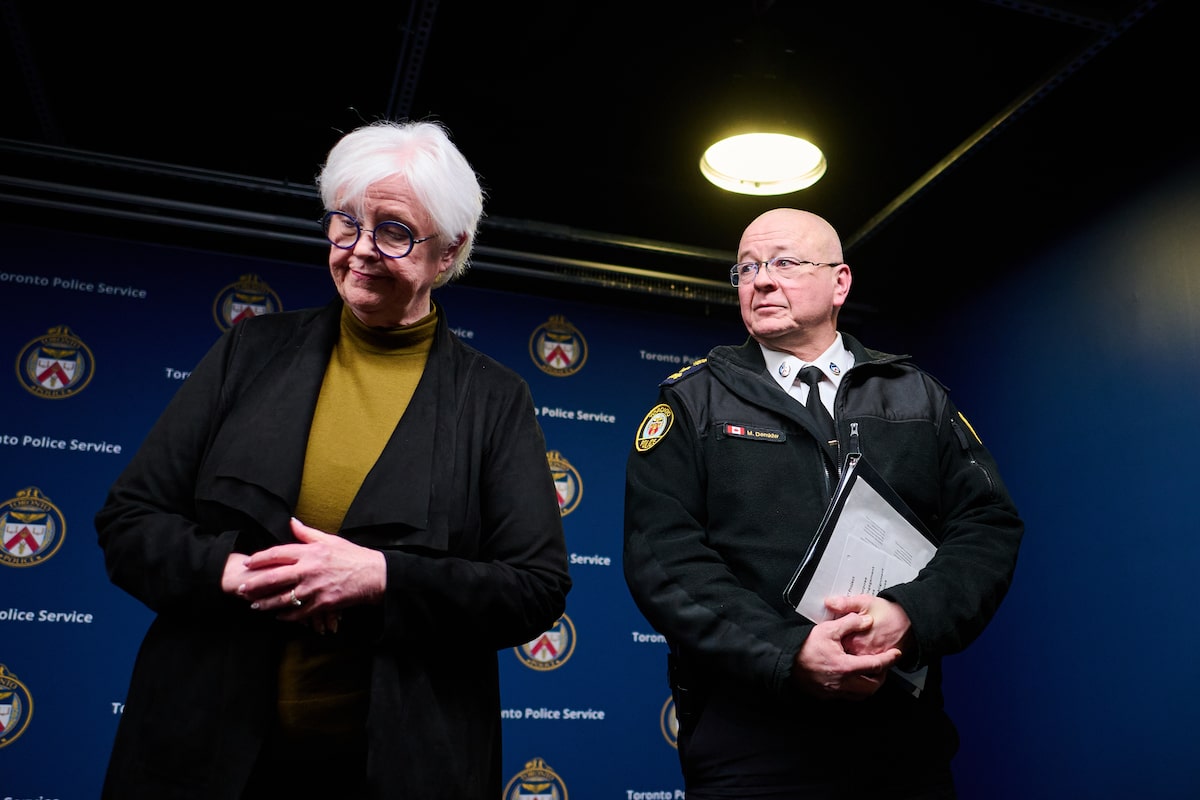
Toronto Police Service Board Chair Shelley Carroll, left, and Toronto Police Chief Myron Demkiw speak to media after delivering an update on Project South at a monthly Toronto Police Services Board meeting on Wednesday.Sammy Kogan/The Globe and Mail
The chair of the civilian oversight board of the Toronto Police Service is resisting calls for a municipal public inquiry into a crisis of corruption within the city’s police force, saying a wider review of police forces across Ontario is the best response to the allegations in Project South that have shaken the province’s criminal justice system.
At a Toronto Police Service Board meeting on Wednesday, chair Shelley Carroll said she is wary of launching additional inquiries into the allegations when the province’s top police watchdog has already vowed to hire an outside official to conduct a review of corruption across Ontario’s police forces.
Ontario’s Inspector-General Ryan Teschner, who is a former executive director and chief of staff of the Toronto Police Service Board, has not yet announced details of who that official will be.
Ms. Carroll told reporters that under provincial law, Mr. Teschner has unique powers to tell police commanders and civilian oversight bodies what actions to take.
“That review, because it comes from the Inspectorate of Policing, results not in recommendations that we can pick and choose from – it results in directions,” said Ms. Carroll, a city councillor who represents Don Valley North.
She added that “there will be actions taken because they will be required under the law.”
Last month, York Regional Police detectives charged a total of seven serving Toronto Police officers and a retired officer, as well as 19 civilians, on an array of allegations, including a plot to murder a corrections officer, bribes and drug trafficking. Investigators said members of organized crime were buying data and addresses from Toronto Police Service officers, which were then used to co-ordinate shootings and other crimes – including an attempted hit on a corrections officer who was allegedly targeted at his home.
Toronto Police Chief Myron Demkiw told the board Wednesday that he is launching internal anti-corruption initiatives, including better supervision and screening of officers, as well as a review of controls on access to police databases.
Toronto Police commanders said that they deployed “wellness resources” to officers at 12 Division, where five of the accused in Project South were stationed. The division, which is located in the northwest of the city, also got an infusion of “high performing” sergeants, according to board documents.
“While we wait for the Inspector-General to take their immediate next steps, which we hope will happen very, very soon, we are additionally doing our work – with a sense of urgency,” Chief Demkiw told reporters on Wednesday.
Earlier this week, former Toronto mayor John Sewell urged city council to launch a public inquiry into police corruption under the Municipal Act, something Toronto did during an early 2000s computer-leasing scandal.
“This is a major, major crisis,” said Mr. Sewell, who is the co-ordinator of the Toronto Police Accountability Coalition. “We haven’t seen anything like this in Canada.”
However, Ms. Carroll said Wednesday that such a review would be less effective and efficient than the Inspector-General’s pending probe.
A municipal judicial inquiry “would not be faster,” Ms. Carroll told reporters. “The Inspectorate begins right away, and he directs both services and boards.”
Toronto City Councillor Lily Cheng, a board member representing Willowdale, asked whether the Toronto Police brass would consider a precinct-by-precinct review of the force’s culture to pinpoint which divisions are of concern.
However, Chief Demkiw said there would be complexities around data collection at the unit level.
“The commitment we can make today is we drill down as much as we can and report to the board transparently,” he said.