
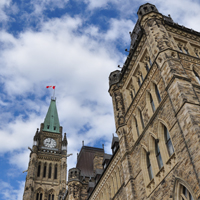
If these parliamentary walls could talk, what would they say? What secrets would they reveal from whispered negotiations, passionate debates, historic decisions, quiet compromises and private moments as Canada blossomed into one of the world’s most desirable nations?
Of course, they can’t speak. And for now, they barely even exist — at least not in the way Canadians remember them. Today, those walls — along with the ceilings, floors and doors — are gone, as the Centre Block of Parliament has been dismantled to its structural core.
In my capacity as the new chair of the Senate’s Standing Committee on Internal Economy, Budgets and Administration (CIBA), I had the privilege of a private tour of the Centre Block rehabilitation project on Parliament Hill in January.
Centre Block is undergoing a massive, $5-billion transformation — the largest and most complex heritage rehabilitation project in Canadian history — as part of what’s known as the Long Term Vision and Plan (LTVP) for Parliament’s buildings and grounds. Rebuilt after the devastating fire of February 1916, the current building is more than a century old and in urgent need of renewal. Behind its familiar Gothic Revival façade, it lacks many features expected of any modern building — like state-of-the-art heating, cooling and ventilation — as well as up-to-date technological and security systems. It also requires significant structural upgrades, including seismic base isolation.
The objective is ambitious, but clear: to create a modern Parliament that works better for parliamentarians and staff, welcomes Canadians and tourists from around the world, improves security and accessibility, reduces environmental impact, and preserves the historic character that makes Parliament Hill so iconic.
When Centre Block was vacated in late 2018, the House of Commons relocated to neighbouring West Block and the Senate moved into Ottawa’s former railway station, renamed the Senate of Canada Building. Since 2019, Centre Block’s modernization has been full steam ahead.
Touring the stripped-down shell of the building and walking through the Senate Chamber, the House of Commons, the Prime Minister’s Office, the Hall of Honour and the Senate Speaker’s quarters, it was impossible not to imagine what these spaces have witnessed and heard over the last 100 years. The walls may be bare and the corridors unrecognizable, but the echoes of history feel unmistakably present.
I was particularly struck by the work beneath the building, where crews are reinforcing foundations dating back to Confederation itself and excavating a new basement. It was mind-blowing. Meanwhile, above ground, approximately 365,000 stones that make up the building’s 20,000-square-metre façade will be restored.
Another of the project’s most striking elements is the new underground Parliamentary Welcome Centre. At 23 metres deep, the excavation is staggering; some 40,000 truckloads of bedrock have been removed. One day, in the not-too-distant future, it will offer Canadians an immersive, fully accessible and engaging entry point into their democracy.
At its peak, the rehabilitation project will employ up to 1,500 workers daily and has already supported more than 4,000 jobs nationwide. It is also training a new generation of workers in highly specialized fields, from heritage masonry to advanced engineering — skills that will endure long after the (proverbial and literal) dust settles.
The team behind Centre Block’s rehabilitation, now in its sixth year, is working hard to keep the project’s current schedule. As someone appointed to the Senate in 2019, I confess I worried that I might never sit in the original Red Chamber. It’s no secret that massive construction projects are not always on time and on budget. I was reassured that, if all goes according to plan, senators will return to our old (new) digs during the first half of the 2030s — well before my mandatory retirement.
So, if these walls could talk, perhaps they would remind us that Canada’s history is one of resilience, tolerance and brilliance. The stories these walls hold, protect and cherish, and the events that transpired within them that shaped our democracy, will live on within a rejuvenated, state-of-the-art Parliament, ready to serve Canada for the next hundred years.
In collaboration with my colleagues on CIBA and with the Senate’s Subcommittee on LTVP, I will continue to oversee and scrutinize major decisions related to this project — especially where Senate spaces are involved — to ensure it stays on time, on budget and respectful of the institution and the people it serves. Canadians can follow its progress online through quarterly progress reports, a live image feed and the Senate’s Front & Centre multimedia series.
Ultimately, we want to ensure that the Centre Block — with its iconic 92-metre Peace Tower and 53-bell carillon — remains one of Canada’s most welcoming, most accessible and most visited public spaces. After all, Parliament belongs to its people.
And if these walls could actually talk, they would surely agree that the democracy they shelter must always remain strong, independent and free.
Senator Tony Loffreda represents the Shawinegan division of Quebec in the Senate and is chair of the Standing Committee on Internal Economy, Budgets and Administration.
A version of this article was published in The Suburban on February 18, 2026.