

With the National Hockey League’s trade deadline just a day away, dreams of Stanley Cup parades are starting to creep into the minds of general managers.
But recent playoff history tells us many of them should put down the phone. (Sorry, James Duthie.)
Why? A review of more than a decade of Stanley Cup champions offers valuable insight into the factors that determine contention windows. Hint: they open slower and close faster than we want to believe.
The feverish fans of the Buffalo Sabres, Detroit Red Wings, and Montreal Canadiens may need to wait even longer to contend. Tampa Bay Lightning and Colorado Avalanche fans, meanwhile, may not have much time left at the top.
But we watch the games for a reason. Even with years of precedent and trends, anything can happen in the playoffs.
Window opens: Cup-winning franchises gain valuable playoff experience first
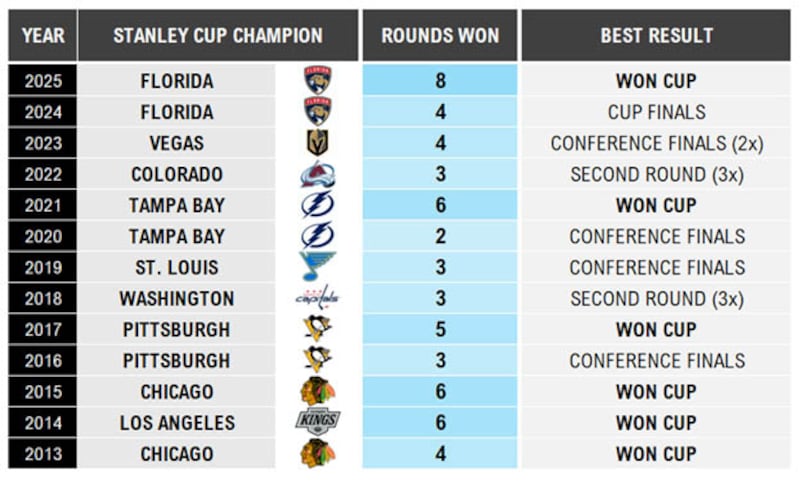
Each of the past 13 Stanley Cup champions achieved the following:
– Made the playoffs at least four times in five seasons.
– Played in a Conference Final or won three or more playoff rounds in the previous three seasons.
Here’s each Cup winner’s performance in the three postseasons before their Cup run:
 Stanley Cup windows (TSN)
Experience matters.
No team has snuck up on the league to win the Stanley Cup since the Los Angeles Kings’ improbable 2012 run, and even that group had made the playoffs the previous two years. Recent history shows us teams have needed time to learn tough lessons after several postseason exits before going the distance.
In the modern NHL, Cup windows haven’t opened until a team consistently makes the playoffs and wins multiple rounds.
This trend looks great for Carolina, Dallas, and Edmonton. Each has made the postseason at least four consecutive times, winning five or more playoff rounds in the past three seasons alone. This type of playoff adversity has been necessary for the past 13 Cup winners.
Window closes: Cup-winning franchises are fuelled by players aged 30 and under
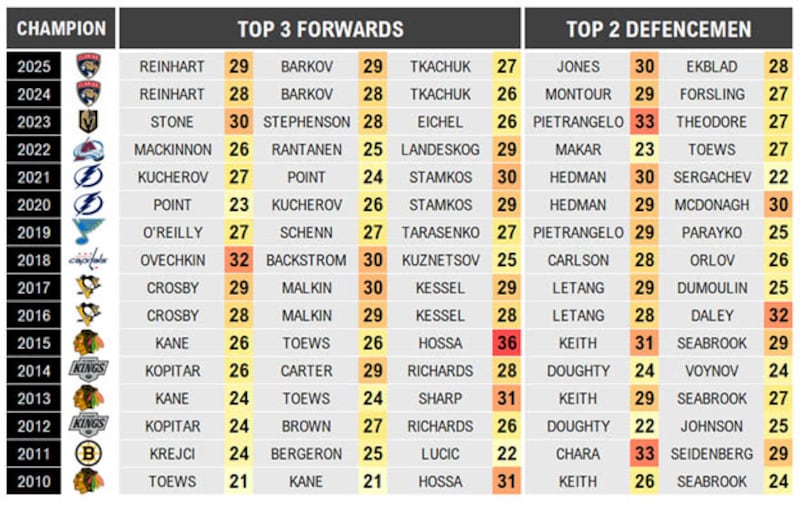
Of the last 16 Stanley Cup champions:
– No defenceman older than 33 played top-pair minutes.
– Only one forward older than 32 (Marian Hossa in 2015) played first-line minutes.
Here’s a summary by age of each Cup winner’s top three forwards and top two defencemen. By using average ice time in the regular season, this represents the de facto first line and top defence pairing. Since Nikita Kucherov sat out the 2020-21 regular season, his previous season’s ice time was used.
 Stanley Cup windows (TSN)
Players don’t turn into pumpkins on the day they blow out the candles on their 33rd birthday cake, but they do stop leading teams to Stanley Cups
Whether it’s an aging core, loss of cap flexibility, lacking the next wave of talent, or simply running out of gas in the postseason, NHL teams hit a brick wall when their foundational skaters turn 30. The Florida Panthers are seeing it happen in real time this season.
Among the cap era heavyweights, Los Angeles last won the Cup when Anze Kopitar was 26 and Drew Doughty was 24. Chicago’s dynasty ended when Patrick Kane and Jonathan Toews were just 26. Crosby was 29 and Evgeni Malkin was 30 for Pittsburgh’s third ring. Washington, the elderly outlier, was led by 32-year-old Alex Ovechkin and 30-year-old Nicklas Backstrom. Steven Stamkos and Victor Hedman were 30, while Kucherov was 27, for Tampa Bay’s Cup repeat.
Life comes at you fast as far as the Stanley Cup is concerned. Cup windows close quickly. If a team relies heavily on a forward over 32 or defenceman over 33, it’s almost certainly too late.
Setting the current Stanley Cup windows
From recent postseason history, we can establish goal posts for the Cup contention windows of the NHL’s 32 franchises:
1. Cup windows open when a team makes the playoffs three times in a four-year stretch.
2. Cup windows close after: a foundational forward’s last season at 32; a foundational defenceman’s last season at 33; a foundational player becomes a UFA; or a team misses the playoffs twice in four seasons.
3. Young guns: we’ll assume future star RFAs (i.e., Connor Bedard, Macklin Celebrini, Leo Carlsson) won’t reach free agency based on cap-era precedent.
4. Ignore goaltending: a goalie’s age hasn’t factored into postseason success. Teams just need to find timely saves from a warm body in today’s NHL.
All 32 teams won’t line up perfectly with our guidelines. So, we’ll make a few exceptions as we go, explaining why. Starting with the teams in win-now mode, we’ll split the league into five tiers.
Of course, a lot can happen with a franchise in a week or month, let alone several years. These tiers reflect what we know today.
TIER ONE: Window open now
TeamPlayoff OddsWindow OpenWindow ClosedYearsCarolinaLock (>90%)202620305MinnesotaLock (>90%)202620305DallasLock (>90%)202620294VegasLock (>90%)202620294EdmontonRace (30-66%)202620283ColoradoLock (>90%)202620283Tampa BayLock (>90%)202620272
Armed with waves of prime-aged talent, Carolina, Minnesota, Dallas, and Vegas have considerable runway to contend. It will be years before their stars age out or hit UFA status. Quinn Hughes’ contract notably ends in 2027 – his exit would damage but not shatter the Wild’s window.
Edmonton’s window is tied to Connor McDavid’s contract, which ends in 2028. Colorado faces the same timeline. While Cale Makar’s walk year is 2027, it’s expected the five-time Norris finalist will be offered a blank cheque. Colorado’s window is thus extended to Nathan MacKinnon’s age-32 season. By 2029, MacKinnon, Makar, Martin Necas, Gabriel Landeskog, and Devon Toews will all be 30-plus, a formula that hasn’t delivered modern Cups.
Tampa Bay gets bumped to 2027 – Kucherov’s UFA year. He’ll be 33 next year but by leading the NHL in points-per-game the last three seasons, we’ll extend the Lightning’s window one extra year. If the windows for Colorado and Tampa seem short, just ask Crosby, Toews, or Kopitar how quickly playoff success vanished at much younger ages.
TIER 2: Retooling but trying to win
TeamPlayoff OddsWindow OpenWindow ClosedYearsNY IslandersRace (30-66%)2026??BostonRace (30-66%)202620294Los AngelesRace (30-66%)202620272WashingtonRace (30-66%)202620272PittsburghSafe (67-90%)202620261
Matthew Schaefer singlehandedly keeps the New York Islanders’ window open indefinitely. The rookie defenceman has been that special, earning the Isles an exemption here.
Past precedent tells us that if Boston misses the playoffs again, a Stanley Cup with this core isn’t happening. But under-30 stars David Pastrnak, Charlie McAvoy, and Morgan Geekie are jamming the window open. Los Angeles is scratching for a fifth straight playoff spot, meaning their window remains slightly ajar. Ice-time leader Drew Doughty’s deal is up in 2027 and may retire.
The Caps/Pens heated rivalry is on its last gasp. Our guidelines tell us that with its five most-deployed players at 38, 38, 35, 33, and 32 years old, Pittsburgh has no contention window. But we’re awarding the Penguins a one-year exemption for an impressive push.
Washington has pivoted younger, but their postseason odds are shaky. Tom Wilson turns 32 next year and UFA John Carlson, 36, still eats major minutes. Missing the playoffs would end their window.
TIER 3: Wait until next year
TeamPlayoff OddsWindow OpenWindow ClosedYearsMontrealSafe (67-90%)202720304TorontoOut (<30%)202720282FloridaOut (<30%)202720282WinnipegOut (<30%)202720282OttawaRace (30-66%)202720282
Four Canadian franchises occupy this tier. Montreal is in the best position, safely in a playoff spot. Windows open when a team makes the playoffs three times in four years – that should mean 2027 for the Habs. Nick Suzuki is a UFA in 2030.
Toronto and Florida never got off the mat this season. The Leafs are tied to Auston Matthews’ 2028 walk year. The Panthers will get two more shots before their core unofficially ages out.
If Connor Hellebuyck is healthy, Winnipeg retains hope for a rebound next year. Losing 2028 UFA Josh Morrissey would close this fragile window.
Despite the NHL’s worst save percentage, Ottawa’s still alive in the playoff chase. Brady Tkachuk’s contract decision in 2028 offers additional pressure.
TIER 4: Window is multiple years away
TeamPlayoff OddsWindow OpenWindow ClosedYearsAnaheimSafe (67-90%)2028??San JoseRace (30-66%)2028??SeattleRace (30-66%)202820314St. LouisOut (<30%)202820314BuffaloLock (>90%)202820303New JerseyOut (<30%)202820303UtahSafe (67-90%)202820292DetroitRace (30-66%)202820292ColumbusRace (30-66%)202820281
Each team in this tier either made the postseason last year or is still in the race, which would jumpstart their contention windows in 2028. Anaheim and Utah are in strong playoff positions and may push to contend sooner. The Ducks and their future Pacific rivals, San Jose, have such significant young talent that there is no clear end to their windows.
But many of the franchises in this tier face a big, looming free agent, from most urgent to least: Columbus (Zach Werenski, 2028); Utah (Clayton Keller, 2029); New Jersey (Jack Hughes, 2030; Buffalo (Tage Thompson, 2030); St. Louis (Jordan Kyrou and Robert Thomas, 2031); Seattle (Matty Beniers, 2031). Detroit captain Dylan Larkin turns 32 in 2029. Will these timelines accelerate front office decisions?
TIER 5: Window is three-plus years away
TeamPlayoff OddsWindow OpenWindow ClosedYearsChicagoOut (<30%)2029??NashvilleOut (<30%)2029??CalgaryOut (<30%)2029??VancouverOut (<30%)2029??PhiladelphiaOut (<30%)202920302NY RangersOut (<30%)202920291
The final tier features franchises that both missed the playoffs in 2025 and have slim to no odds in 2026.
Chicago is in by far the best situation, a Bedard-led core that is young and controlled for many years. Nashville, Calgary, and Vancouver are so devoid of talent presently that their roster will be unrecognizable by 2029, so there’s no way to know when their window might end (or begin).
Philadelphia will see both Travises – Konecny and Sanheim – age out by 2030. The struggling New York Rangers face Adam Fox’s contract expiration in 2029.
Playoff odds from HockeyStats.com through March 2; player ages and playoff results from Hockey-Reference; player contract information from PuckPedia
Follow Paul Pidutti on X (@AdjustedHockey) and www.adjustedhockey.com