
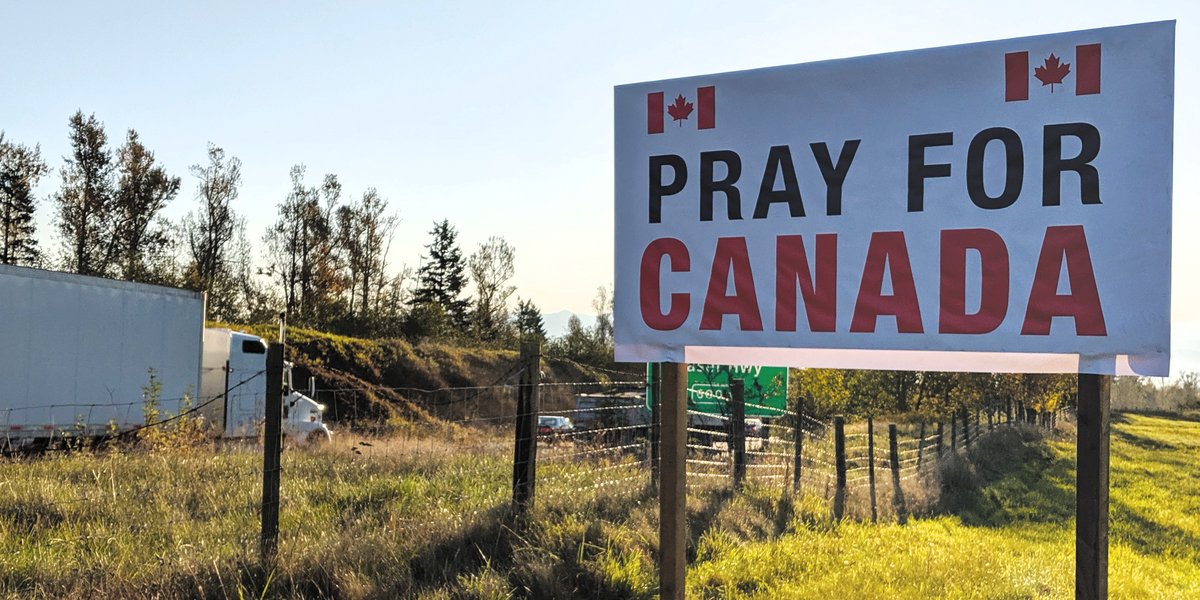
Perhaps today, more than even a month ago, we can see the reason for a call to go to our knees in prayer to repent on behalf of Canada, and to call out to the Lord to have mercy on our nation.
Initially, the impetus for this came from reflecting on the darkness of the rampant “culture of death” that has spread its tentacles across our nation—through unbridled, unrestricted abortion and physician-assisted suicide, and the coercive tactics used to pressure individuals to choose MAiD as a solution not only to health challenges but to an array of social challenges, from poverty to lack of appropriate housing and other issues that can be resolved if the choice is there for service agencies to advocate and come alongside those facing such situations to resolve them.
Now, with the loss of life at Tumbler Ridge, BC, we have added to the mix situations where individuals, feeling such a degree of isolation and alienation, turn on their own family and community, and on themselves, becoming agents of death in such a horrific, tragic fashion.
Scripture says, “Blessed is the nation whose God is the Lord.” (Ps. 33:12)
As a nation, Canada has turned away from the holiness of God, adopting and embracing attitudes and practices that grieve the heart of God. We as believers must be the ones to go to our knees and call out to God for forgiveness on behalf of this nation that we are citizens of, and to beg His mercy so that His favour might be restored to Canada and to us, so that we might all live “…peaceable lives” (1 Tim. 2:2) as citizens of this nation.
We began our call for 40 days of prayer and penance starting on Ash Wednesday to coincide with the season of Lent, based on Joel 2:12–13a, 14a:
Yet, even now, says the Lord, return to Me with your whole heart,
with fasting, and weeping, and mourning;
Rend your hearts, not your garments,
And return to the Lord, your God.
…
Perhaps He will again relent,
And leave behind Him a blessing.
Therefore let us pray:
Lord God, You who are merciful and just,
who have created us in your image and likeness,
and called us to live in holiness and righteousness,
we have sinned against you, as a Nation,
in acceding to the death-dealing of abortion
and euthanasia and physician-assisted suicide,
blatantly transgressing your Law
that we are not to commit murder.
Forgive us, Lord, and remove the stain
of the sin of shedding innocent blood
that has polluted the land
and seeded darkness and death into our cultural fabric.
Forgive us for the hardness of our hearts,
for harbouring antagonism, hostility, hatred and blame
towards those whose views differ from ours.
Give us the grace to love those we see as enemies,
to pray for them, and return blessing for curses.
Extend your hand of mercy, Lord,
and restore us to righteousness, to heal our land
so that Canada might again be blessed as a Nation.
In Jesus Name, we pray and ask it,
to the Glory, Honor and Praise of the Father,
who lives and reigns with the Holy Spirit, now and forever.
May his peace prevail in our hearts as we seek to return to the Lord with our whole hearts and pray on behalf of our Nation of Canada so he might truly have “Dominion from Sea to Sea” (Ps 72:8) as we stand on guard for our nation.
Virginia Battiste
Yorkton, Sask.
In your recent coverage of National Catholic Health Care Week, I was surprised there was no mention of the upcoming replacement of the Health Professions Act with the Health Professions and Occupations Act in B.C., scheduled to take effect April 1.
Under the previous framework, health-care colleges were largely self-regulating. The new legislation introduces greater government involvement in regulatory governance, including the appointment of board members and expanded disciplinary powers for the Minister of Health. Some provisions, particularly those related to misinformation, access to medical records, and professional discipline, have raised concerns among health-care workers about professional autonomy, privacy, and freedom of conscience.
Many physicians, nurses, dentists, and allied health professionals have expressed unease about these changes, and some have chosen to leave the province quietly. For those who previously spoke out against forced vaccination and felt unheard, this silence reflects a sense of discouragement rather than indifference.
At the bedside, families may notice that discussions about MAiD are frequent, while conversations about meaning, hope, and the value of life can feel rare. For many Catholics, this imbalance is troubling. It raises important questions about how our health-care system supports vulnerable patients not only clinically but spiritually and humanly as well. Many of the professionals who have raised these concerns are among those leaving the province for their own professional security.
I offer these reflections in the hope of encouraging thoughtful dialogue within our Catholic community about the direction of health care in our province and how we can continue to advocate for the dignity of every human life.
Gillian Long
Vancouver
(The B.C. Catholic reported on Catholic physicians’ concerns about the impact on conscience rights and the doctor-patient relationship when the legislation was introduced as Bill 36 in 2023. With the legislation now scheduled to take effect April 1, the issue has renewed relevance — Editor.)
Your voice matters! Join the conversation by submitting a Letter to the Editor here.