
Rendering shows proposed vision for the Living Arts Centre property and other downtown city-owned lands. In addition to main components that include a new performing arts centre and a large hotel and convention facility (lower left and middle, respectively), the redevelopment plan calls for urban parkland areas, internal courtyards, open green space, water features and rooftop patios. (Image: City of Mississauga)
A new performing arts centre that would rival the largest in Canada and a highrise hotel and convention facility as big as 500,000 square feet are highlights of a sweeping plan to dramatically transform Mississauga’s downtown for generations to come.
The new-look downtown core of Canada’s seventh-largest city, should it come to fruition in the years ahead, would rise up on 12 acres of City of Mississauga-owned land just steps to the north of city hall and anchored by the large parcel of real estate currently occupied by the Living Arts Centre, senior city staff said in a potentially game-changing report to be discussed at city council next Wednesday.
“Mississauga’s downtown is at a pivotal moment of transformation, driven by major transit investments, sustained population and employment growth, and increasing demand for culture, tourism and employment infrastructure,” Andrew Whittemore, the city’s planning and building commissioner, said in a report on council’s March 11 agenda titled Proposed Vision for the Living Arts Centre Property & Downtown City-Owned Lands. “City-owned lands, particularly the LAC property and surrounding civic lands, represent a once-in-a-generation opportunity to shape the downtown’s long-term economic, cultural and civic role.”
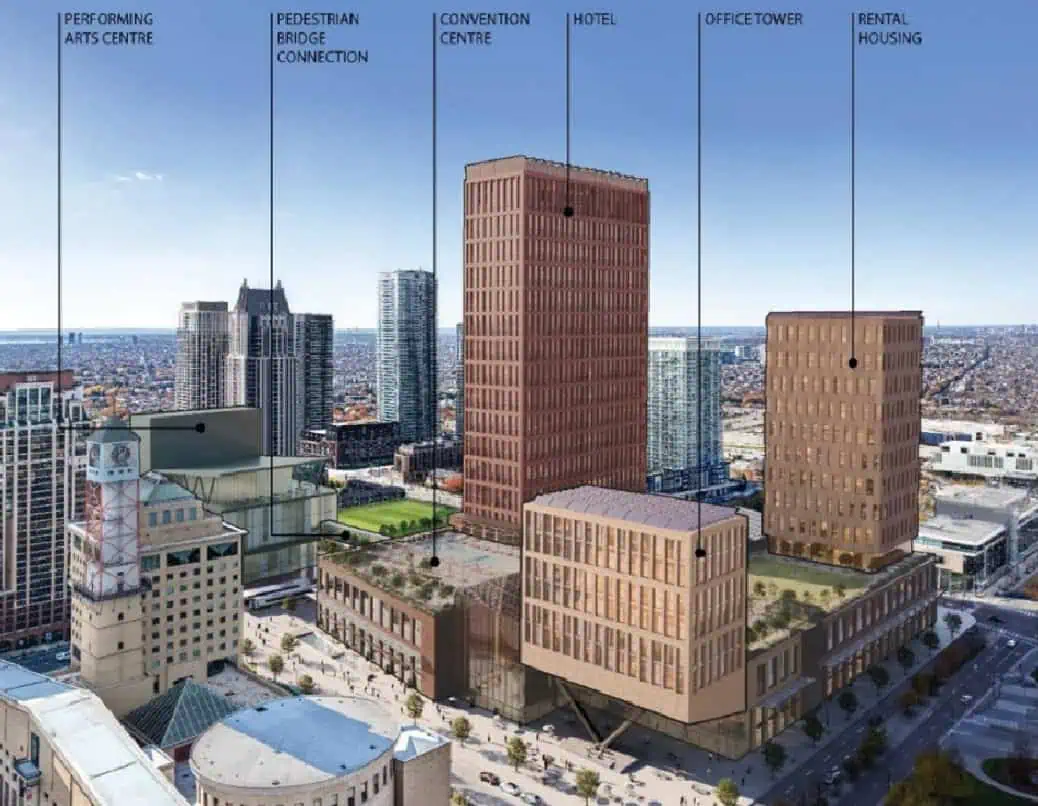
Rendering of what a new downtown Mississauga could look like. (Image: City of Mississauga)
Core components of the proposed vision include:
A new state-of-the-art music hub that would include a 2,500-to-5,000-capacity performance venue to replace the LAC (current capacity of 1,120 rising to 1,680), recording studios and a music school located on the 3.4-acre Community Common park parcel of land.
A 400,000-to-500,000-sq.-ft. convention centre and hotel to be “positioned as a regional economic and tourism catalyst.” The highrise hotel would include some 400 rooms.
New nine-storey office and 20-storey rental housing developments to support employment growth and downtown vitality.
A redesigned and widened Princess Royal Drive and abutting atrium-style open space “that will prioritize programming and events and retail activity to animate the downtown and to generate more pedestrian activity.”
A precinct-based parking strategy including 1,500 to 3,000 new underground parking spaces beneath Community Common “to support shared civic, cultural and commercial uses and tunnel connections.”
A signature Sky Park and enhanced programmable Community Common urban park, “strengthening downtown open space and civic identity.”
Should city council support the vision for the downtown core, staff will then develop a project plan to begin the work, Whittemore noted in his report, with a commitment to return with both a plan and further analysis early in 2027.
“Throughout this process, council direction and input will be regularly sought,” the planning commissioner added. “As part of the project plan, robust public, business and stakeholder consultation will be undertaken to ensure all affected voices are heard.”


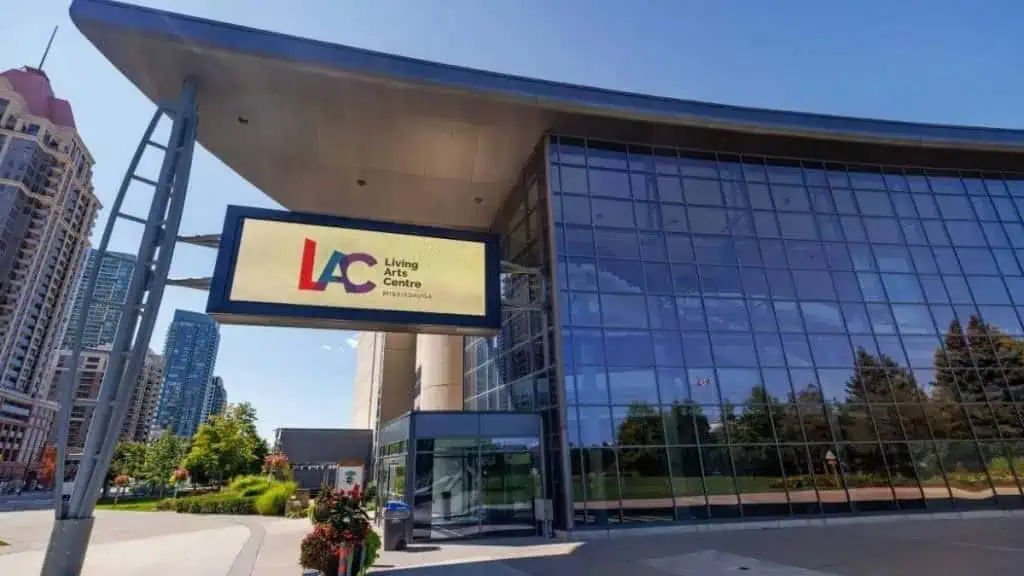
A plan to be discussed next week at city council calls for the Living Arts Centre, which opened in 1997, to be replaced with a much larger venue.
The report also pointed out that a “redeveloped LAC precinct is expected to generate an additional $1.7 to $2 million annually in Municipal Accommodation Tax (MAT) revenues, providing a stable and recurring funding source to reinvest in tourism, culture and destination development.”
The city’s MAT fund collects money via visitors to the city paying a six per cent tax during short-term stays.
Initially, the city revealed plans last year to redevelop the area around the LAC, Mississauga’s largest performing arts and culture facility, and simply improve — but not replace — the performing arts venue itself.
That initiative included large-scale renovations to the Living Arts Centre that included a move to increase seating in the main hall from 1,120 to 1,680.
The staff report to be discussed next week noted that while the LAC, which sits on roughly six acres of land, “remains a cornerstone of Mississauga’s cultural infrastructure,” the building itself “is outdated and requires significant investment (a minimum of $120 million as noted in recent studies) to make it viable to meet the needs of a modern city.
“Additionally, the suburban nature of the LAC site layout limits opportunity to introduce new uses for optimizing lands for other priorities.”
In the end, the report reads, “rather than approaching the LAC property through incremental or piecemeal upgrades, staff were asked to contemplate situating the LAC lands and the other city-owned lands within a broader downtown vision.”
In addition to the LAC site, the report points out there are four other parcels of city-owned land in the immediate area that total another six acres. Those areas are currently used for parking lots and passive open space.
“In total, there is an opportunity to transform almost 12 acres of land in the city’s downtown core,” the report stated, adding city staff suggest “these lands collectively represent a rare and strategic opportunity to reshape the future civic, cultural and economic identity of the downtown core.”
INsauga’s Editorial Standards and Policies
Last 30 Days: 41,154 Votes
All Time: 1,250,520 Votes
2377 VOTES
Should Ontario keep daylight saving time year-round?
WIN A $100 GIFT CARD
Subscribe to INsauga’s daily email newsletter for a chance to win a $100 Amazon gift card.