
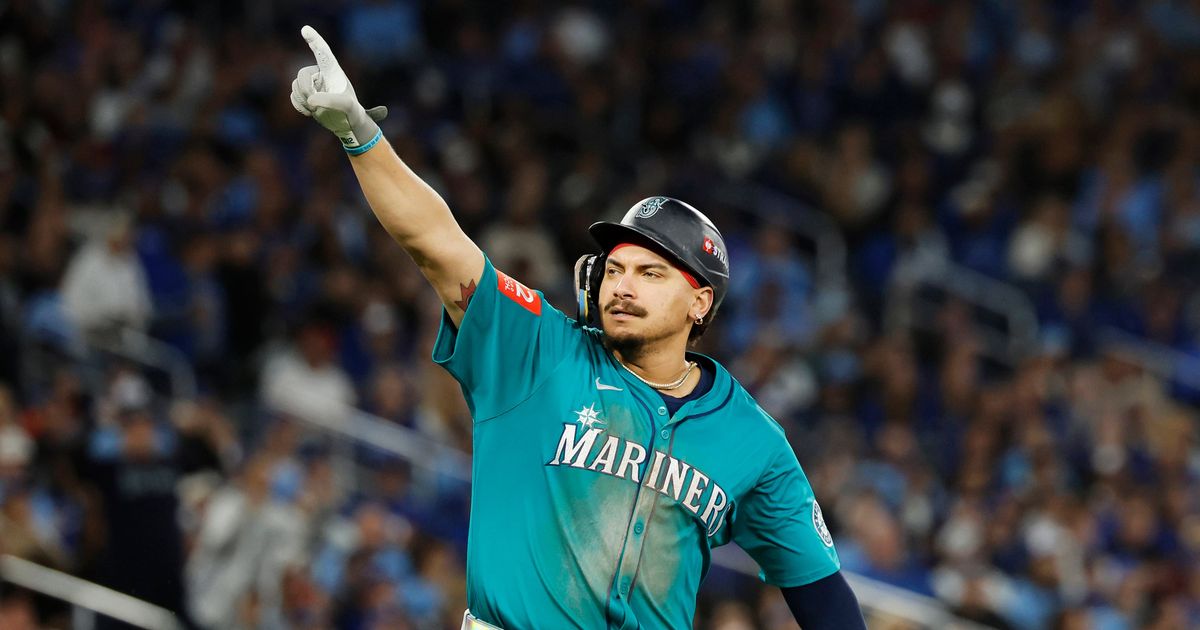
PEORIA, Ariz. – They don’t let you roll over infielders anymore. But you can still try to break up a double play, if you think about it. And Josh Naylor is the thinking man’s player on a thinking man’s team.
“He has as high a baseball IQ as anybody I’ve encountered, truly, and I’ve been around a long time,” said Jerry Dipoto, the Seattle Mariners’ president of baseball operations, who spent the offseason collecting very good, very smart players. “This guy is insane in terms of his IQ, his feel for it, what he sees.”
What Naylor saw, in the first inning of Game 7 of the American League Championship Series in Toronto last fall, was opportunity. With one out, he drove in Seattle’s first run with his series-high 10th hit. Now, leading off first, his bedazzled spikes darted this way and that in short, frenetic bursts.
In baseball parlance, Naylor looked runnerish. He is 5-foot-10 and 235 pounds, with the sprint speed of a catcher. But he swiped 21 bases, without being caught, in three months with the Mariners. That only happens by reading the game.
So when Jorge Polanco bounced a ball up the middle, and Blue Jays third baseman Ernie Clement, shaded far to his left, snagged it and crossed the bag, Naylor had a plan. As he approached second base, he turned, jumped and blocked the throw.
With his head!
“I played with Ernie a lot in Cleveland, so I knew his arm angle,” said Naylor, now the captain for Team Canada at the World Baseball Classic. “And I knew if I jumped at a certain time, he was going to release it in this area, and the ball is going to hit me either square on my back or the back of my helmet, and it’s going to ricochet probably far to my right. So I kind of just played it all out as I was running to first base on the single.”
The Blue Jays squawked. The umpires conferred. Interference by the runner, double play, inning over. But Naylor tried. What’s a throw off the helmet with a pennant at stake?
“That tells you exactly what you need to know about him,” Dipoto said. “He’s thinking, ‘What can I do to make this work for us?’”
When the Mariners acquired Naylor from the Arizona Diamondbacks last July, for pitchers Brandyn Garcia and Ashton Izzi, it energized a clubhouse that once questioned ownership’s commitment. Cal Raleigh, the catcher on his way to 60 home runs, texted general manager Justin Hollander: “A++++”.
“Four plusses,” Hollander said.
At the time of the trade, the Mariners trailed the Houston Astros by five games in the AL West. Seattle wound up winning it by three games and coming closer to the World Series than ever before, losing that seventh game by one run.
The Mariners wanted Naylor as their long-term anchor at first base, and they signed him in mid-November for five years and $92.5 million. He was the handle of a trident that hit three more targets: a left-handed reliever (Jose A. Ferrer), an outfielder who mauls lefty pitchers (Rob Refsnyder) and a do-everything infielder who rarely strikes out (Brendan Donovan).
Seattle also hoped to retain Polanco, who left for a two-year, $40 million deal with the New York Mets. But you’ll win a lot of games going 4 for 5.
“It was the precision of the moves,” Raleigh said. “Gabe (Speier) carried a big load last year in the bullpen, so getting Ferrer, another lefty arm that we can have for facing certain pockets of the lineup, was great. And then adding two guys to complement the rest of our lineup, not just big swing-and-miss guys or big power guys, but guys that actually put the ball in play, move it forward, hit with runners in scoring position, two strikes, have a little more contact in the game – very complementary pieces, not just blindly signing a guy based off of a WAR or something like that.”
Ferrer arrived in early December, from the Washington Nationals, for young catcher Harry Ford, who was blocked by Raleigh. Ferrer held lefties to .186/.217/.304 last season, with the hardest sinker (97.7 mph) among MLB lefties with at least 75 innings pitched. He is dependable already, Seattle believes, with room to improve.
“When I first got here, the first thing they told me was these are the things you need to get good at: increase my strikeouts and continue to work on my slider,” Ferrer said through an interpreter. “And it was good for me because those are things that I knew that I had to get better.”
Ferrer, 26, fits into the 25-to-30 age range the Mariners eagerly cultivate. (“That’s your premium zone,” Dipoto said.) Most of their best players fall in that bracket: Raleigh, Naylor, Donovan, Julio Rodríguez in the lineup; Logan Gilbert, George Kirby, Bryan Woo, Bryce Miller, Matt Brash and Andrés Muñoz on the pitching staff.
Refsnyder turns 35 on Opening Day, but plays a part-time role with uncanny consistency. In four seasons with the Boston Red Sox, he always had a high on-base percentage, generally slugged well and torched lefties for a .312 average and 19 homers.
As a young player, Refsnyder learned the value of platooning from teammates like Chris Young and Steve Pearce, seasoned pros who leaned into their strengths. The Mariners signed him in December for one year and $6.25 million, easily the most he’s ever made.
“I want, over the course of the long season, for my at-bats to make sense,” Refsnyder said. “I want the coaching staff and the hitting department to look at my at-bats that day and be like, ‘That’s what he was trying to do, that was his approach, that makes sense.’ There’s a lot of headaches in our game, so hopefully I’m not a part of that by having bad at-bats. I’ve always kind of known I could control that, and I take a lot of pride in it.”
Such cerebral thinking gets results for Naylor, Refsnyder and Donovan, a player the Mariners fixated on all winter. Trade talks with the St. Louis Cardinals never gained traction, but the Mariners knew that the Tampa Bay Rays – everyone’s favorite three-team trade partner – wanted third baseman Ben Williamson.
On Feb. 2, they finalized a deal: three prospects and two draft picks to the Cardinals, Williamson to the Rays and Donovan to Seattle, where he profiles as an ideal leadoff man. The Mariners offense, which led the majors in strikeouts in 2024 and ranked sixth last season, now has three hitters who were well below the league-average strikeout rate of 22.2 percent last season: Donovan (13 percent), Naylor (16.7) and J.P. Crawford (18.7).
“I just try to take an at-bat that the game needs at that moment,” Donovan said. “And I think that does a good job of helping me understand what approach I need to take, what thought process I need to have, what’s the team-first bat that I can take. That helps me really narrow down what I’m trying to do.”
A Gold Glove winner at the utility spot as a rookie in 2022, Donovan will probably play third base for the Mariners. Seattle’s farm system – ranked third in MLB by The Athletic’s Keith Law – is deep in infielders with Cole Young, Colt Emerson and Michael Arroyo, so Donovan’s positional flexibility gives them options.
As the Mariners closed in on Donovan, Dipoto texted some veterans, suggesting they reach out to welcome him to the team. Naylor was especially enthusiastic. Whenever he played against Donovan, Naylor told Dipoto, it made him better.
“That guy is incredible,” Naylor said of Donovan. “The epitome of a grinder, kind of your old-school gamer, in my opinion. He does every little thing right. His game is almost – and this term is thrown around in the game – it’s boring. But boring is so good because it’s clean, it’s efficient, it’s not flashy.
“He has, like, a boring game, but he’s so elite at it. He makes things look effortless. He has great at-bats. His barrel control is some of the best I’ve ever seen. Great hand-eye coordination at third base or wherever in the infield he plays. He’s super-smooth, gets to baseballs without making any extra movements. It’s a very boring game, but it’s so beautiful the way he does it.”
In its own way, Naylor’s game has a similar allure. There’s nothing elegant about jumping in the baseline to break up a double play with your helmet in Game 7. But even when it doesn’t work, it’s worth a try.
There is beauty in the effort, and a lesson for later.
“They said if I didn’t leave my feet, it would have been legal, but I left my feet, so they had to call both runners out,” Naylor said. “So I know that for next time. Don’t leave your feet. You learn something within the failure, I guess.”