

In late February, elected officials from the borough of Côte-des-Neiges—Notre-Dame-de-Grâce gathered across the street from the Empress Theatre to unveil their latest plan for the site.
To illustrate the announcement, they stood before easels displaying renderings of the project.
While the visuals gave a general idea of the plan, they also contained the hallmarks of AI-generated images: people’s faces were blurred or missing, for instance, or their limbs were oddly distorted.
After facing pushback online, the borough has clarified it only used artificial intelligence for “esthetic” elements in the renderings and adhered to the City of Montreal’s policy on the matter.
Still, experts caution the episode should serve as a reminder to cities about the importance of using AI responsibly and the public backlash its misuse can provoke.
“It’s not about how (cities) should effectively or efficiently use it, but when they should and when they should not,” said Renee Sieber, an associate professor at McGill University and an expert on AI ethics.
Announced on Feb. 24, the borough’s short-term plan for the theatre is to demolish it and create an open-air cultural space on the lot.
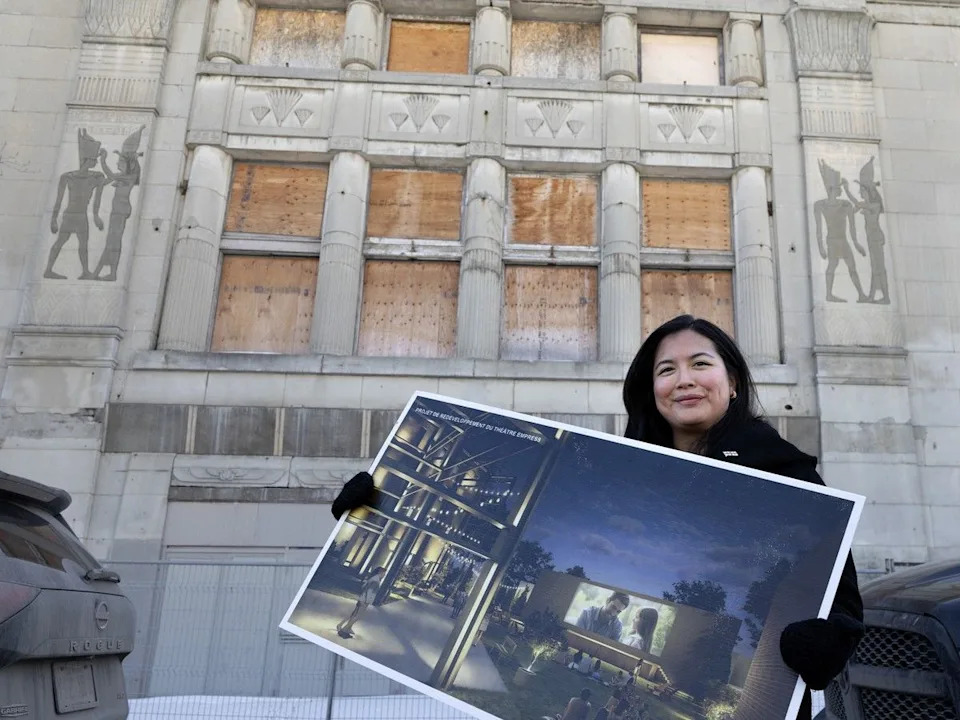
Stéphanie Valenzuela, borough mayor of C.D.N.-N.D.G., displays a design for Phase 1 of the project to revive the Empress Theatre on Tuesday, Feb. 24, 2026.
The theatre’s iconic Egyptian Revival facade would be preserved during the demolition and serve as a backdrop to the new outdoor space, which is what the renderings illustrate.
But when the borough posted the visuals to its Facebook page, commenters were quick to notice something was off.
People and children depicted in the scenes had warped or contorted shapes. Their faces were mostly featureless, giving them an uncanny appearance.
Several commenters criticized the borough for its “blatant use” of artificial intelligence, describing the visuals as “AI slop” and urging it to do better.
“AI-generated images, from a borough?” wrote one.
“Let’s hope the soul of the Empress Theatre doesn’t fade away like the faces,” added another.
The renderings include a note stating they were “retouched by AI.”
Responding to the comments below the Facebook post, the borough noted that only certain “atmospheric elements” of the images were produced by artificial intelligence.
Contacted for this report, a spokesperson for the borough said it complies with the City of Montreal’s policy on artificial intelligence in any project.
“In the case of the Empress Theatre, the AI-generated tweaks are purely esthetic (adding people or adjusting lighting),” they wrote. “The original 3D visuals are the result of work done by our in-house teams.”
The borough declined to comment any further on the negative reaction to the renderings.
A spokesperson for the City of Montreal said the city uses artificial intelligence “ethically and responsibly” and regularly updates its guidelines.
They did not specify whether it is common practice for the city to use AI-generated images when presenting new projects.
The city pointed to the directive that governs its use of artificial intelligence in response.
Under its guiding principles, the document says AI tools should only be used when they provide significant added value and when other “technological solutions cannot effectively meet the identified needs.”
Asked about the use of AI-generated images in architectural renderings, the Canadian Society of Landscape Architects said the use of AI in design isn’t inherently problematic.
But the association also warned against potential pitfalls.
“Design is complex and carries real-world implications that AI alone cannot address,” wrote Hope Parnham, the society’s manager of advocacy and strategic affairs.
“The key issue isn’t whether AI is used,” Parnham added, “but how it is used and whether it supports professional practice and informed dialogue, or is intended to substitute for it.”
Sieber said she is encouraged that people recognized aspects of the renderings were AI-generated and suggested the city should learn from the experience.
She noted how similar use of AI can contribute to some of the concerns surrounding the technology, particularly in terms of job loss. She questioned whether an urban designer or architect could have been employed to do the work instead.
“One of the challenges will be when it’s no longer easy to detect that it’s AI slop, but it’s still taking someone’s job,” Sieber added.
In addition to her work at McGill, Sieber studies how local governments are implementing artificial intelligence.
She argued the city should take a leading role in showing how to responsibly use AI, even if it means certain projects may take longer or cost more.
“Because if cities and governments don’t push back, or don’t establish good role models, who will?”
Related