
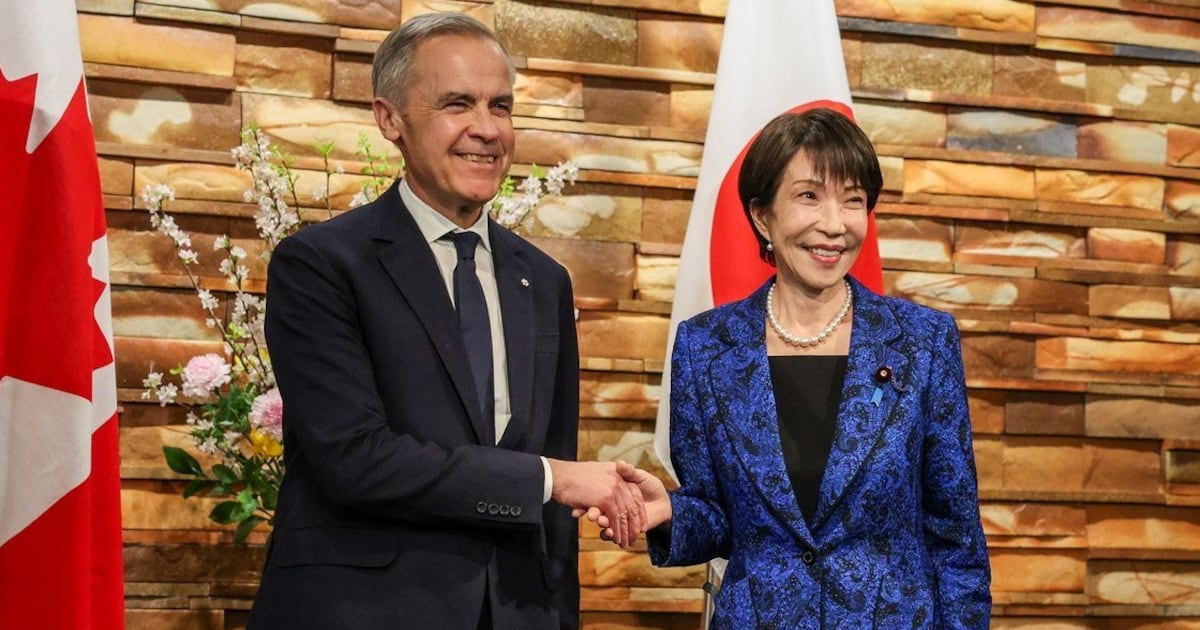
TOKYO — Several hours after landing in Tokyo, Prime Minister Mark Carney and Japanese Prime Minister Takaichi Sanae signed a new Comprehensive Strategic Partnership, looking to deepen ties across defence, energy, and technology.
“We do much, but we’re ready to do much more,” Carney said in remarks after signing.
He also spoke a few halting sentences in Japanese during his remarks — his office says he has a working knowledge of the language, having previously lived and worked in Japan.
Prime Minister Takaichi and others in the room appeared to enjoy the effort, clapping enthusiastically.
The government press release begins with one of Carney’s frequently used lines: “Canada is focused on what we can control.”
But Japan has made clear continued support in Canada’s auto sector is contingent on something not entirely within that control: a successful renegotiation of the Canada-United States-Mexico Agreement (CUSMA). It is currently up for review. U.S. President Donald Trump has mused about getting rid of it.
On CTV’s Question Period, Japan’s Ambassador to Canada Kanji Yamanouchi told host Vassy Kapelos continued access to the U.S. market, as provided for under CUSMA, is essential for current and potential increased Japanese investment in auto manufacturing in Canada.
“That is the critical condition,” Yamanouchi said. “Canada is, of course, a G7 country. Your GDP is one of the top 10 countries — US$2.5 trillion. But you know the size of the U.S. market? $30 trillion.”
Seventy per cent of cars manufactured in Canada are made by Japanese companies, which provides thousands of jobs.
“All those cars made in Canada, of course sold in Canada, but at the same time exported to the U.S. market,” said Yamanouchi.
CTV QP: How can Canada continue to further ties with Japan? Kanji Yamanouchi, Japan’s Ambassador to Canada, discusses ways Japan and Canada can further ties as PM Mark Carney is expected to make a brief stop in Japan.
A senior Canadian government official speaking on background to reporters on the plane to Tokyo said Canada is confident and committed to maintaining automotive relationships with Japan, but would not get into details about how.
Dominic LeBlanc, the minister responsible for Canada-U.S. relations, is in Washington Friday, discussing that review with the United States Trade Representative Jamieson Greer.
On defence, Canada and Japan announced a number of new measures to work together, including several focused on the North Pacific Ocean that will increase joint exercises between the two navies.
When you think Japan, you may not immediately think of the Arctic.
But Vina Nadjibulla of the Asia Pacific Foundation points to the North Pacific Ocean as a gateway to the Arctic, the context underlined by ongoing diplomatic disputes and tensions between China and Japan.
“We need to be doing a lot more with Japan and with Korea when it comes to understanding the threat from China and Russia to basically Canada’s Western part of our Arctic,” she told CTV News.
Measures announced Friday include joint sails between the Royal Canadian and Japanese Navies, the “potential” for Japan to participate in Canada’s Operation Nanook in the Arctic, and “action against illegal, unreported, and unregulated fishing in the North Pacific,” according to the press release.
Energy and food security are other important areas of partnership according to the government, as Canada looks to diversify trade, and sell the message of its reliable and stable supplies as it believes it has what Japan needs.
Japan imports 87 per cent of its energy and 62 per cent of food from elsewhere.
The government wants to sell more liquefied natural gas, liquified petroleum gas and uranium to Japan.
“Canada is in a position where we can double our LNG exports…by the end of this decade, and double again by the end of the following decade,” Carney said.
As per the English translation, Prime Minister Takaichi referred to Canada’s LNG expansion as having “great significance” for Japan.
On food, Canada overtook the U.S. to be the number one supplier of wheat and pork, and overall supplies 10 per cent of Japan’s caloric intake.
Nadjibulla says it’s a good time for Carney to be visiting in general, given Takaichi’s landslide win and commitment to investing in Japanese defence and security.
“She has popular support in a way that we haven’t seen in many, many years in Japan,” Nadjibulla said.
“She’s investing in Japan’s partnerships with other democracies. So it’s a great moment for Prime Minister Carney to essentially further deepen that relationship.”
Carney is the first world leader to meet with Takaichi since she was elected in February.
He brought her a Canadian themed cake for her 65th birthday, as they dined on her birthday’s eve.
The cake had Canadian maple mascarpone cream, a Japanese cherry blossom (sakura) sponge cake, and Canadian cranberry syrup.
Tokyo was the last stop on the prime minister’s trade focused trip which also included India and Australia. Carney lands back in Ottawa Saturday.
With files from CTV News’ Chief Political Correspondent Vassy Kapelos and CTV News Question Period senior producer Brennan MacDonald
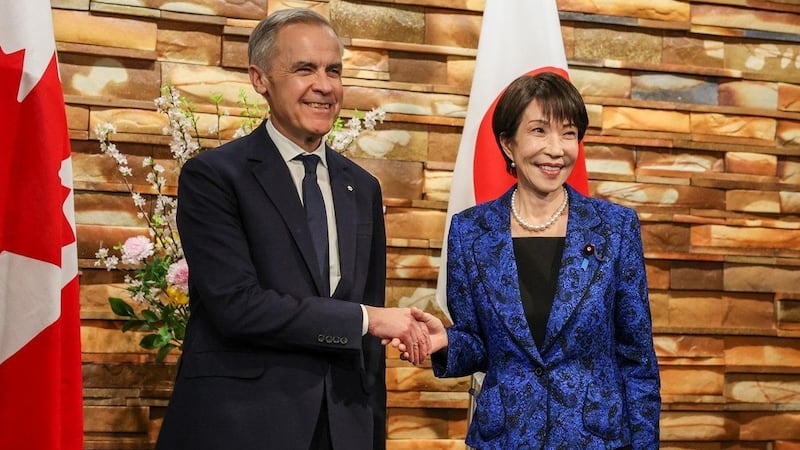 Prime Minister Mark Carney in Japan Prime Minister Mark Carney, left meets with Japan’s Prime Minister Sanae Takaichi in Tokyo, Japan, Friday, March 6, 2026. (Takashi Aoyama/Pool Photo via AP)