
Sir John Vanbrugh lived a remarkable life. Or rather, several remarkable lives. Soldier, adventurer, playwright, theatre manager, architect, possibly spy, he seemed to cram half a dozen careers into his 62 years and this year, the tercentenary of his death, sees him being celebrated. There will be events and exhibitions across his most prominent buildings from Blenheim Palace and Castle Howard to Seaton Delaval Hall and Stowe House, as well as London’s Sir John Soane’s Museum, where a fine display of drawings is currently on view in Vanbrugh: The Drama of Architecture.
This is not a given for his reputation has spiked like the silhouettes of his often bizarre buildings. Vanbrugh set the template for the English country house with a series of overblown baroque buildings, but he also created architecture at a smaller scale that was wildly creative and enduringly influential. Yet in his own lifetime he saw his work collapse out of fashion and widely derided.
It seems incredible today that Vanbrugh should switch careers so easily. Born in London in 1664 (two years before the Great Fire), the son of a cloth merchant of Protestant Flemish descent (Van Brugh), his family fled the capital’s plague and he grew up in Chester. He had a spell as a wine merchant, went to India to work for the East India Company and had a long stint as a soldier. Although the details are a little obscure, he appears to have been working undercover on the continent to bring about the invasion of England by the Dutch king, William of Orange. In the process he was captured at Calais and imprisoned in France for four and a half years, part of it spent in the Bastille.
 Sir John Vanbrugh: soldier, adventurer, playwright, theatre manager, architect, spy © National Portrait Gallery
Vanbrugh was a true original and arguably the first postmodernist, 200 years before modernism even appeared
After his return to England in 1693, he made up for lost time by inveigling himself into Whig society, becoming a prominent member of the Kit-Cat Club, where he would meet a number of future patrons (his portrait from the club’s walls is here on loan from the National Portrait Gallery). First he decided to become a playwright (at a time when theatre was roaring back after the Puritan interlude) with a series of provocative and scandalous works and memorable characters including Sir Novelty Fashion, Narcissa, Sir Tunbelly Clumsey and Lord Foppingham. His women were given real agency and surprising sexual freedom. He then launched his career as a theatre manager by taking on the site, design, construction and management of the Queen’s Theatre in Haymarket. A painting of it appears at the Soane, an austere, almost industrial building, its stripped-brick pilasters like huge chimneys.
 Vanbrugh’s perspective view of Castle Howard, circa 1699-1706 . . . © Victoria and Albert Museum
 . . . and the finished building © Alamy
While still (rather chaotically) running the theatre, Vanbrugh decided to become an architect and began building the vast Yorkshire pile of Castle Howard for fellow Kit-Cat Club member Charles Howard, Third Earl of Carlisle (all his commissions would come from this kind of assiduous networking). The house is now familiar from period productions like Brideshead Revisited and, more recently, Bridgerton, a strange heap with a roofline haunted by statues, urns, chimneys and protuberances. There are some beautiful sketch studies shown here, real, scrappy working drawings illustrating how Vanbrugh designed and altered.
Then came Blenheim Palace, another sprawling pile intended as a national monument to its owner, the first Duke of Marlborough, who had defeated the French at the eponymous battle in 1704. Britain’s only non-royal palace, later the birthplace of Winston Churchill, is now the epicentre of English country-house trust culture. Yet Blenheim is both masterpiece and monsterpiece, a slightly nauseating appropriation of Italian baroque made clunky and almost nightmarish in places, and surreal in its details.
 Vanbrugh’s drawing of Blenheim Palace . . . © Ardon Bar-Hama
 . . . and the finished building, now a Unesco World Heritage site © Alamy
There are three paintings here from Soane’s office (used to illustrate lectures) showing Blenheim first in detail, then slightly obscured by mist, then in silhouette only. It evolves into a massive stage set and suddenly it makes much more sense. This is architecture as drama, not necessarily in its own right but as representation of a national self-image, of victory, landscape and power.
Which is just as well, because it is not a very good house. Its rooms were criticised as mean. Mostly paid for by the nation, it became a kind of national joke, an overinflated, clunky expression of ego. Now, of course, it is beloved. There is a delightful short film of Robert Venturi and Denise Scott Brown (architects of the National Gallery Sainsbury Wing) wandering around Blenheim and admiring it — the building became for postmodernists, as it had been for Soane, an inspiration.
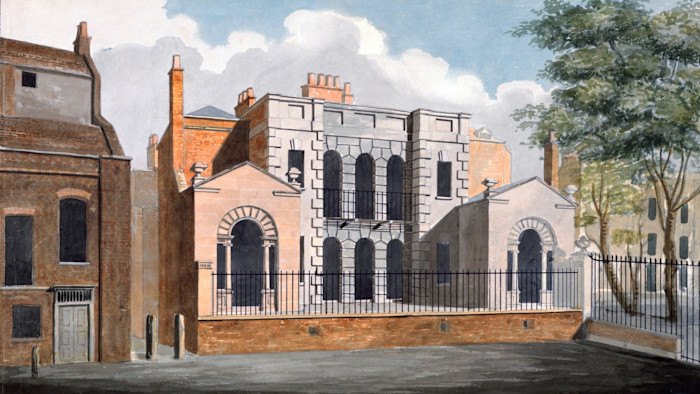
Vanbrugh’s own house was eccentric, too. Built on Great Court, Whitehall (1701, after a fire had destroyed the old palace), the most visible London site imaginable, Goose-Pie House looked like an inflated toy; two enlarged sentry-boxes framing a house with blank arcades, a De Chirico doll’s house. But it is also undoubtedly compelling. “At length they in the rubbish spy, a thing resembling a goose-pie,” wrote Jonathan Swift in a satirical poem about the house. The nickname stuck.
Vanbrugh was prolific, building inventive, eccentric houses across the country. The next home he built for himself in Greenwich resembled a castle, in its fortifications and massive walls an arch nod to the Bastille. You might even argue that he sparked the gothic revival, maintaining ruins where he found them and building pointed windows and castellations decades before Horace Walpole realised his iced fantasia at Strawberry Hill.
 Vanbrugh’s drawing of Queen’s Theatre, Haymarket, which he designed and went on to manage © Ardon Bar-Hama
The exhibition is co-curated by Charles Saumarez Smith, whose excellent new book of the same title paints a nuanced picture of Vanbrugh’s career. He has worked here with architect Roz Barr, who brings her feeling for the drawings and her sensibility for the process to the show. She has also curated and designed the forthcoming exhibition Staging the Baroque at Castle Howard (opening March 26), where in the grounds designer Es Devlin presents an installation at the lovely Temple of the Four Winds.
Vanbrugh’s overblown, hyper-stylised houses would fall out of favour in his own lifetime, supplanted by the restrained Palladian Georgian style which became the fashion for the rest of the 18th century. But they were revived again, admired for their ambition and, quite often, their sheer oddity. Vanbrugh was a true original and, as Venturi and Scott Brown suggest, arguably the first postmodernist, using bits of other buildings, references, styles and a magpie love of archetypal elements, theatre, scenography and atmospheres, 200 years before modernism even appeared. How’s that for avant garde?
To June 28, soane.org
Find out about our latest stories first — follow FT Weekend on Instagram, Bluesky and X, and sign up to receive the FT Weekend newsletter every Saturday morning