
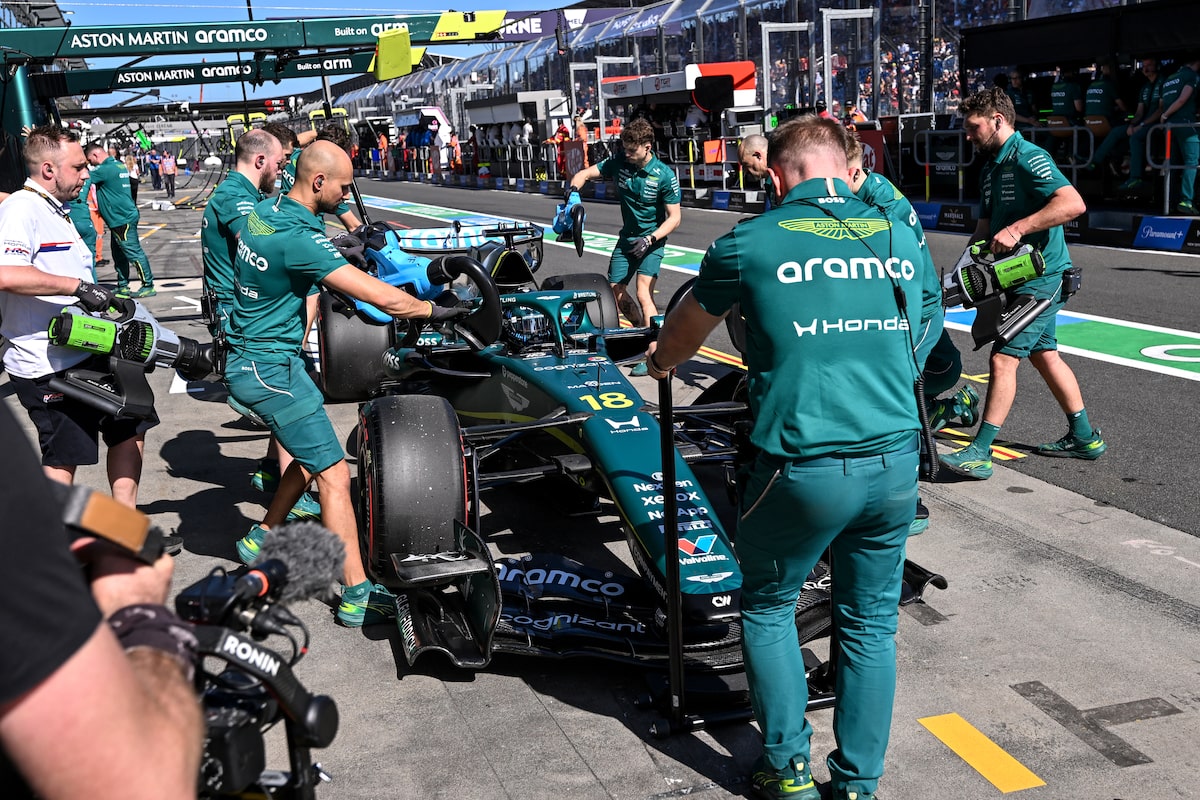
Mechanics work on the car of Aston Martin’s Canadian driver Lance Stroll during the second practice session of the Australian Grand Prix at the Albert Park Circuit in Melbourne on Friday.WILLIAM WEST/AFP/Getty Images
Across the road from Aston Martin’s gleaming Formula One headquarters in the British countryside, the famed Silverstone racetrack has a museum that displays several championship cars created by designer Adrian Newey over the decades.
His latest car probably won’t be joining them.
On the eve of one of the most highly anticipated F1 seasons in years, Aston Martin has a significant problem on its hands. The team’s new car, designed by Newey at great cost to Aston Martin, isn’t just a dud; it’s looking like an early disaster.
Barring any miracle design tweaks in the final hours before this weekend’s Grand Prix opener in Australia, Aston Martin and Newey have already signalled that the team’s new car won’t make it to the end.
Aston Martin’s car risks giving drivers ‘nerve damage’ and is unlikely to finish F1 season-opener
F1 cars are forced out of races all the time. It’s not uncommon for one or two, or more, to pull into the paddock midrace because of unforeseen difficulties. But for a team to admit ahead of time that the design it’s been working on for months won’t be able to fulfill the 58 laps required in Melbourne is a different sort of embarrassment.
Canadian billionaire and team owner Lawrence Stroll poached Newey in 2024, after the designer had reeled off 12 Constructors’ Championships since the 1990s, including six with Red Bull between 2010 and 2023.
To land Newey, Stroll forked out between £25-million and £30-million, while also making him a shareholder in the team.
In recent months, Newey was further elevated from managing technical partner to team principal, giving him more control over the direction at Aston Martin F1.
“He’s a unicorn. He interprets the loopholes better than anyone,” Stroll said last fall. “Him and air have a relationship no one can figure out.”
But with Newey rushing to design a new car ahead of this season, and the team bringing in Honda to oversee its engines, there are a few things Aston Martin has yet to figure out: Not only has the new design tested slower than its peers, the Honda power unit is also causing the entire chassis to shake. And Newey’s team of engineers hasn’t been able to get that problem under control.
“That vibration into the chassis is causing a few reliability problems,” Newey told reporters ahead of the Australian GP.
“Mirrors falling off the car, tail lights falling off, that sort of thing, which we are having to address. But the much more significant problem with that is that that vibration is transmitted ultimately into the driver’s fingers.”
F1 heads into new era that demands a new driving style
Fearing permanent nerve damage in his hands, Aston Martin’s lead driver, Fernando Alonso, estimates he’ll only be able to log about 25 laps under the circumstances. Teammate Lance Stroll figures he can finish about 15 laps.
“We are going to have to be very heavily restricted on how many laps we do in the race until we get on top of the source of the vibration – and to improve the vibration at source,” Newey said.
Though the team is trying to be optimistic – both Alonso and Newey have said they believe the new design has a lot of potential this season, assuming the problems can be fixed soon – it is a sizable blow to a middling team that was looking to use the new car to move up the standings.
F1 has introduced some of the most sweeping rule changes in its history this season. The regulations governing each car have been revamped to make them narrower, shorter and lighter, with an eye to making the races more competitive. Meanwhile, the engines will be 50-50 electric-fuel hybrids.
The changes could shake up the leaderboard more than any season in recent memory. A team able to capitalize on the regulation changes, through innovative designs or new engineering strategies, could leapfrog its rivals by rolling out a faster car.
F1 reset finally gives automakers a plan they can defend to stakeholders
The ability to exploit rule changes and translate them into gains on the track has been a hallmark of Newey’s storied career. But he has been working on a compressed timeline. Meanwhile, there are glitches emerging in the team’s research and development relationship with Honda.
Lawrence Stroll has been vocal about his desire to build a champion and has been pouring his own money, along with that of investors, into turning Aston Martin into an F1 force, including a massive new complex in Silverstone that rivals the campus of a Silicon Valley tech giant.
Stroll, a car aficionado and fashion magnate from Montreal who has made billions investing in Ralph Lauren, Tommy Hilfiger and Michael Kors since the 1980s, figures Aston Martin and its sponsors are spending more than US$500-million to build a winner.
“To be honest with you, I don’t even know the exact number. I just put in whatever’s necessary,” Stroll said last fall.
“I have a very huge competitive nature, and I’m here to win – I didn’t do this not to win.”
But Stroll’s outspoken personality and his aggressive move into F1 over the past decade, with his son Lance as a driver on the team, have made Aston Martin a target for criticism.
As word of the new car’s difficulties circulated around the sport, rival driver Valtteri Bottas was asked who he thought would contend for the title this season. He sarcastically named Aston Martin.
Stroll has always maintained that his project to build Aston Martin into a winning outfit was a five-year process, and that the team wouldn’t start winning immediately.
But to win, a team must first finish races. As the season gets under way, the outsized ambitions of Aston Martin are now trailing the rest of the grid. And the spotlight on Newey will only get brighter if the issues aren’t resolved.