
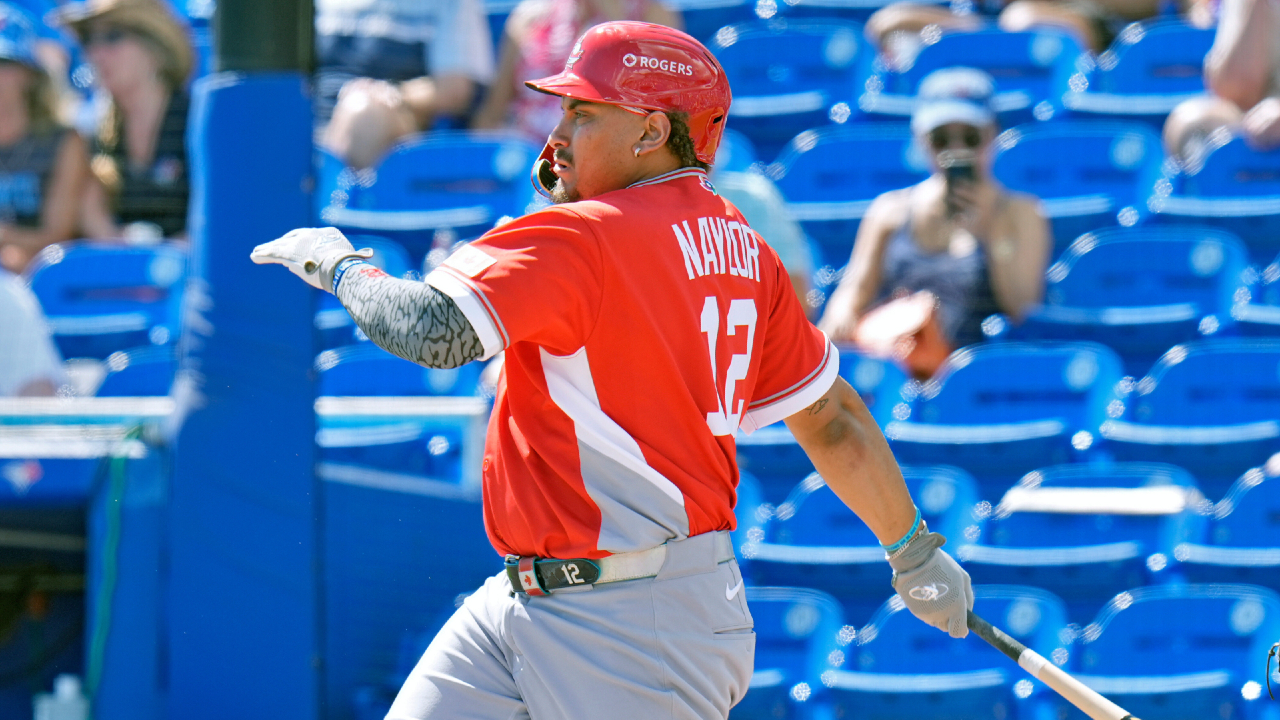
CAROLINA, Puerto Rico – Josh Naylor is a big jersey guy.
While with the Arizona Diamondbacks, for instance, a friend made him a custom hockey top with the NL West club’s logo that he often wore during warmups. Now that he’s with the Seattle Mariners, his collection is filled with a selection of local-team unis, from the PWHL’s Torrent and WNBA’s Storm to the departed SuperSonics.
At the World Baseball Classic, the national team captain from Mississauga, Ont., is rocking a carefully curated set of Canadian hockey tops, including a 1987 Canada Cup Wayne Gretzky he wore during Friday’s practice at Estadio Roberto Clemente.
“I like representing great players, current and alumni players, so I brought a ton of jerseys I had back home,” Naylor said after the workout in preparation for Saturday’s opener against Colombia. “I don’t want to expose which ones I have just yet. This was one of them. I have, like, five more, all Canada hockey. I love this jersey. It’s really cool. I tried do three or four different eras, classic or (various) Canada tournaments.”
Like the No. 99 shirt he wore Friday, his national team jersey at the WBC will also have a captain’s C on it, named to the role by manager Ernie Whitt and the Baseball Canada brain-trust. Most teams at the tournament selected captains at Major League Baseball’s suggestion and Naylor was a natural choice for his fire, fearlessness and aggressive play.
As third-base coach Stubby Clapp put it, “pardon my English, but he comes to kick ass every day. That’s what you want in your leader. Because whatever he does everybody’s going to follow.”
Whitt, in English that needed no pardoning, agreed, saying Naylor’s approach on the field is “absolutely the stuff that we want,” even if the club’s leadership group extends beyond the 28-year-old.
“I talked to Tyler (O’Neill) also, I said, you handle the outfielders, Josh, you handle the infielders and the whole team, and (James) Paxton, you handle the pitching staff. You delegate it out with them,” continued Whitt, who also urged the team’s younger players to lean on the vets, telling them, “we’ve got all kinds of knowledge here for you, don’t be afraid to reach out to them.”
Naylor said he was “humbled” at being named captain, having played on the junior national team growing up, watching his brothers Bo, the catcher on this Canadian team, and Myles, a prospect in the Athletics system on track for future clubs, follow on his footsteps, and now preparing for his second WBC.
“I’m very thankful to represent my childhood in that form and then represent those who came before me,” said Naylor. “But I think everyone, in their own way, can be a captain. Everyone can lead as an individual. Hold yourself accountable. Work hard, play hard, practice hard. Just because I have the C on it doesn’t mean everyone else doesn’t have a responsibility or the accountability to be a captain on their own.”
Whitt wholly agrees with that sentiment, which is why he thinks captaincies in baseball are unnecessary.
“If you need a captain to motivate you, then something’s really wrong,” he explained. “In hockey, I know they do it all the time and they have that guy. But you as an individual, you have to look in the mirror at the end of the day and say, ‘Did I give it my best?’ I know with Josh, he does that.”
Clapp, a part of the national team program since playing at the 1999 Pan American Games in Winnipeg, described wearing a C as “immaterial” in baseball.
“There’s always a captain in the clubhouse, per se, whether there’s an actual letter on the jersey or not, everybody knows who the guy is,” he explained. “You put a C on a jersey for everybody to see it, that’s more visual, I guess. It’s obviously more traditional for hockey to see the C and it would be cool if we put the C on Josh’s jersey and the A on everybody else. That would be that would be kind of cool. But he’s deserving of it.
“He represents us really well.”
Canada ran through a series of fundamental drills atop the usual rounds of batting practice and bullpens Friday, trying to get tight in the field ahead of their opener.
They worked on everything from who handles relay throws from the outfield to wheel plays on bunts to handling potential delayed double steals, seeking uniformity in work that can vary from organization to organization.
“We had one practice (Monday) where we went over some stuff and then we had two of the exhibition games and we screwed up some stuff, so I said, well, this is going to be a perfect day just to clean it up a little bit,” said Ernie Whitt. “Everyone knows how important it is to execute these plays that could happen and not give the other team extra outs. You give the other team extra outs, they have a chance to score, it builds up the pitchers’ (pitch) counts, all those things really come into play. So it’s very important in these tournaments.”
Before taking the field Thursday in Panama’s 3-1 loss to Cuba in the Pool A opener, Leo Jimenez last wore his country’s colours as a 15-year-old at a junior world championship in Japan. He’s 24 now, turning 25 on May 17, and is on the bubble of the Toronto Blue Jays’ roster now, a major progression far from lost on the infielder.
“It makes me happy that I’m representing Panama now on the biggest world stage, against the best players in the world,” he said after going 0-for-2 with a walk. “It’s a huge jump from 15 years old to now but it’s part of the development I’ve had as a player and it’s awesome. I’m enjoying every single thing.”
He doesn’t believe anyone else from that team a decade ago is here in San Juan with him now, but did play travel ball at the age of 12 with Enrique Bradfield Jr. While he didn’t collect a hit Friday, Jimenez did hit a groundball to the right side that moved Leo Bernal to third ahead of Johan Camargo’s RBI single for Panama’s only run.
Jimenez did not face Blue Jays teammate Yariel Rodriguez, who followed Cuban starter Livan Moinelo with 2.1 innings of no-hit, no-walk ball, while striking out three on only 27 pitches. Rodriguez got up to 96.6 m.p.h.
“It was just funny to be there and see him pitch,” said Jimenez. “I told him in Dunedin, ‘When we play against each other, we are enemies, you know? I’m not even talking to you that day, I’m not even saying, ‘hey.’ At the end of the day, I just texted him, ‘Great game, keep going.’ He texted the same thing back. That’s what baseball’s all about. Being enemies in the field and then being back to normal whenever the game is done.”