
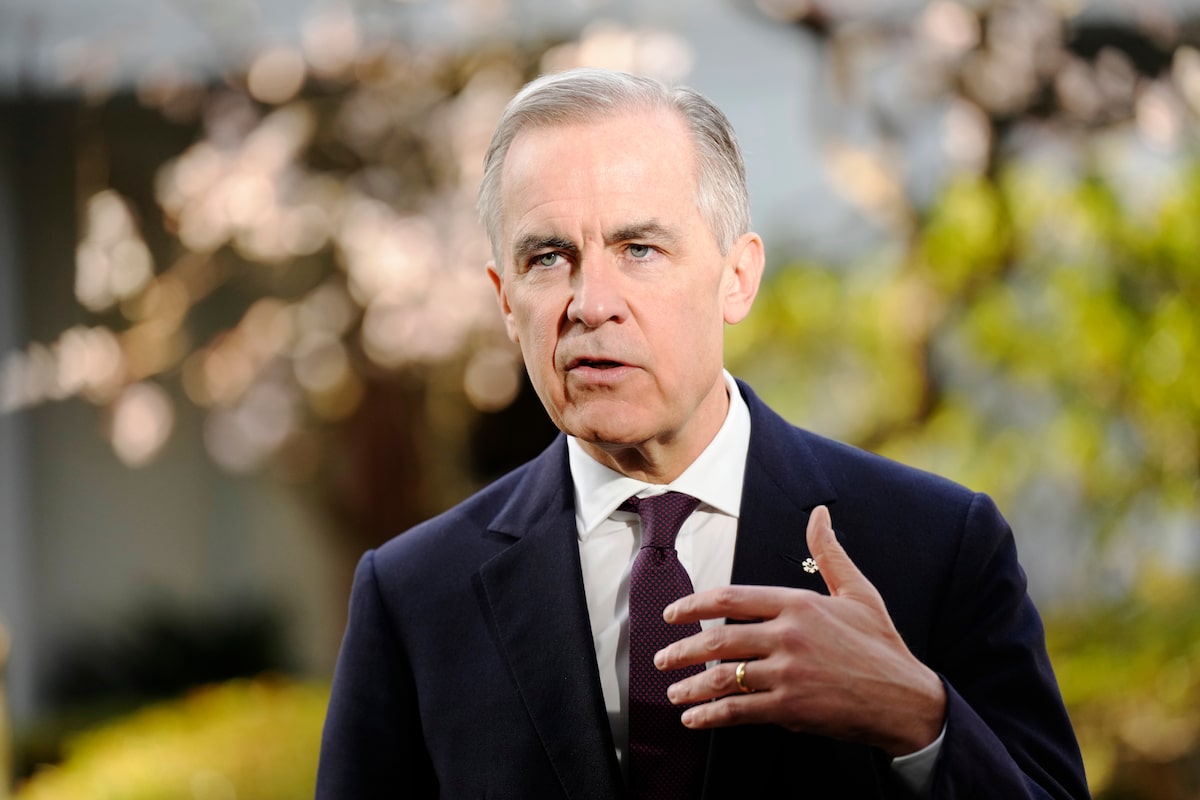
Prime Minister Mark Carney speaks with reporters on the final day of a three-country tour in Tokyo.Adrian Wyld/The Canadian Press
Prime Minister Mark Carney said Canada has not yet received requests from Persian Gulf states for military aid to help them defend against attacks from Iran.
And, he suggested, these requests might not arrive.
The Prime Minister spoke to journalists in Tokyo near the end of a two-day visit to Japan. Earlier this week, Canada’s Chief of the Defence Staff General Jennie Carignan had said Ottawa was weighing options to support Gulf states.
The Prime Minister’s response Saturday appeared to be an attempt to reframe the state of affairs.
“We have not yet received any requests [and] don’t necessarily anticipate those requests,” Mr. Carney said Saturday. He said that he and Foreign Affairs Minister Anita Anand are in talks with leaders in the Gulf region.
‘Shia Crescent’ grapples with fear and anger after Iran’s upheaval
Ultimately, the Prime Minister said, “any decision would obviously be taken by the government, not by the armed forces.”
He reiterated that Canada’s first priority was protecting Canadians in the region and helping them evacuate.
The broadening Iran war, sparked by missile attacks launched by the United States and Israel, has ricocheted across the region and beyond, with nearly every country in the Middle East sustaining damage from missile hits, drone strikes or shrapnel.
Mr. Carney wraps up a 10-day visit to three countries – India, Australia and Japan – on Saturday. He has been trying to expand foreign markets for Canadian products and services and attract new overseas investment to shift trade away from the increasingly protectionist United States.
Earlier this week, Mr. Carney left the door open to military deployments to the Gulf to defend or support allies as well as Canadians in the region. “One can never categorically rule out participation,” he said.
Parliament’s return next week is expected to bring additional scrutiny to how the Prime Minister has responded to the conflict. He initially issued a statement supporting the U.S. and Israeli strikes because, he said, Iran must be prevented from acquiring nuclear weapons. Later he tempered his support, saying it appeared the pre-emptive strikes may violate international law.
How the Iran war is affecting countries in the Middle East and wider world
Conservative Leader Pierre Poilievre is calling for an emergency debate in the House of Commons on energy policy in particular, urging the Liberals to repeal existing laws and speed up permitting for resource projects. Mr. Poilievre pointed to the pressure the war is creating on global energy markets and said Canada has the capacity to respond.
“Our country possesses vast reserves of oil and natural gas that could help stabilize global markets, support our allies and strengthen our own economy,” he wrote in a letter to Mr. Carney.
Earlier in the week, Conservative defence critic James Bezan had also suggested there be a parliamentary debate on what role Canadian Armed Forces might play in response to the war. The New Democrats said Friday they intend to call for one next week.
Gen. Carignan met with her NATO counterparts Friday to discuss how the situation in the Middle East is threatening the security of the alliance, and she had previously told reporters those talks would also include how countries such as Canada could provide defensive support to Gulf states.
A decision on whether or not to engage would be up to the government, she said.
Separately, on Saturday, Mr. Carney played down the fact that the U.S. is holding one-on-one discussions with Mexico over the scheduled review of the United States-Mexico-Canada Agreement – talks that will not include Canada.
Mr. Carney noted that U.S. officials, including President Donald Trump, have said several times that they are planning to have separate talks with Mexico and Canada during the USMCA review, because the nature of trade frictions are different. There will still be trilateral talks on the overall deal at a later date, he said.
“The list of and the nature of the trade issues, or trade irritants, as it would be described by the United States, is quite different between Canada and Mexico,” Mr. Carney said, “So we don’t necessarily need to be at the table for the issues with Mexico.”
While in Japan on Saturday, the Prime Minister also met with executives from Asahi Kasei, Sojitz, Mitsui, Toyota and Mitsubishi.
With reports from the Associated Press