
Read: 4 min
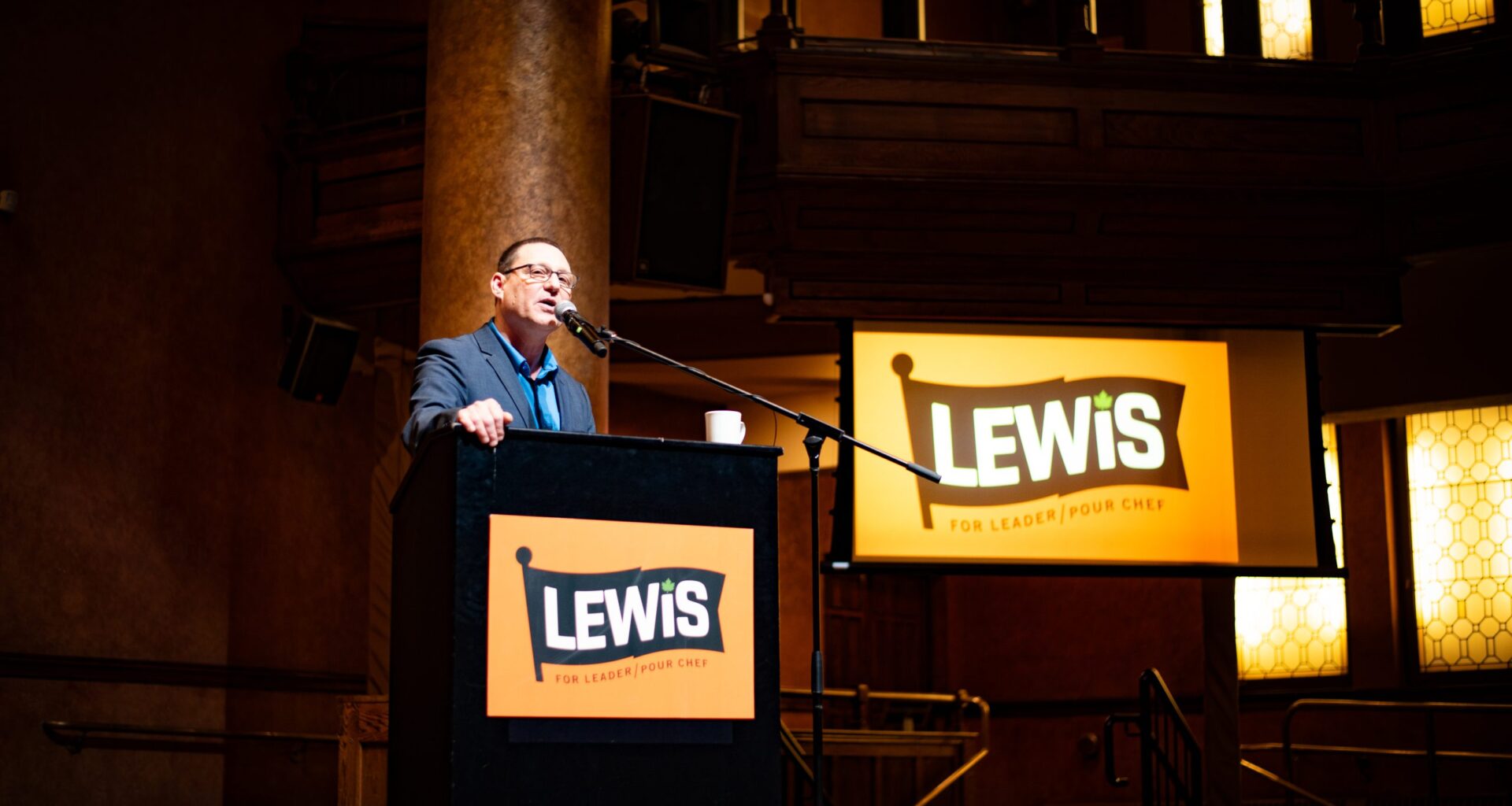
The downtown Ottawa crowd that gathered March 5 to hear from NDP leadership frontrunner Avi Lewis showed little concern about the party’s dismal prospects.
“What are you all doing here?” Lewis asked in mock surprise as he took the stage, following more than an hour of musical performances and endorsements from politicians and activists.
“You didn’t hear the party’s on life support?”
Lewis, who aims to lead a party that was reduced to just seven seats in last federal election, told the enthusiastic audience not to worry about media reports questioning the party’s relevance.
“We love being underdogs,” he said. “Let them underestimate us.”
Lewis said that, with him as leader, the NDP would address Canadians’ cost-of-living concerns while avoiding deadly global entanglements.

“The rules of the global and economic international order — the written ones and the unwritten ones — they’re shredded,” he told the roughly 800-person crowd.
“They’re lying around us like the lining of a bird cage. What we knew before just doesn’t apply right now. In this moment, our country needs a vision to chart a path forward that doesn’t take the world just as it is, but actually articulates where we want to go.”
‘Getting election ready’
But much needs to be done before the NDP can turn that vision into federal policy.
Speaking to reporters after the event, Lewis said his top priority as leader would be to ensure the fledgling party is ready for a federal election.
“We’re building the ground game for the next election right now,” he said, noting the party’s large debt and minimal presence in the House of Commons.
“We’re going to be focused on getting election ready.”
However, Lewis does not currently have a seat in the House of Commons, and emphatically told reporters he will not run in either of the two upcoming Toronto by-elections. His said his first priority is winning the NDP leadership race.
Lewis, a professor at the University of British Columbia and former journalist, was raised in Toronto. He is the son of former Ontario NDP leader Stephen Lewis, and grandson of former federal NDP leader David Lewis.
Lewis ran in Vancouver during the 2025 and 2021 federal elections, and finished third both times.
‘Criticize capitalism’
During his nearly 50-minute speech, Lewis urged the crowd to back him, saying only the NDP can tackle the affordability crisis many Canadians face.
“We’re the people that criticize capitalism,” he said. “We don’t celebrate profits as a good unto itself, because we’ve got a collective sore neck from 40 years of waiting for it to trickle down.”
He reiterated his campaign promises to create publicly funded, warehouse-style grocery stores that sell food at reduced prices.
He also promised to create a network of public telecom providers, inspired by the Saskatchewan provider SaskTel.
“You can watch your finest days drain away on hold waiting for some minor adjustment to your goddamn cellphone plan,” he said, lamenting the high costs and poor customer service many Canadians experience from large telecoms like Bell and Rogers.
The environment also needs to remain a key priority, Lewis said. He touted the need for Ottawa to invest in electric vehicles and to create a publicly run EV manufacturer.
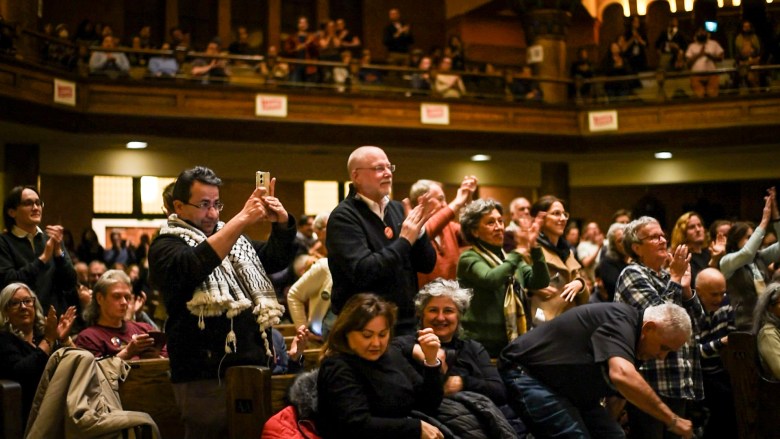 Attendees at the Ottawa event. | Hailey Asquin
Lewis, along with his wife climate activist Naomi Klein, authored the Leap Manifesto, a 2015 document that outlined how the Canadian government could reduce carbon emissions and other environmental dangers.
“The new iron law of energy development must be: if you wouldn’t want it in your backyard, then it doesn’t belong in anyone’s backyard,” the manifesto reads.
“That applies equally to oil and gas pipelines; fracking in New Brunswick, Quebec and British Columbia; increased tanker traffic off our coasts; and to Canadian-owned mining projects the world over.”
The manifesto also calls for high-speed rail and more public transit; a universal program to build energy efficient homes; and investing more in teachers and caregivers, including creating a national child-care program.
Defence criticisms
Lewis fiercely criticized the Carney government’s focus on defence and its apparent willingness to send Canadian troops to Iran.
Last month, the government released a Defence Industrial Strategy, which outlines a multi-year plan to significantly increase spending on defence and create jobs.
“That’s the industrial growth strategy,” Lewis said, questioning why the Carney government is tying job creation to the military.
“I’m not saying you don’t need a military,” he said. “We need a military. But this is not the way.”
Military investments rely on “ever increasing production of fossil fuels,” he said. AI data centres also rely heavily on energy production, and Canadians should be wary of the government’s interest in AI, he told the crowd.
He blasted Prime Minister Mark Carney for showing a willingness to send Canadian troops to fight in Iran.
“A war of aggression launched by one country currently committing genocide, and another which has threatened us with annexation, is not a war we can support,” he said.
He reiterated this to reporters after the speech, noting Carney’s response to the conflict has “been all over the place.”
“We’re waiting for the prime minister to actually come out and say what most Canadians believe, which is that we do not approve of violations of international law,” he said.
“We don’t send our own troops into wars of aggression that violate international law, and that Canada is against this war. It’s destabilizing the entire region, potentially the entire world.”
U.S. trade
Lewis also spoke about how he would approach trade negotiations with the U.S.
Canada needs to get the best deal for Canadian workers, but “can’t do it with any faith that the process has an end point or a potential happy resolution,” he said.
“What we’ve seen from the U.S. administration is a lack of capacity to stay on any track for any extended period of time,” he said.
“I believe in saving the Canadian auto industry, but I don’t think we just get to go back to when the United States, Canada and Mexico had an integrated auto industry.”
Canada needs to invest in clean energy infrastructure, like electric vehicles, he told the crowd.
Canadian workers can use Canadian steel to make products that will make the country less reliant on the United States. “We need a clean energy renaissance in Canada,” he said.
NDP members will vote on a new leader at a convention in Winnipeg from March 27 to 29. Lewis’ strongest competition is Heather McPherson, an Edmonton MP.
On March 6, the prediction market Polymarket put Lewis’ odds at winning the race at 92 per cent, and McPherson’s odds at six per cent.
By the end of the Ottawa event, attendees had donated around $9,000 to Lewis’s campaign.
Related Posts