
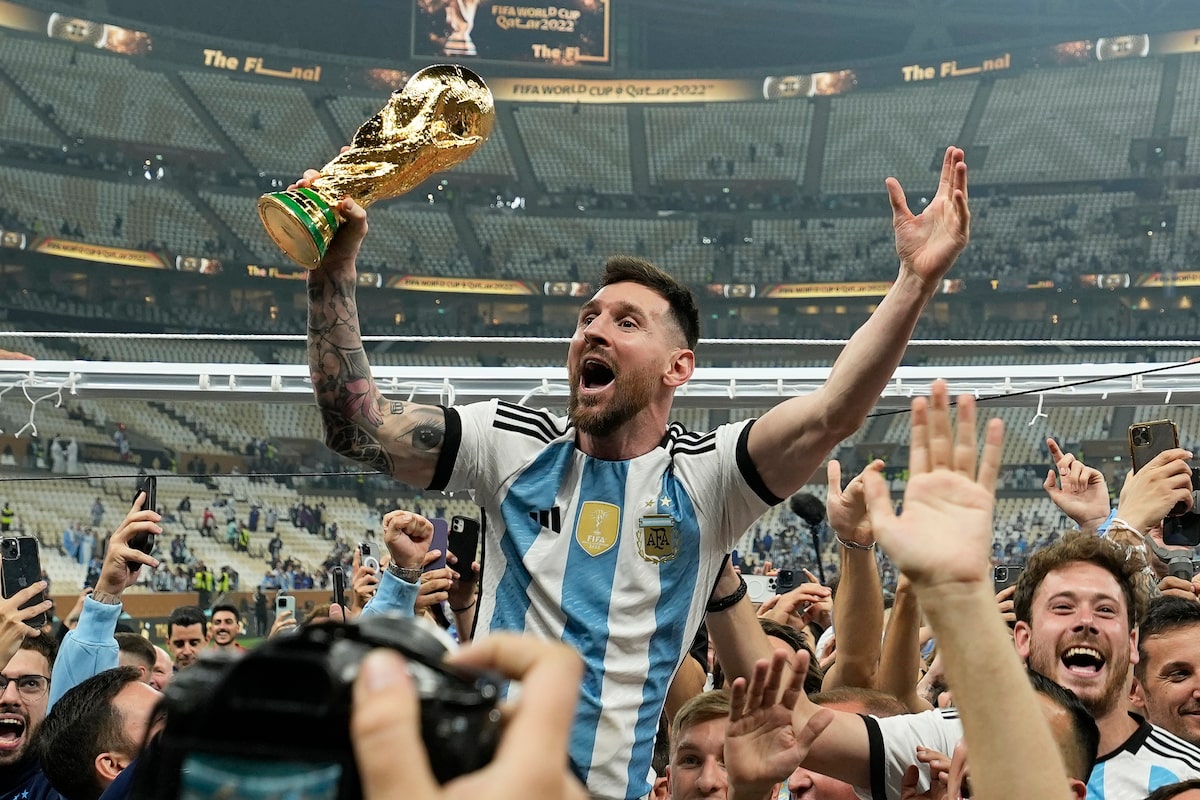
Argentina’s Lionel Messi celebrates with the World Cup trophy in front of the fans after defeating France in the championship game at Lusail Stadium in Qatar on Dec. 18, 2022.Martin Meissner/The Associated Press
The World Cup, like poetry, makes nothing happen. It can deliver beauty (intermittently), heart attacks (quite often, actually), and moments of emotional release for repressed men (in the billions), but not change. Perennial expectations of political impact – it’s a global tournament followed by about half the world, after all – are usually disappointed.
That is the conclusion of Simon Kuper’s fascinating and timely new book World Cup Fever: A Soccer Journey in Nine Tournaments. It might seem like an odd conclusion to draw for someone who has spent long stretches of his adult life schlepping to World Cups and has now dedicated a book to them, but one of Kuper’s many strengths as a journalist is an aversion to overstatement.
The Paris-based Financial Times columnist whose previous books include a wonderful study of FC Barcelona and the bestselling Soccernomics is widely regarded as one of the best living soccer writers.
Instead of ballyhooing a subject that doesn’t need it, he offers a subtle anthropology of a sporting event that has become a society unto itself, a kind of Atlantis that emerges from the deep once every four years. As Kuper puts it with typical pithiness: “The World Cup is almost always its own country.”
It is a useful reminder as Canada prepares to co-host the tournament this year amid the usual hype, and more than the usual anxiety about the involvement of President Donald Trump’s United States. The net effect on North America will likely be a wash. Not even Trump is likely to leave his mark on the World Cup. That also means he probably won’t ruin it.
In this July 4, 1954 file photo, West Germany’s Helmut Rahn, centre with arms raised, celebrates after equalizing in the World Cup final match against Hungary at Wankdorf Stadium in Bern, Switzerland.The Associated Press
The French soccer bureaucrat Jules Rimet founded the World Cup with loftier ambitions. Scarred by his experience serving in the First World War, he wanted to create “the footballing equivalent of the new League of Nations” – a conduit for peace through sport.
Politics of a less exalted kind were also involved from the beginning: Only countries in Europe and the Americas were invited to the first World Cup in 1930. The colonies of Africa and Asia didn’t fit into Rimet’s mental map.
Cathal Kelly: The 2026 FIFA World Cup will be the one that runs off the rails
The best example of a World Cup actually changing a country also came early. The 1954 final in Switzerland between West Germany and Hungary is still remembered by Germans as the Miracle of Bern.
After the shame and ruination of the Nazi era, and the country’s painful division by the Iron Curtain, Bern was the moment West Germany “advanced from being a state to becoming a nation.” It was the first time some German boys saw their fathers smile.
The tournament was about to enter its golden age. Television made the World Cup a truly global spectacle. Every neutral’s favourite team, Brazil, won three of the next four trophies playing the effervescent joga bonito that became its signature. Each country had its own footballing style then: the West Germans ruthlessly efficient, the English ruddy and unsophisticated, the Argentines flamboyant and cunning. “A national team was the nation made flesh,” Kuper writes.
The World Cup had become too big to be derailed by politics. There was talk of boycotting the Argentine military junta when it hosted in 1978, but in the end every qualifying country showed up.
The political impact was probably neutral: One important dissident group felt the world’s attention gave them a new visibility, and Amnesty International even found that scrutiny of human rights abuses led some countries to take more Argentine refugees. On the other hand, Amnesty found the successful unfolding of the tournament “bolstered the junta’s reputation inside Argentina.”
Likewise France ’98, when a multiracial team won the World Cup on home soil and brought the nation together in a seemingly lasting way, only for bigotry and disenfranchisement to reassert themselves in short order. “A World Cup can’t heal a country,” no matter how glittering it seems in the moment, Kuper concludes.
World Cups are always a success in a narrow, logistical sense. The grasping functionaries of FIFA have too much at stake to let one fail. Disruptive politics can be edited out, like anti-regime protests by Iranian militants in 1998 that were deliberately not shown on TV.
Argentina’s forward Lionel Messi, right, vies for the ball with France’s midfielder N’Golo Kante, left, during the Russia 2018 World Cup round of 16 football match between France and Argentina at the Kazan Arena in Kazan on June 30, 2018.ROMAN KRUCHININ/Getty Images
Plunk the tournament down in locations as disparate, and unpromising, as South Africa, Brazil, Russia and Qatar, and you end up with the same smooth, featureless experience, each venue a well-ordered “non-place,” with only the slums you pass on the highway changing from year to year.
World Cups tell lies about the host country, sometimes even to itself. In 2002, Japan was delighted to find its stadiums packed with cheering young women – the first football crowd Kuper had ever heard with a soprano voice – and enamoured of its irreverent platinum-blonde team, a youthful vibrancy that masked the planet’s most elderly country.
The 2018 tournament showed Kuper an illusory Russia of “world-class infrastructure, international brotherhood, and helpful police.”
Gary Mason: The burgeoning World Cup debacle
None of this means the World Cup is insignificant. There’s a reason Kuper has travelled to the last nine of them. No other sporting event captures the world’s imagination like it; in football-mad countries like England it is “the nation’s biggest communal experience.” The risk of admission to hospital with heart attack increased by 25 per cent on the day of England’s crushing loss to Argentina in 1998.
The tournament can stir even the most stoic souls. When their country was awarded the 2010 World Cup, Kuper writes, it was the first time South Africans had seen Nelson Mandela cry.
The mistake is to put too much stock in the tournament, beyond its fleeting emotional atmosphere.
South Africa had high hopes that hosting would enrich the country and prove to the world it was competent. Instead the World Cup left a landscape of white elephant stadiums and entrenched poverty, its enduring sense-memory the drone of vuvuzelas, those plastic trumpets beloved by South African soccer fans. When Kuper returned to the country in 2024, he saw few traces of the event. It had disappeared beneath the waves like it always does, an enchanted city loyal only to itself.