
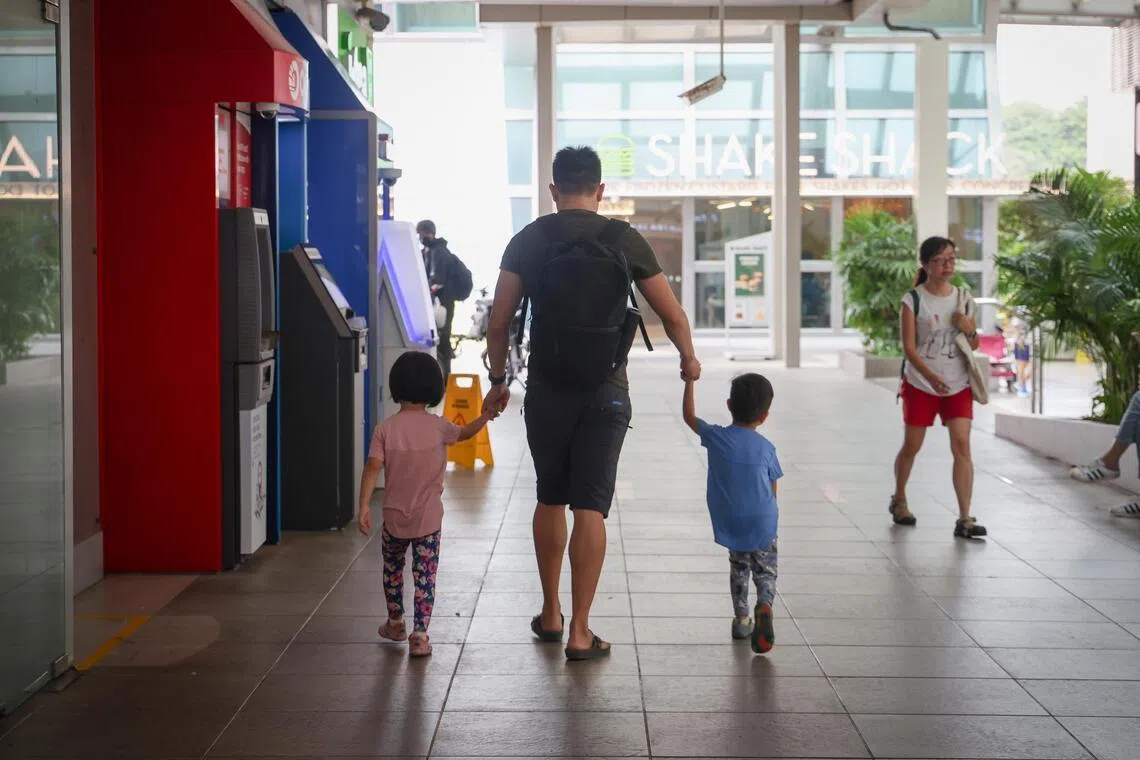
SINGAPORE – More families who face marital and parenting issues can get free counselling, as the
Strengthening Families Programme (FAM)
expands its capacity.
Minister for Social and Family Development Masagos Zulkifli said in the debate on his ministry’s budget on March 5 that FAM centres will support up to 12,000 cases by 2030, double the caseload in 2025.
The Ministry of Social and Family Development (MSF) said the expansion was to address a rise in demand for family counselling.
Its spokesperson told The Straits Times that the number of family counselling cases seen by FAM grew from 4,800 in 2023 to 5,700 in 2025.
FAM supports families with their marriage, parenting and other relationship issues
via counselling offered at 11 centres across Singapore.
Families can book face-to-face or online counselling sessions with FAM centres
through the Family Assist portal
.
Mr Masagos, who gave a broad outline of his ministry’s work, said MSF partnered the Health Ministry on a new social-health integration model for ComLink+ families.
ComLink+ is a national push to boost social mobility
by giving low-income families financial incentives and other support to reach goals, like securing employment and sending their children to pre-school regularly, with the help of a family coach or case worker.
Under the social-health model, family coaches and healthcare staff come together to support families to adopt healthier lifestyles and to go for recommended health screenings, among other things.
About 500 families were on the trial in 2025, and MSF estimates at least another 500 families will come on board in 2026.
This social-health model aims to address poorer health and higher prevalence of chronic diseases, such as diabetes and hypertension, among ComLink+ families compared with the general population, said MSF.
Children from these families also have a higher prevalence of asthma.
The ministry added: “This may leave some families trapped in an ongoing vicious cycle where poor health makes it harder to stabilise their lives, and life’s pressures make it harder to stay well.”
Mr Masagos also said that eligible residents aged between 25 and 39 will be enrolled in the Healthier SG scheme, which is currently meant for those aged 40 and older to help them take proactive steps to stay healthy.
He said that these are part of plans to better support lower-income families and improve social mobility, a key concern raised by Mr Xie Yao Quan (Jurong Central) during the debate.
Mr Xie, who chairs the Government Parliamentary Committee for Social and Family Development, noted that relative social mobility in Singapore is slowing down, citing
a Ministry of Finance paper released on Feb 9
.
The paper showed that 25.3 per cent of children born between 1985 and 1989 to fathers in the lowest 20 per cent of income earners remained in that same income bracket as adults.
This is slightly higher than for earlier cohorts: 24.2 per cent for children born between 1978 and 1982, and 25.1 per cent for those born between 1982 and 1986.
Within each generation, Mr Xie said, the starting points in life between children from higher- and lower-income families are moving further apart, resulting in larger inequalities in life outcomes.
He called for solutions across various life stages to overcome opportunity gaps which compound throughout life, including intervening in children’s early years and “well into adulthood” to close these gaps.
Turning to the use of artificial intelligence, Mr Masagos said that MSF wants to “co-create AI and technology solutions” that improve the quality of life of users.
He said he was “deeply impressed” by the adoption of innovative AI solutions for persons with disabilities during his work trips to Qatar and China in 2025.
In Qatar, hologram assistants that can respond to hearing-impaired persons via sign language are installed in public spaces.
Mr Masagos noted that new technologies can empower hearing impaired individuals both socially and at work. These include AI-powered glasses that can translate and transcribe what others are saying in real time.
He added: “These technologies may only impact a small proportion of each society, but the impact is profound on the beneficiaries and their families.”