
Astronomers have announced the potential discovery of a pulsar in the very heart of the Milky Way, a region known as the galactic center (GC). If confirmed, this could “revolutionize physics” by providing an unmatched method to test the predictions of general relativity.
Exploring the GC is complicated. This turbulent, incredibly dense region is home to millions of stars, gas clouds, and other celestial objects tightly huddled around Sagittarius A* (Sgr A*), the 4-million-solar-mass supermassive black hole (SMBH) that anchors our galaxy.
In a paper published in The Astrophysical Journal, researchers report the results of a comprehensive search for pulsars in the innermost region of the GC. This pulsar hunt was conducted with the Green Bank Telescope, the world’s largest fully steerable radio telescope, at the Green Bank Observatory in West Virginia, for the Breakthrough Listen Galactic Survey. Its overarching program, Breakthrough Listen, is the largest-ever search for civilizations beyond our planet, a $100 million program surveying the one million stars and 100 galaxies closest to Earth.
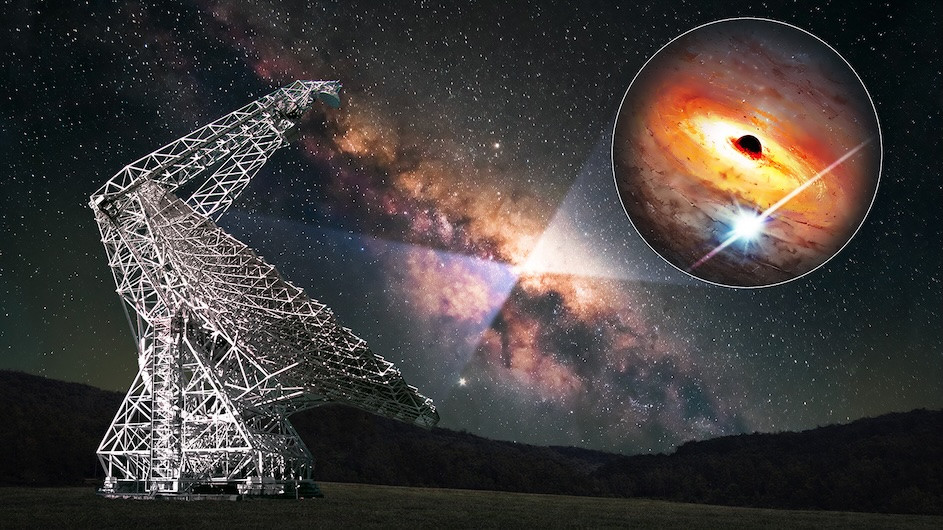 Artistic illustration of the Green Bank Telescope gathering data, including a potential pulsar near Sagittarius A* at the center of the Milky Way (image inset). Credit: Danielle Futselaar/Breakthrough Listen.
Observing a pulsar in the innermost heart of the Milky Way could help to constrain the gravitational influence of Sgr A* and probe the chaotically mysterious GC.
Cosmic Lighthouses
Pulsars are a type of neutron star, the unimaginably dense, collapsed cores of dead stars that were up to around 20 times more massive than the Sun. Pulsars are essential astronomical tools because they generate two relativistic jets of radiation from their magnetic axes, akin to a “lighthouse” on the shores of spacetime.
When these jets sweep across Earth, astronomers see them reappear at extremely regular intervals, so pulsars serve as exceptionally accurate cosmic clocks. Millisecond pulsars are especially stable because they have rotational periods of mere milliseconds. For perspective, try to imagine an object that squeezes the mass of the Sun into a tiny body just 20 kilometers (12 miles) across, spinning hundreds of times per second.
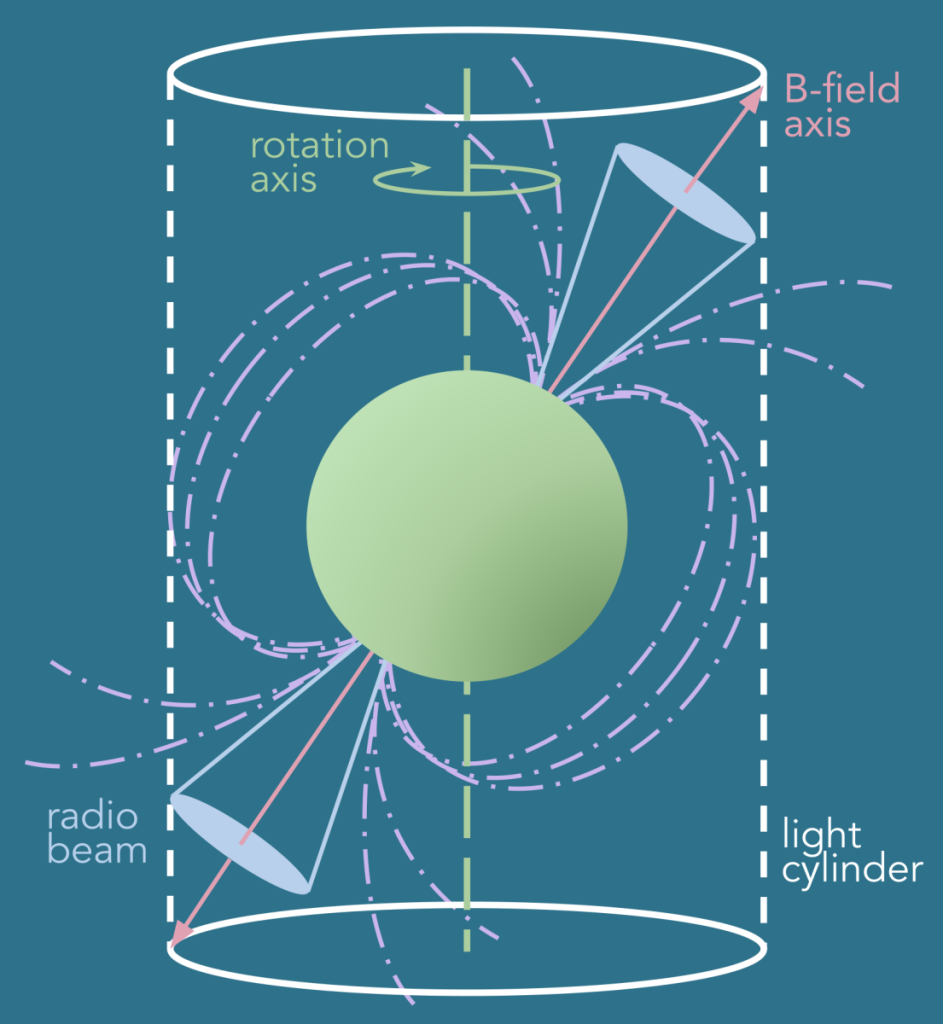 Credit: Thankful Cromartie.
In terms of general relativity, astronomers can predict the arrival time of a pulsar’s pulses then compare it with its actual arrival time, revealing how massive objects bend spacetime. “Any external influence on a pulsar, such as the gravitational pull of a massive object, would introduce anomalies in this steady arrival of pulses, which can be measured and modeled,” explained Slavko Bogdanov, research scientist at Columbia University and study co-author.
Investigating a Cosmic Conundrum
Curiously, among more than 5,000 potential signals, astronomers found only a single “promising” candidate, an 8.19-millisecond pulsar.
“We should have been sensitive to approximately 10% of MSPs and 50% of canonical, slow pulsars, assuming the pulsar population in the Galactic Center resembles that of the broader Milky Way,” said Karen Perez, a recent Columbia University PhD graduate and the study’s lead author. “Despite this sensitivity, we detected only a single candidate—dubbed the Breakthrough Listen Pulsar (BLPSR)—which remains under active investigation.”
This dearth of discoveries highlights a cosmic conundrum. Pulsars around the GC are notoriously rare. Astronomers only know of six such specimens, located between 100 to 130 light-years from Sgr A*. On cosmic scales, that’s incredibly close. But to probe the gravitational field of our galaxy’s central SMBH, astronomers seek a pulsar that’s within just a few light-years, or a single parsec, of Sgr A*.
Such pulsars may be undetectable by current methods, possibly due to the chaotic environment of the GC. Due to the scattering of their light or their orbital dynamics, they may only be briefly detectable during favorable periods when conditions are just right.
Alternatively, many pulsars may be gravitationally kicked out of the GC via interactions with other celestial bodies in this incredibly star-dense region. Scientists also consider that the trends of the GC don’t match the trends seen elsewhere, such as in star-dense globular clusters. Therefore, there may not be as many pulsars here as believed. Or maybe the GC hosts a population of magnetars rather than pulsars. If true, then even higher-sensitivity searches may come up empty.
Holding out Hope
To answer the essential question, have astronomers detected a physic-revolutionizing pulsar? Maybe. There were some promising signs, but the BLPSR signal disappeared in subsequent observations. “In other words, although BLPSR may indeed be a real pulsar, current evidence remains insufficient to support that claim with high statistical significance,” the researchers said in the paper.
Mathematically, the figures favor an eventual pulsar discovery within the GC. Estimates suggest that around 10% of all the high-mass stars in our galaxy reside within about 650 light-years of the GC. This may suggest a commensurately large quantity of candidates: there may be as many one hundred million neutron stars, and as many as 100,000 of them may be active pulsars.
Researchers plan to sweep the GC with next-generation facilities, like the historically humongous Square Kilometer Array observatory, to hopefully help solve this galactic mystery.