

Cindy Cheung is thankful to be home in Montreal after a 30-hour journey from Dubai earlier this week.
“I feel so relieved, “ she told CBC News on Friday. “Not just relieved — I think I didn’t realize how stressed I was because I was trying to remain super calm.”
What was supposed to be a 24-hour layover in Dubai before going to South Africa for work, turned into several days of fear and uncertainty for Cheung amid a widening conflict in the Middle East.
Cheung arrived in the country on Saturday morning, one week ago, completely unaware of the unfolding attacks on neighbouring Iran launched by the United States and Israel.
It was only later that day that she learned of the situation, after hearing from a local friend that the airspace had been shut down.
And during the evening, reality hit.
“During supper, we heard some booms and blasts,” she said, adding they could also see missiles shooting outwards toward the sky, as part of the U.A.E. defence system.
The noise, she said, was from debris from an intercepted Iranian missile that struck the Fairmont The Palm, a five-star hotel, some 15 kilometres from where Cheung was having dinner.
“That was like when everything changed where we were. There were so many kids and families,” she said.
WATCH | How some Montrealers are trying to get home from the Middle East: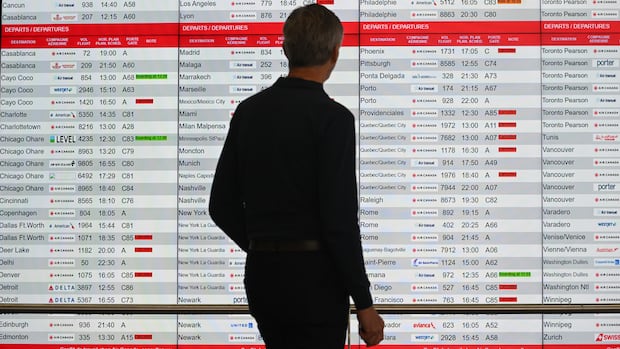
Montrealers stuck in Middle East struggle to get home following cancelled flights
While some travellers are finally returning home from the Middle East, others are still caught in the area. They’re coping with fear and uncertainty as the conflict continues.
Cheung described feeling the tension in the air as people realized the attack was aimed at the city and not just outlying areas.
“Do we need to flee? Do we need to panic now?” she asked.
Since the war began last Saturday, Iran has fired waves of missiles and drones at Gulf states hosting American forces, including the United Arab Emirates.
Cheung said she followed protocol and registered with the Canadians Abroad service and also called the Canadian emergency number for assistance.
The guidance at the time, she said, was to stay put, to stay sheltered. She was also told there were no repatriation flights at the moment for Canadians and received an email the following day advising against travel to Dubai.
“That wasn’t really helpful,” she said, of the email.
Cheung said she realized she only had herself to rely on and managed to find a flight back home, via São Paulo, Brazil. She arrived in Montreal Thursday morning.
Since her return, Canadian Foreign Affairs Minister Anita Anand has outlined three options for Canadians trying to leave the Middle East, including chartered flights, blocked bookings and land transportation.
“The availability of those options will largely depend on the particular country. For example, if airspace is open or not and, for example, if we are able to advise travel over land.”
Thousands of Canadians asking for government help
Ayoub Dasser, another Montrealer in Dubai, recounted a similar experience, but he remains stuck in the country.
Like Cheung, he arrived on the first day of the ongoing war and huddled inside a makeshift shelter in the hotel’s underground parking garage as Iran launched retaliatory attacks.
“It was terrifying,” he said, recalling the sound of explosions, the smell that filled the air and people crying.
Dasser also registered as a Canadian abroad and said he had to laugh when he received an email like Cheung the next day warning against travel to Dubai.
He says he had expressly picked the city for his vacation, over places like Mexico, because it was considered a safe travel destination.
As of Saturday, more than 109,000 Canadians in the Middle East were registered as Canadians abroad and just over 8,000 had requested assistance, including 4,464 in the U.A.E., according to Global Affairs Canada.
Dasser said he received a government email informing him of seats reserved for Canadians on outgoing flights but said he was unable to secure a spot.
And although he managed to book a ticket for himself for a flight March 10 to Warsaw, Poland, he’s still looking for other options.
“It’s very hard to have flights from here. It’s crazy,” he said. “Everyone is trying to leave.”
Worry and uncertainty persists
Dasser said local authorities have been extremely supportive and done much to assuage his fears, but there is still much concern.
“We never know if the situation will get better or worse,” he said.
On Saturday morning, air raid sirens and missile interceptions rattled Dubai yet again, prompting the temporary closure of Dubai International Airport after debris struck a terminal.
Flights resumed a few hours later and Iranian President Masoud Pezeshkian went on state television to apologize to its Gulf neighbours.
He said Iran’s leadership had approved a policy of not striking neighbouring countries unless attacks on Iran originate from their territory.
WATCH | Iran’s apology to Gulf states doesn’t mean it’s surrendering :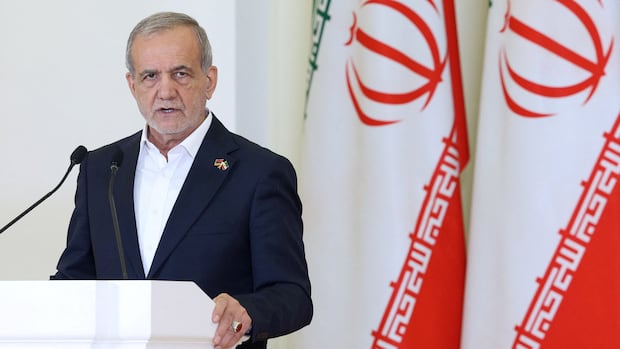
Iranian president issues apology to Gulf states but rejects Trump’s demands to surrender
Iranian President Masoud Pezeshkian apologized to Gulf states that have suffered missile and drone strikes from Iran targeting U.S. military bases. However, Pezeshkian rejected U.S. President Donald Trump’s demand for Iran to surrender. Trump warned in a Truth Social post that Iran will be ‘hit very hard’ as Iran and Israel continue to exchange strikes.
Iranian military officials quickly clarified, however, that strikes against U.S. and Israeli assets would continue, including on bases used to launch attacks.
Across the Gulf, most Iranian strikes have targeted U.S. bases, embassy compounds and major oil and gas facilities.
But in the U.A.E, which has faced the largest number of attacks, airports, data centres and luxury hotels have also been hit, leading to three civilian deaths.
As it continues its efforts to assist Canadians home safely, Global Affairs Canada said in a statement to Radio-Canada, that it is “not aware of any Canadians who have been injured or killed because of the hostilities.”