

While The Expanse initially struggled with the limitations of a linear cable budget when it arrived on SYFY, its transition to Prime Video in 2018 provided the financial resources necessary to fully realize the interplanetary conflict between Earth, Mars, and the Belt. Over its six-season run, the series evolved from a gritty noir mystery into an epic exploration of alien technology and human tribalism, eventually concluding as a defining achievement of the sci-fi genre. This legacy of high-quality storytelling is poised to continue as the original creative team, including showrunner Naren Shankar and authors Daniel Abraham and Ty Franck, reunites for The Captive’s War. This new adaptation, based on the recent space opera trilogy, serves as a spiritual successor that promises to fill the void left by The Expanse. However, another high-profile project at Amazon MGM Studios could offer an even more expansive replacement for fans of The Expanse‘s complex world-building.
Following Amazon’s acquisition of the MGM library, which included the whole of the Stargate franchise, Amazon MGM Studios greenlit the long-awaited revival of the sci-fi epic. Unlike previous attempts to reboot the property, this new iteration is led by veteran creator Martin Gero, who previously served as a primary writer and producer on Stargate SG-1 and Stargate Atlantis. The production also features a notable reunion of the brand’s original architects, with film creators Roland Emmerich and Dean Devlin serving as executive producers alongside consultants Brad Wright and Joseph Mallozzi. Early reports from the writers’ room indicate that the series will function as a “new chapter” rather than a complete erasure of the existing continuity, ensuring that the decades of established history remain relevant to the narrative.
Stargate‘s Sprawling Lore Is Perfect for Fans of The Expanse
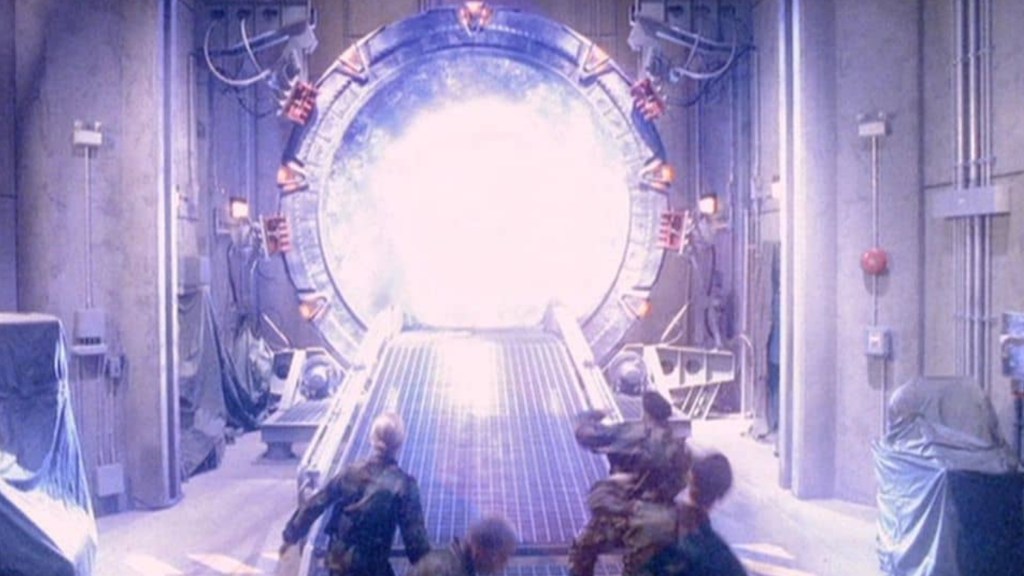 Image courtesy of Prime Video
The Stargate franchise began with the 1994 feature film starring Kurt Russell and James Spader, but it truly flourished through the television medium, where series like Stargate SG-1 explored the consequences of humanity’s arrival on the galactic stage. The narrative revolves around a network of ancient wormhole devices that allow for instantaneous travel across the stars, a concept that mirrors the Ring Gates in The Expanse. In addition, much like the complex geopolitical tensions between the United Nations and the Outer Planets Alliance that The Expanse explores, the Stargate universe is built on a foundation of competing factions and ancient power vacuums. That’s because the Stargate technology allowed for a serialized exploration of cosmic conflicts involving the parasitic Goa’uld and the technologically advanced Replicators, providing a sense of scale that few other franchises can match.
The synergy between these two properties is also evident in how they treat the concept of discovery and its impact on human society. While The Expanse utilized the Protomolecule to challenge the biological and political limits of our species, Stargate uses the legacy of the Ancients to ask similar questions about our place in the universe, constructing a massive mythology that bridges ancient human history with futuristic technology. In fact, the Stargate television run, spearheaded by Colonel Jack O’Neill (Richard Dean Anderson) and Samantha Carter (Amanda Tapping), balanced military procedural elements with high-concept physics and archeological mystery, offering an enticing combination of grounded character drama and expansive lore.
For viewers who appreciated the slow-burn reveals of the James Holden (Steven Strait) and Naomi Nagata (Dominique Tipper) arc, the deep-rooted secrets of the Stargate network offer a similarly rewarding experience. By focusing on the scientific and cultural implications of interstellar travel, the new Prime Video series can provide a sophisticated alternative to the more action-oriented space operas currently on the market. Ultimately, the Stargate revival represents an opportunity to return to a style of narrative that prioritizes intellectual curiosity and the daunting reality of a populated galaxy, crucial elements that helped The Expanse to become one of the best sci-fi series of all time.
The Stargate revival is currently in the early stages of development at Amazon MGM Studios, with a potential premiere window targeting 2027. Sci-fi fans can currently stream the entire existing catalog, from the original film to Stargate Universe, on Prime Video to prepare for the franchise’s return.
Do you think a new Stargate series can live up to the legacy of The Expanse? Leave a comment below and join the conversation now in the ComicBook Forum!